
Ser du något att förbättra? Föreslå en ändring.
On October 23, 1775, as the Anza colonizing expedition was just setting out, Manuela Ygnacia López Peñuelas gave birth to a healthy boy at nine at night. In his next diary entry, the expedition's leader, Juan Bautista de Anza, recorded that the afterbirth could not be removed and that in the early morning she entered her death throes. Her body was carried to San Xavier del Bac Mission the next day and buried with the rites of the church on the same day her son was baptized.
Of the 240 colonists who walked the more than 1,200 miles from Tubac to San Francisco, Manuela was the only one to die. But the hardship she faced was shared. At least eight women on the trek were pregnant, and several gave birth along the way. With no wagons, only pack animals, they delivered in the open or in makeshift tents and carried their youngest children in their arms.
The colonists reached San Francisco just a week before the Second Continental Congress signed the Declaration of Independence. Events on the eastern seaboard have long overshadowed the expedition, yet both shaped the nation, its people, and the policies that pushed Indigenous peoples off their homelands.
Why the families went
Spain began founding a chain of missions in California in 1769 to colonize and convert the Indigenous peoples of the coast. Within a few years those settlements were close to failing, and the Franciscan friar Junípero Serra argued that "Spanish" or "Hispanicized" women and families had to be sent. The Viceroy of New Spain ordered an overland route opened from Sonora to northern California. Anza, captain of the military post at Tubac in northern Sonora (now southern Arizona), found one in 1774 by following existing Indigenous trails, and made the journey again in 1775–1776 with settler families.
Those families included 30 soldiers, their wives and more than 100 children, along with Indigenous guides and servants. Most came from the lower castes of colonial New Spain, of mixed Indigenous, African and European descent.
Manuela was born in the mid-1740s on the northwestern frontier of Sonora and Sinaloa, into a military family that identified as creole — Spaniards born in the Americas. In 1740 the Yaqui and Mayo peoples had risen against settlers taking their land and the abuses of landowners and mine operators; the revolt and Spain's reprisals caused great bloodshed on both sides. Manuela married Joseph Vicente Féliz in 1760. His once-powerful family's hacienda had been destroyed in the fighting, probably taking his inheritance with it. When he enlisted in the expedition with Manuela, then pregnant, and their seven children, he was likely hoping to build a better life in Alta California.
Women on the trail
Children were central to how Spain meant to hold its New World empire, so the expedition's two main chroniclers — Anza and its chaplain, Father Pedro Font — carefully noted every pregnancy, birth and miscarriage. Most of the women could not read or write, and none left an account. Men's words are the only record of what they went through.
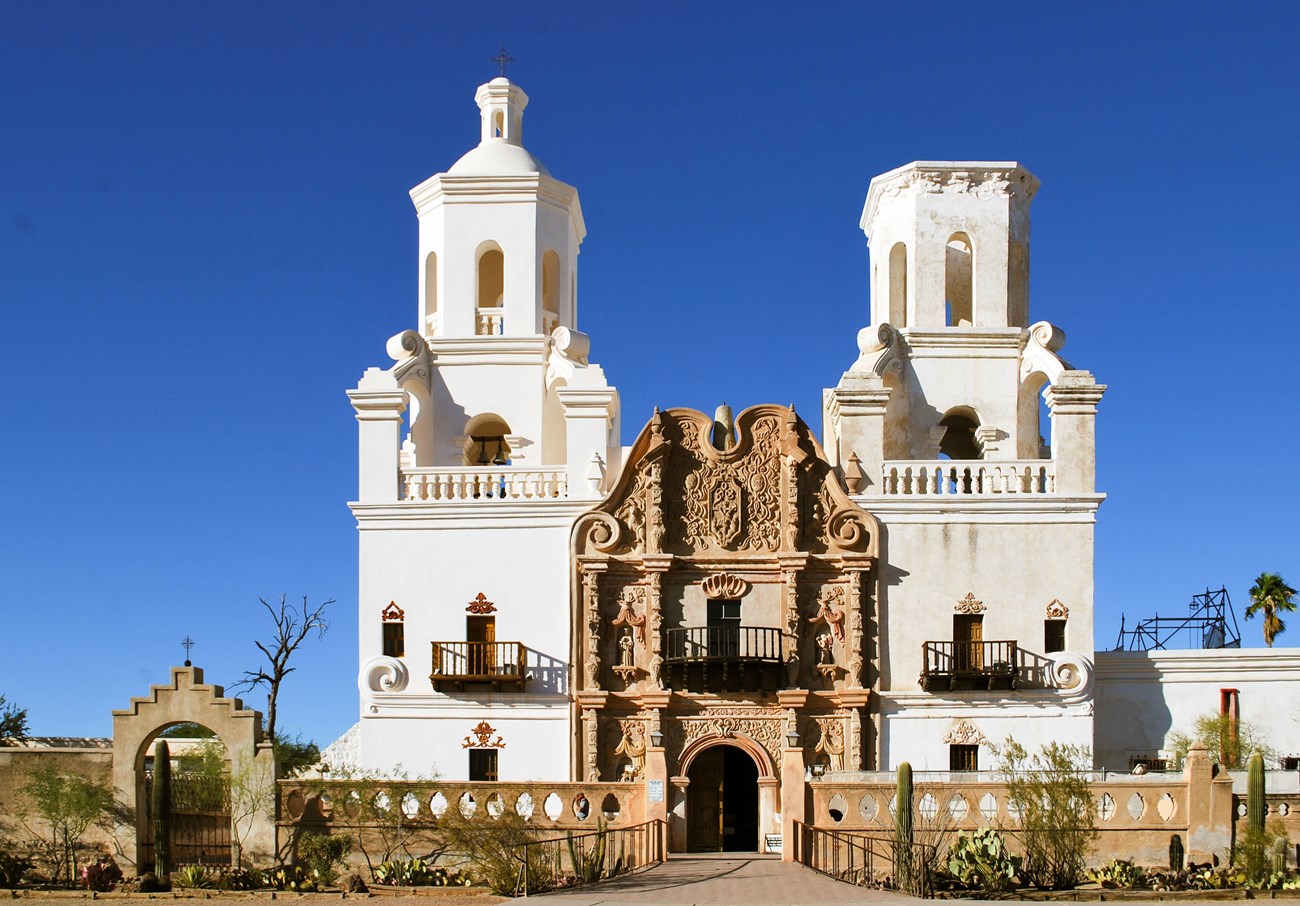
Mission San Xavier del Bac, on the lands of the Tohono O'odham Nation in Arizona, where Manuela was buried and her son baptized on October 25, 1775. National Park Service photo.
Spanish custom required women to be chaste, obedient, modest and timid, and they were subject to their fathers and husbands. Women did resist these expectations, but most probably had little say in whether their husbands joined. Many were used to hard living at remote posts; Manuela's family had already crossed more than 500 miles of Sonoran desert just to reach Tubac.
Even so, pregnancy and childbirth on the march were dangerous. Font recorded each time a pregnant woman fell seriously ill or unwell, and wrote of one who told him in confession that she was terrified of dying. Anza described a woman who had miscarried waking with her whole body swollen, and put off the day's march. He repeatedly delayed the expedition so women could recover after giving birth, though often for only a single day.
Stella Cardoza, a descendant of Manuela's family, has suggested that after so many pregnancies Manuela may not have been strong enough to survive this delivery, worn down by the strain of getting ready for the journey. The diaries show that the pregnant women struggled and feared death, but not whether they grieved for the homes they left or looked forward to new ones, whether they felt a bond with the Native women who helped the expedition, or what they thought of taking part in a colonizing effort that seized Indigenous homelands and tried to wipe out Native ways of life. What their actions do show is great resilience in the face of loss and hardship.
Sources
- National Park Service, Juan Bautista de Anza National Historic Trail: "Life and Death of Manuela Peñuelas," by Nicole Martin, part of the Home and Homelands exhibition. It draws on the diaries of Anza and Font, Peter L. Gough's historic resource study for the trail, and an interview with Stella Cardoza.
- Manuela's name varies between documents, most often Maria or Manuela Piñuelas; this page follows the author in using the spelling adopted by Stella Cardoza.
- The source misspells Anza's middle name as Bautisa and Buatista in two places; it is corrected here. The source's paintings of expedition colonists, by a named artist, are not reproduced.
I dessa publikationerHome and Homelands Exhibition: LossJuan Bautista de Anza National Historic Trail
Licens: CC0 1.0 (allmän egendom) · Bearbetat efter www.nps.gov
1
0
0
0

Kommentarer


