
Vill du förbättra nodens innehåll? Försök att göra en redigeringsbegäran.
In a rare departure from his typically composed public persona, NVIDIA CEO Jensen Huang engaged in a sharp, high-stakes debate with podcaster Dwarkesh Patel that has sent ripples through Silicon Valley and Washington alike. The crux of the conflict centered on the "China Dilemma": whether the U.S. should restrict the export of high-end AI chips to prevent national security risks or allow companies like NVIDIA to maintain their global ecosystem. When pushed on the possibility of Chinese firms eventually commoditizing AI hardware and displacing NVIDIA—similar to the trajectory of the iPhone and Tesla in China—Huang reacted with visible frustration. He famously retorted, "You’re not talking to somebody who woke up a loser," rejecting the "loser mindset" of pre-emptively conceding market share to foreign competitors. Beyond the viral soundbite, the debate underscored a fundamental philosophical rift in the tech world. Huang argued for a "five-layer" view of AI (energy, chips, infrastructure, models, applications), criticizing the narrow focus on "model security" as a threat to the broader American industrial base. He warned that forcing a split into two separate tech ecosystems—one American and one foreign—would be a "horrible outcome" for the United States, potentially accelerating the development of a rival, independent tech stack that the U.S. can no longer influence or outpace.
The Great AI Sovereignty Debate
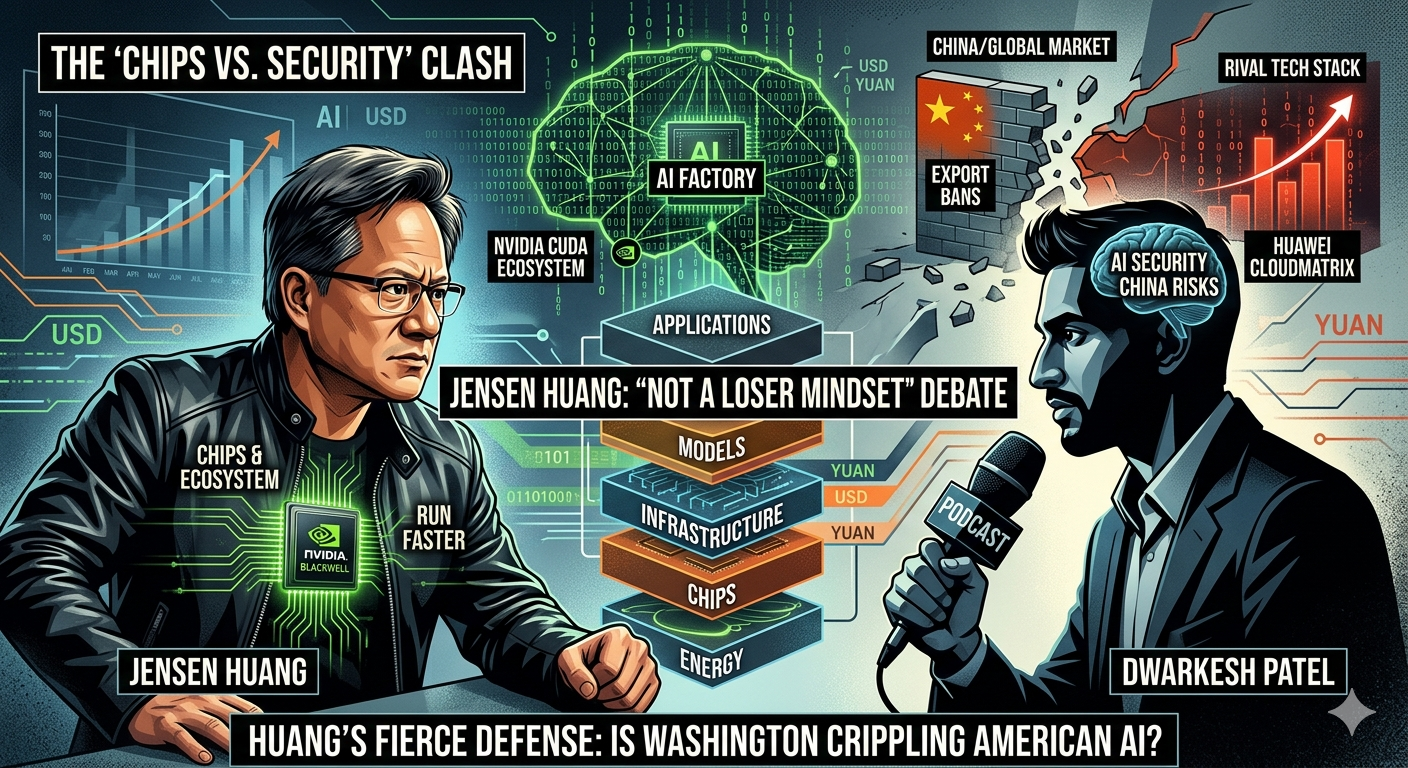
The Catalyst: A Clash of Ideologies
The interview on the Dwarkesh Podcast was intended to be a deep dive into NVIDIA’s supply chain moats and the physics of accelerated computing. However, it quickly pivoted into a debate on the existential risks of AI proliferation. The podcaster, Dwarkesh Patel, acting as a devil's advocate, presented a scenario where providing China with NVIDIA-level compute power enables the discovery of "thousands of zero-day vulnerabilities" (referencing capabilities seen in models like Claude Mythos), thereby arming a geopolitical rival with unprecedented cyber-offensive tools.^^
Huang’s immediate rebuttal was technical: he noted that such capabilities are often "grounded" in mundane capacities that do not require the latest H200 or Blackwell architectures.^^ But the debate soon transcended technicalities, entering the realm of industrial strategy and national pride.
The "Loser Mindset" vs. Global Ecosystems
The most intense moment of the exchange occurred when Patel suggested that the U.S. might be better off "conceding" the Chinese market now rather than being slowly pushed out by domestic Chinese clones later.
Huang’s response was a fierce defense of American competitiveness. He argued that:
- Software Stickiness: Unlike consumer electronics, where a user can switch from an iPhone to a Huawei phone overnight, the computing ecosystem (CUDA, x86, ARM) is "sticky."^^ Moving an entire nation's enterprise infrastructure to a new chip architecture takes decades of developer investment.
- Innovation as Defense: The only way to "win" is to run faster. By abandoning the Chinese market, the U.S. effectively subsidies the creation of a rival ecosystem. Huang posited that if Chinese companies are forced to build their own "AI Factories" (like Huawei’s CloudMatrix), they will eventually export that non-American stack to the rest of the world.
- The Industrial Fallacy: Huang criticized the idea that one "layer" of the AI stack (the models) should be protected at the expense of the "chip layer."^^ He argued that for the U.S. to lead, all five layers must be world-dominant.
The Five-Layer Cake: Huang’s Blueprint for AI Maturity
Throughout the debate, Huang articulated a more sophisticated view of the AI industry than the current "LLM-centric" narrative. He defines AI as a "five-layer cake":
- Layer 1: Energy. The foundational constraint of the AI era.
- Layer 2: Chips. The "engine" where NVIDIA currently holds a near-monopoly.
- Layer 3: Infrastructure. The "AI Factories" (data centers) being built at a trillion-dollar scale.
- Layer 4: Models. The reasoning engines (GPT-5, Claude 4, etc.).
- Layer 5: Applications. The ultimate value-add where AI actually performs work.
Huang’s frustration stems from his belief that Washington and the media are "fixated" on Layer 4 (Models).^^ He argued that if the U.S. cripples Layer 2 (Chips) through overly broad export bans, it weakens the entire stack’s economic viability.
The "Agentic Moment" and the Future of Labor
The debate also touched on the shifting nature of AI itself. Huang noted that 2026 marks the transition from "Reasoning Models" to "Agentic Systems." This is not just a semantic change; it represents a move from AI that answers questions to AI that performs tasks.
In a recent commencement speech at Carnegie Mellon University, which echoed themes from the podcast, Huang linked this "Agentic AI" to a "blue-collar boom."^^ He predicted that the massive physical build-out required for AI factories would transform traditional trades—plumbers, electricians, and technicians—into six-figure careers. He argued that the "software-only" era of the last 20 years is ending, replaced by a "physical sciences" era where AI interacts with the real world.
The Journalist’s Perspective
Jensen Huang is no longer just a "chip salesman"; he has become the de facto industrial planner of the AI age. His "heated" defense on the Dwarkesh Podcast reveals a CEO who is increasingly concerned that protectionist policies—while well-intentioned—might inadvertently destroy the very dominance they seek to preserve.^^
His refusal to "wake up a loser" is a signal to both his competitors and his regulators: NVIDIA’s strategy is not to retreat behind a "fortress America," but to ensure that the entire world remains dependent on an American-led technological ecosystem. The "debate" wasn't just about chips; it was about whether the U.S. has the confidence to compete in an open, albeit dangerous, global market.
1
0
0
0

Kommentarer