
Vill du förbättra sidans innehåll? Föreslå en ändring.

1939 Photo of quarantine building showing the southeast side. NPS Photo
Although historic Fort Pulaski and the Cockspur Island Lighthouse more well-known structures at the park, there is an old white house on the west side of the island that is a significant part of our history. Currently it serves as our Park Headquarters building, but it has served multiple roles throughout the decades since it was built in 1912. Quarantines were used to protect the residents of Savannah from diseases coming by way of ships. Ships anchored offshore for 40 days before they were allowed to come into port. Several quarantine stations served Savannah throughout the years. The first Tybee Island quarantine station was established in 1767 to serve slave ships arriving from Africa. It was accessed via Lazaretto creek, which separates McQueen’s Island from Tybee. Lazaretto is a synonym for quarantine.
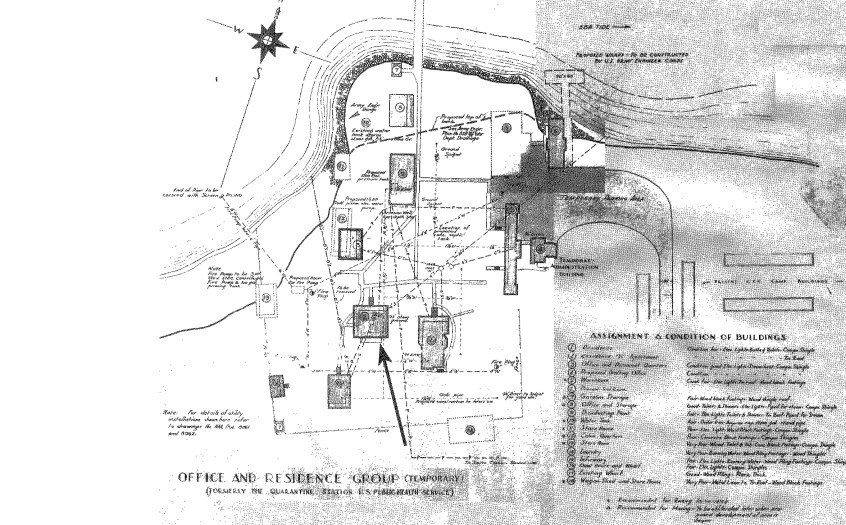
1939 Map of Cockspur Island Quarantine Complex with arrow pointing to current park headquarters. NPS Photo
Previous quarantines were established at Oyster Island, Fort Greene, and Fort Jackson. In 1889 the War Department issued a license to the city of Savannah to establish a quarantine station on Cockspur Island. In 1891 the station was open to receive incoming ships from around the world. Several structures were added over the years including a hospital, fumigation building, and quarters for the staff. The Park Headquarters building is the only remaining structure from the original Quarantine Complex. It served as the quarantine keeper’s quarters, replacing an older facility from 1889. Both buildings co-existed, side by side, until 1960 when the older structure was demolished.

1942 U.S. Navy Map showing quarantine station and CCC camp 460.
Current park headquarters indicated by arrow. NPS Photo
President Calvin Coolidge designated Fort Pulaski a National Monument in 1924. In 1934, Civilian Conservation Corps Camp 460 came to restore the historic fort and grounds. They set up their camp just east of the Quarantine station. Quarantine operations on Cockspur Island completely ceased in 1937. That same year the War Department transferred ownership of the entire quarantine complex to the Department of the Interior, which runs the National Park Service. On March 18,1942, shortly after America’s entry into World War II, the Department of Interior issued a special use permit to the Department of the Navy. The Navy established Navy Section Base #20 to protect entry into the Port of Savannah. Fort Pulaski National Monument was closed to the public for the duration of WWII. The park did not reopen to the public until August 1, 1947.

1950 Photo of Park Headquarters building southeast side. Shows Navy alterations from 1942. NPS Photos
After World War II, when Fort Pulaski was re-opened to visitors, the National Park service slowly demolished all of the dilapidated buildings remaining from the quarantine complex and CCC camp 460. Our park headquarters, which once served as the Superintendent’s and Chief Ranger’s residence, is the only remaining structure from the quarantine station. It is a lovely building. The interior woodwork is beautiful, and there is a fireplace in the conference room. One of the island’s famous fig trees rests in the yard nearby, watching over the north channel of the Savannah river.
Bibliography: Fort Pulaski Historic Structure Report (2004), Fort Pulaski Administrative History (2003), Fort Pulaski Foundation Document (2016)
Where this belongs
- Fort Pulaski National Monument
Where this page came from
This page was imported from National Park Service. Produced by the U.S. National Park Service and, as a work of the United States government, in the public domain.
Nobody has written it yet — it is the source material at a new address, which is why search engines are asked to skip it and why no one earns from it. It is up for grabs: take it on, and it is yours to rewrite and to earn from.
I dessa samlingarFort Pulaski National Monument
Licens: CC0 1.0 (allmän egendom) · Bearbetat efter www.nps.gov
1
0
0
0

Kommentarer
Läs härnäst


