
Vill du förbättra sidans innehåll? Föreslå en ändring.
Since 2013, park staff and visitors on the South Rim of Grand Canyon National Park have been watching 26 scrubby Gambel oaks — recording, week after week, when they break bud, leaf out, change color, drop leaves and bear acorns. Nine years of those observations have now shown how the oaks respond to heat and rain: warmer, wetter years push their seasonal stages later, and rain can soften the delay that heat causes.
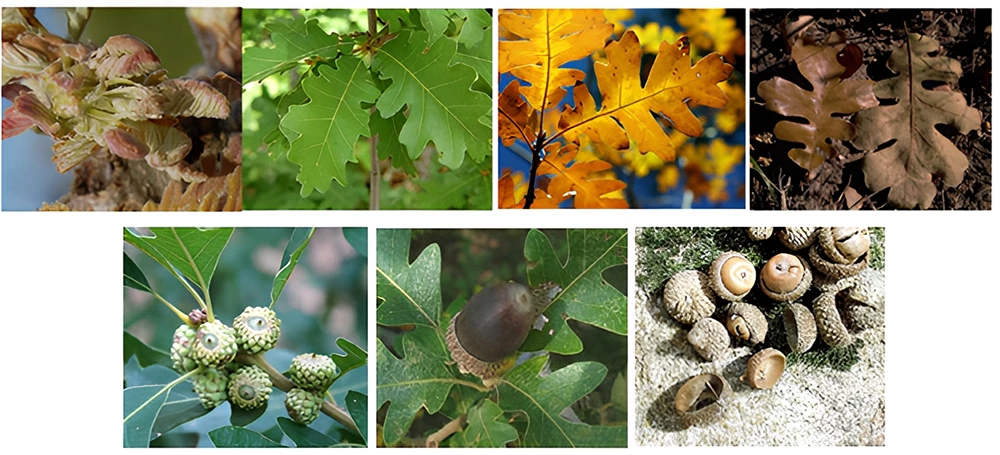
The monitored stages of Gambel oak. Top: breaking leaf buds, leaf-out, colored leaves, fallen leaves. Bottom: fruit, ripe fruit, fallen fruit. Credit: Laura Shultz, National Park Service.
Nature's calendar
Phenology — the study of seasonal life stages in plants and animals — is a sensitive gauge of how ecosystems respond to environmental change. The Southwest has the hottest, driest environments in the country and has been growing more arid for the past 50 years, and the park watches closely for climate effects on its plants, wildlife and water.
In 2013, Laura Shultz, the first George Melendez Wright Climate Change Intern, created the Local Touchstones: Phenology and Climate Change protocol, a long-term dataset for community scientists to add to and learn from. Staff from the park's Interpretation Division and Vegetation Program recorded observations weekly to every two weeks at five South Rim sites. In the early years, visitors joined in on educational trail walks. The observations went into Nature's Notebook, the USA National Phenology Network's program that lets anyone record observations of more than 1,500 plant and animal species; its data have been used in more than 185 peer-reviewed studies.
One found that 76% of national parks are seeing earlier springs, with Grand Canyon in the "extreme early" category. "This means that recent 'springs' are at the far early end of the distribution of all springs at the park since 1900," says Alyssa Rosemartin of the network.
Why Gambel oak? A deciduous tree of the Southwest, usually 10 to 40 feet (3–12 m) tall, it grows in the middle layer of the South Rim's ponderosa pine, Utah juniper and pinyon forests. It changes far more visibly through the seasons than the conifers around it.
What the data showed
In 2022, Scientists in Parks intern Jalyn Gearries analyzed the nine years of data, focusing on three stages that were observed reliably:
| Stage | Average start |
|---|---|
| Breaking leaf buds | April 25 (day 116) |
| Maximum leaf cover | May 23 (day 143) |
| Fruiting | July 22 (day 204) |
Each start date was linked to two climate drivers from Oregon State University's PRISM climate data: heat accumulated through the year (accumulated growing degree days) and precipitation accumulated from rain and snowmelt.
- Both delayed the oaks. More accumulated heat and more accumulated precipitation significantly pushed all three stages later.
- Leaf-out was most sensitive. Maximum leaf cover showed the strongest delay.
- Rain buffered heat. The combined effect of heat and precipitation was as significant as either alone: higher precipitation offset some of the delay caused by higher temperatures.
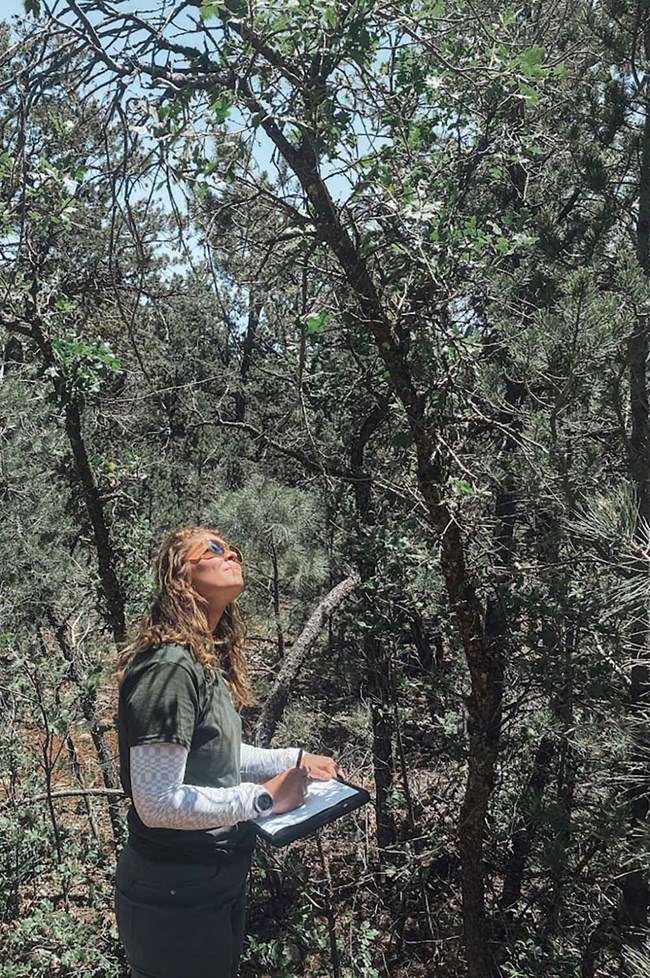
Observing one of the study oaks. Credit: Jalyn Gearries, National Park Service.
Why it matters
- Trophic mismatch. If leaves and acorns arrive later while herbivores and pollinators keep to historical timing, animals may find their food isn't ready — reducing survival and reproduction.
- Water stress. In an arid park, heat-driven delays can stretch the period when plants need water for growth, possibly leaving less water later in the season. That precipitation eases the delay shows how intertwined heat and water are, and why managing for both matters.
Long-term monitoring, the authors write, lets scientists "read nature's history books," turning observations into evidence for conservation — and community science shows how much the public can contribute.
Sources
Based on "Phenology and Climate Change: Understanding Nature's Language through Data and Community Science," by Jalyn Gearries, Lonnie Pilkington and Annie Kilby, Grand Canyon National Park, National Park Service; a work of the United States government in the public domain. It cites Gonzalez et al. (2018), Monahan et al. (2016), Lawrence et al. (2024), Renner and Zohner (2018) and the USA National Phenology Network (2022).
I dessa samlingarGrand Canyon National ParkIntermountain Park Science: Drought in the Southwest
Licens: CC0 1.0 (allmän egendom) · Bearbetat efter www.nps.gov
1
0
0
0

Kommentarer


