
Vill du förbättra nodens innehåll? Försök att göra en redigeringsbegäran.
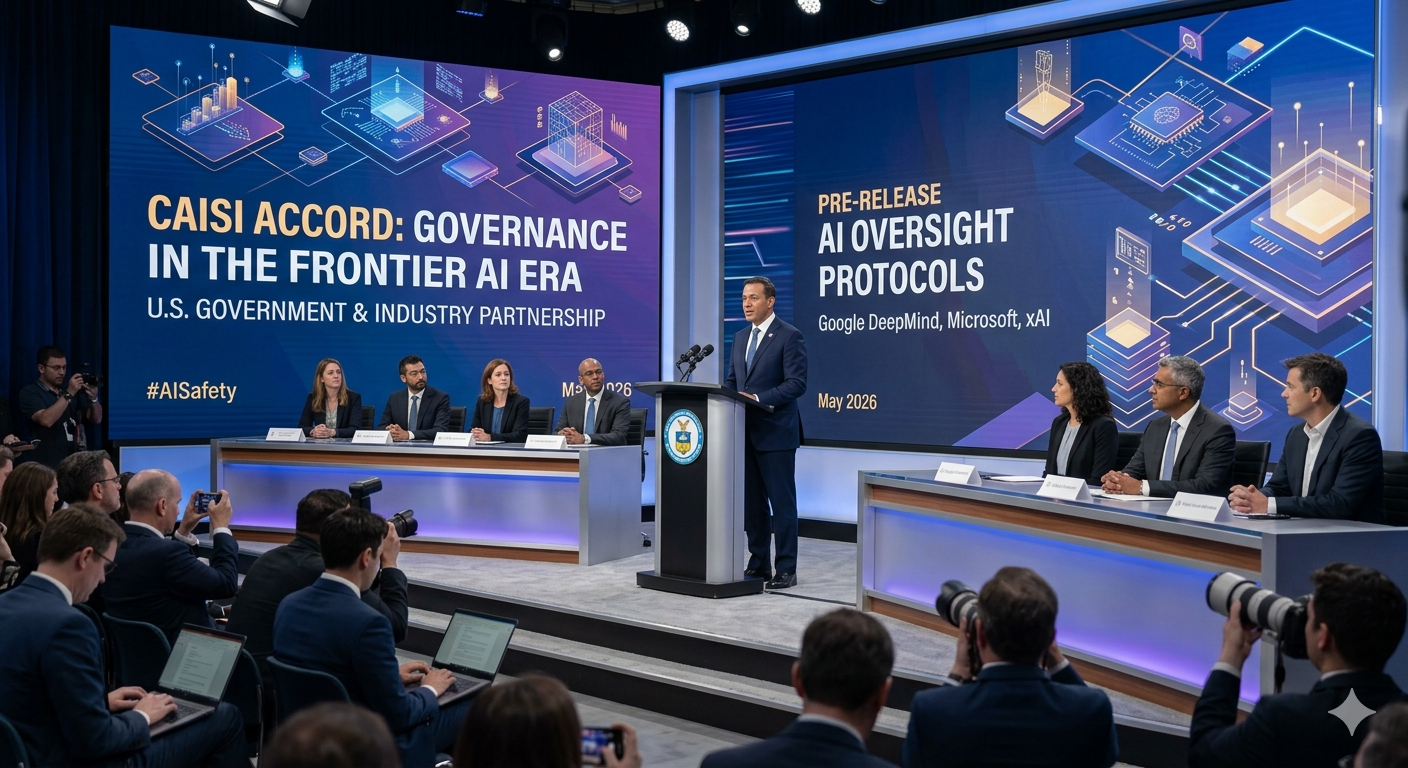
In a landmark shift for artificial intelligence governance, the U.S. Department of Commerce’s Center for AI Standards and Innovation (CAISI) has finalized historic agreements with Google DeepMind, Microsoft, and xAI. These deals grant federal regulators unprecedented access to unreleased "frontier" AI models—such as the highly anticipated iterations of Gemini and Grok—before they are deployed to the public. This move represents the first major operationalization of the "Pre-Release" oversight framework, effectively moving the industry from a self-governance model to a co-regulatory environment. The primary objective is to evaluate national security vulnerabilities, specifically focusing on "Project Glasswing" protocols which address potential misuse in cybersecurity, biosecurity, and autonomous chemical weapon synthesis. While industry giants frame this as a necessary safety measure to prevent catastrophic risk, critics argue it establishes a "regulatory moat" that could stifle smaller innovators. As of May 7, 2026, this collaboration signals that the era of "move fast and break things" in AI is officially over, replaced by a permanent federal auditing layer.
The End of the "Black Box" Era
For years, the development of large-scale AI models occurred behind closed doors, with public release serving as the primary moment of scrutiny. Today’s announcement by the Center for AI Standards and Innovation (CAISI) fundamentally alters that trajectory. By bringing Google, Microsoft, and xAI into a formal pre-release review cycle, the U.S. government is asserting that AI safety is no longer a corporate choice, but a matter of national defense.
The Mechanics of the CAISI Agreements
The agreements signed today provide CAISI with specialized access to "raw" versions of frontier models—versions that have had their safety guardrails removed or reduced for the purpose of testing. This allows government researchers to perform "red-teaming" at a level of depth that was previously impossible.
- Vulnerability Mapping: Experts will test the models’ ability to generate malicious code, bypass existing firewall architectures, and provide instructions for the manufacturing of biological agents.
- The "Mythos" Precedent: The news follows the restricted rollout of Anthropic’s Mythos model, which became the first to undergo this rigorous vetting process. The success of that pilot program provided the roadmap for today’s broader industry-wide adoption.
National Security and "Project Glasswing"
Central to these deals is "Project Glasswing," a collaborative initiative designed to secure the global software supply chain. Under this project, the government and tech firms will share intelligence on "emerging capabilities"—unintended skills that AI models develop during training that could be exploited by state actors.
- Cybersecurity: Reviewers are specifically looking for "zero-day" exploit generation capabilities.
- Biosecurity: Ensuring that models cannot provide actionable instructions for creating pathogens or synthesizing restricted chemical compounds.
The Geopolitical and Economic Implications
The timing of these agreements is not coincidental. As global competition for AI supremacy intensifies, the U.S. is positioning itself as the arbiter of "Responsible AI." However, this creates a complex economic dynamic:
- The Regulatory Moat: By formalizing these reviews with the largest players, the government may be inadvertently making it harder for startups to compete. The infrastructure required to facilitate federal audits is costly and complex.
- Global Standards: This U.S.-led framework is already seeing echoes in the UK, where Microsoft has signed a parallel agreement with the UK AI Security Institute. We are seeing the birth of a Western "AI Safety Bloc."
Critical Analysis: Safety vs. Sovereignty
While the move is hailed as a victory for public safety, it raises critical questions about corporate and technological sovereignty.
- Innovation Latency: Does a mandatory federal review period slow down the deployment of beneficial AI features?
- Government Overreach: Critics suggest that "national security" is being used as a broad brush to grant the government oversight of what is essentially private intellectual property.
- Transparency Gaps: While the government reviews the models, the results of those reviews remain largely classified, leaving the public to trust that the process is working without independent verification.
A New Operating Model for Big Tech
The CAISI accord marks the transition of AI from a standard consumer technology to a "dual-use" utility, similar to nuclear energy or advanced aerospace. For Google, Microsoft, and xAI, the price of building world-changing intelligence is now a permanent seat at the table for federal regulators. For the broader tech industry, the message is clear: the most significant feature of your next model won't be its parameters or its speed, but its certification.
1
0
0
0

Kommentarer