
Vill du förbättra sidans innehåll? Föreslå en ändring.
Cheatgrass has now been found in more than a quarter of Dinosaur National Monument. A decade of monitoring in the monument's sagebrush and pinyon-juniper uplands shows the invasive annual grass spreading quickly while native grasses decline — one of several signs that plant communities are changing in one of the nation's most threatened ecosystems.
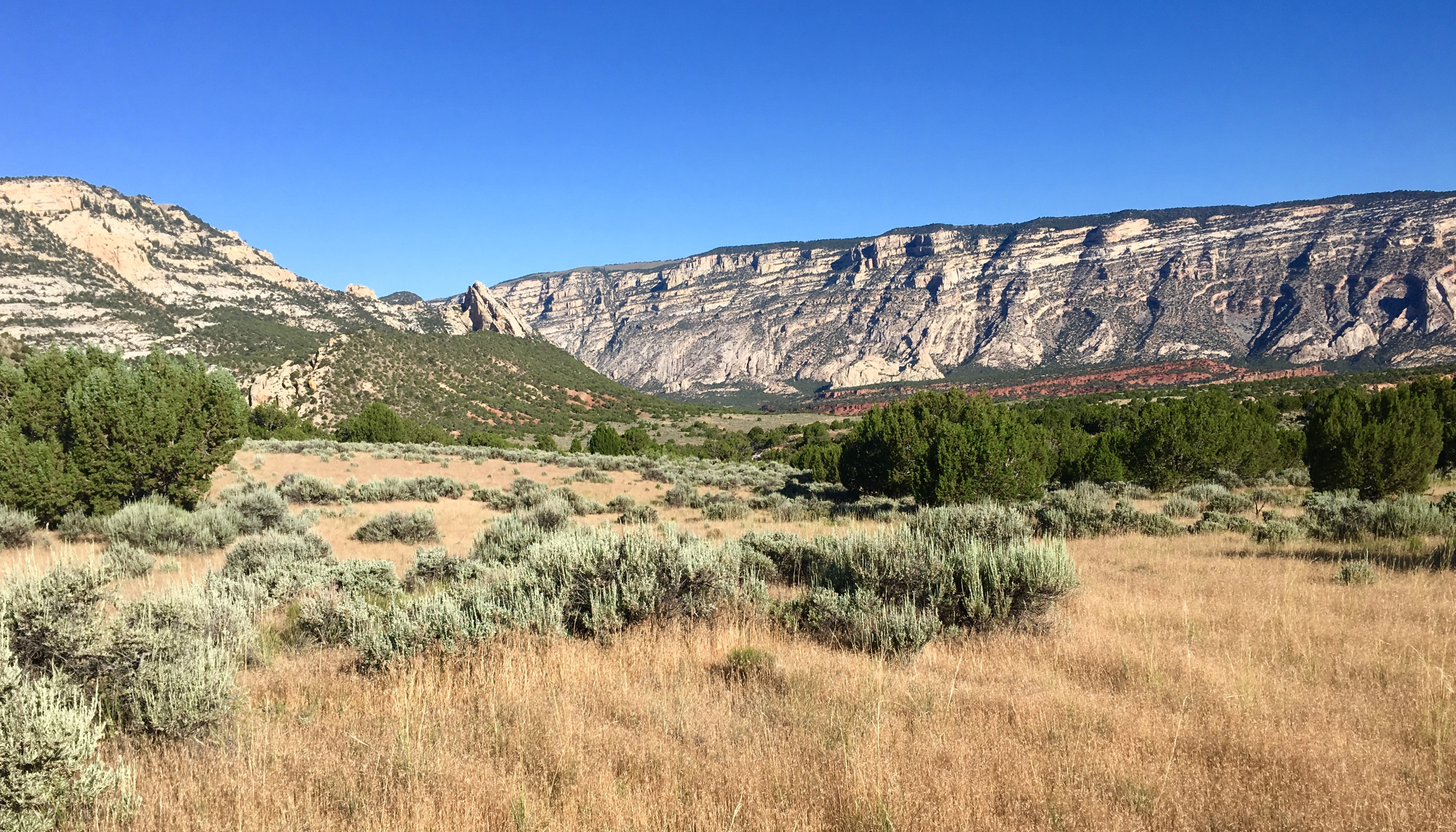
Pinyon-juniper woodland meets sagebrush in Dinosaur National Monument. Credit: Amy Washuta, National Park Service.
"We found some surprising and encouraging results related to soil conditions but were concerned to see the decline in native grasses in combination with rapidly increasing cheatgrass," says Carolyn Livensperger, an ecologist with the Park Service's Northern Colorado Plateau Network.
Why these landscapes matter
Sagebrush shrublands and pinyon-juniper woodlands provide ecosystem services — natural processes that benefit people and other living things — including holding soil in place, resisting fire, conserving water and sheltering wildlife. Across the United States, intact sagebrush supports more than 350 plants and animals of conservation concern, and livestock graze it. But sagebrush-steppe is among the nation's most threatened ecosystems, broken up and converted to pinyon-juniper woodland or to grassland dominated by invasive annuals. Pinyon and juniper sometimes invade shrublands, yet the woodlands have value of their own, from plant materials for cultural use to habitat for sensitive species — and in some places they are dying back under drought stress.
How they monitored
Since 2009 the Northern Colorado Plateau Network has tracked the vegetation and soils of three communities at Dinosaur: high-elevation sagebrush, low-elevation sagebrush and pinyon-juniper woodland. Crews visit about 36 of 135 plots a year — five years for a full rotation — recording sagebrush, perennial grass, exotic annual and tree cover, biological soil crust and soil stability, and asking how climate, grazing and fire shape the results.
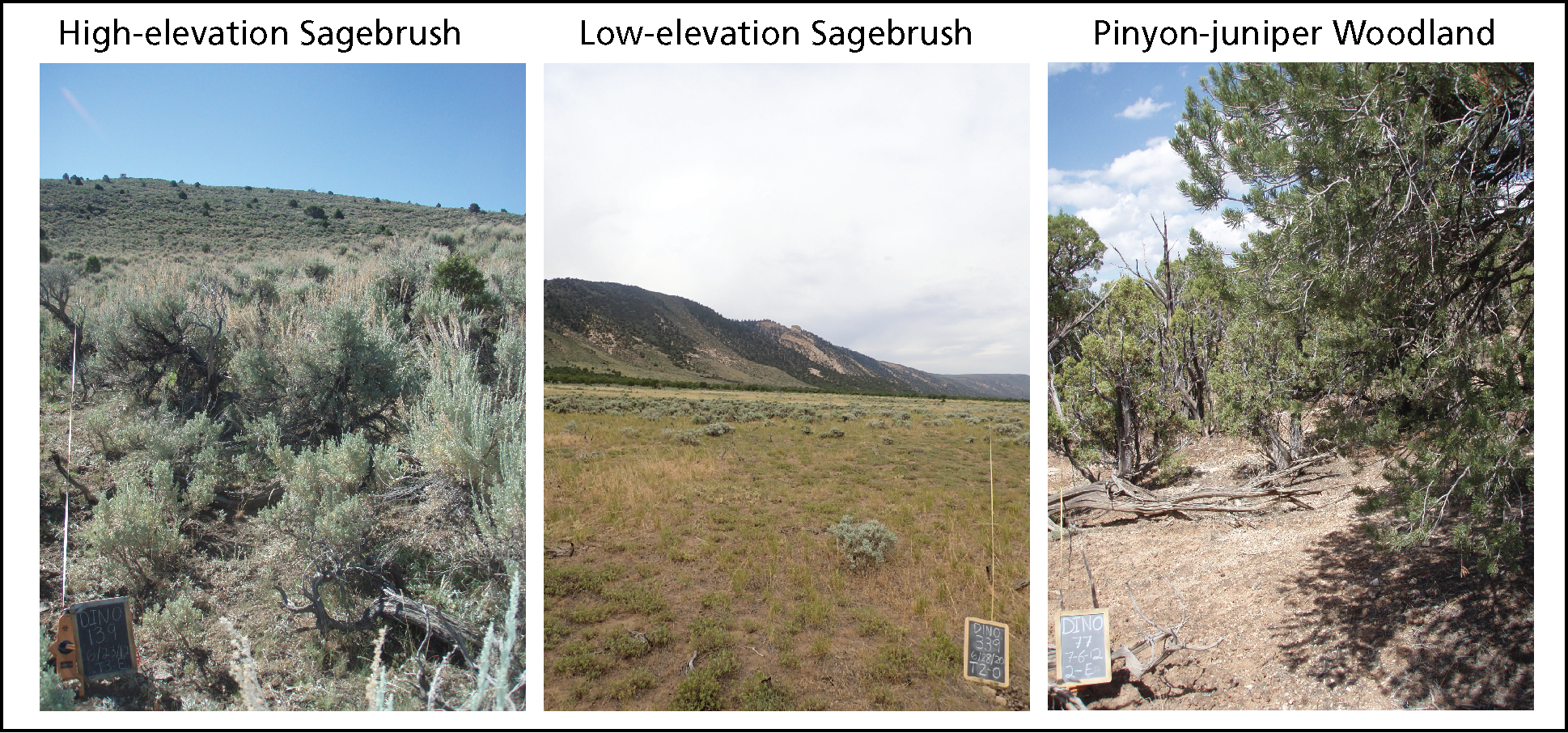
The three sampling areas: high-elevation sagebrush, low-elevation sagebrush and pinyon-juniper woodland. Credit: National Park Service.
What they found, 2010–2020
| Sagebrush (high and low elevation) | Pinyon-juniper woodland | |
|---|---|---|
| Native cool-season grasses | decreasing | — |
| Exotic annuals | increasing rapidly, led by cheatgrass | low (under 10%) and stable in cover, but detected more often |
| Big sagebrush | cover slowly increasing; more young mountain big sagebrush at high elevation | — |
| Trees | no change in cover | cover stable, but sapling density falling |
| Soil surface | mostly stable or improving; biological soil crust increasing despite unfavorable weather; more bare soil at high elevation | condition may reflect little disturbance |
Cheatgrass (Bromus tectorum) outcompetes native plants in dense stands, makes wildfires more frequent and intense, and can reduce biodiversity. At Dinosaur it has spread after past fires, especially low-severity fires followed by dry weather. Pinyon-juniper woodlands cover most of the monument; exotics from nearby heavily invaded sagebrush could spread into them, and future monitoring will add a measure of tree crown health to catch dieback.
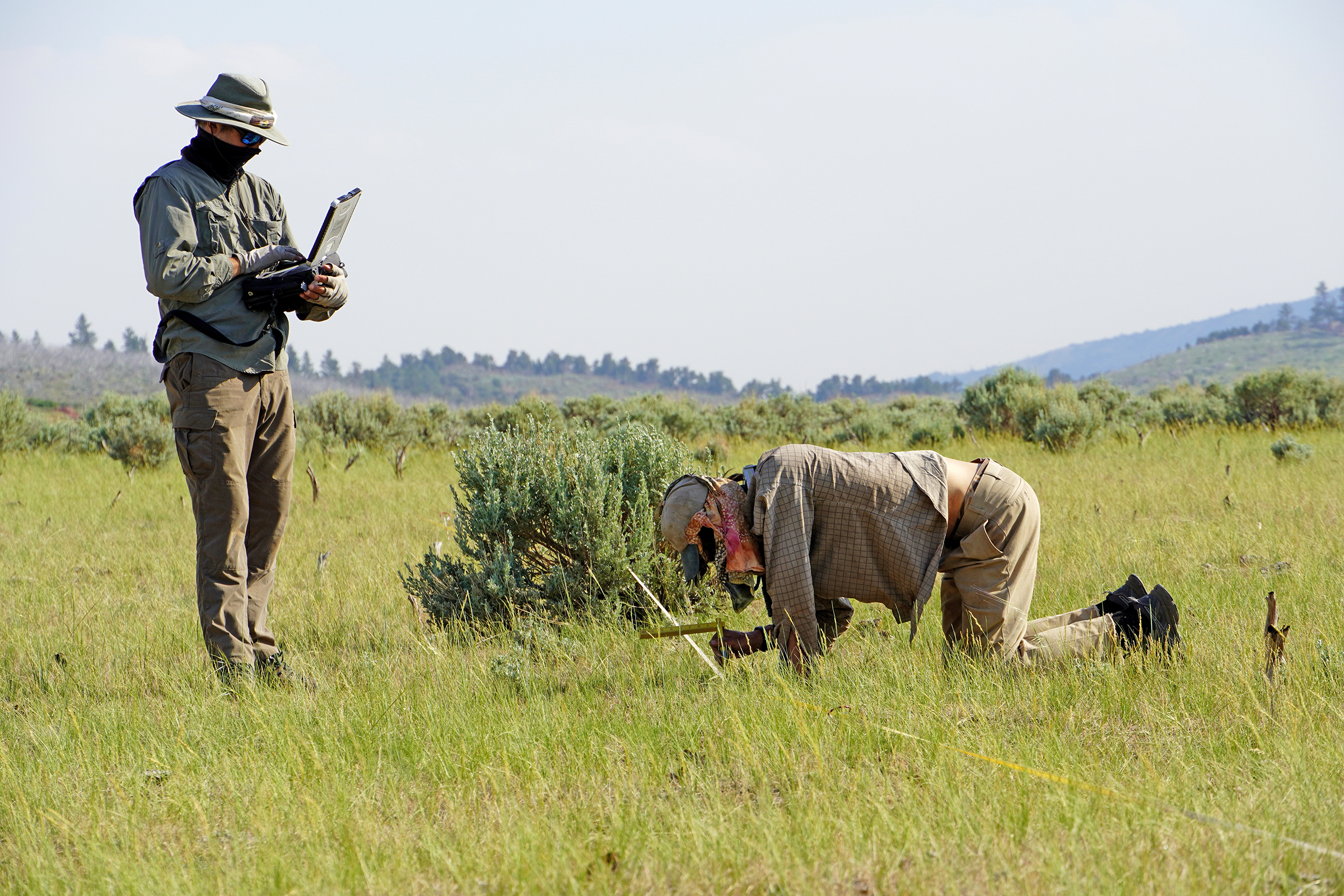
Scientists measure gaps between plants: canopy gaps show how well the land resists wind erosion, basal gaps water erosion; bigger gaps mean more erosion risk. Credit: Amy Washuta, National Park Service.
Climate, fire and grazing
Dinosaur has grown warmer — higher highs and lows, warmer winters with less snowpack, more extreme rainstorms — and the warming is projected to continue; the longer growing season is already changing plant communities. Fire and grazing have shaped the sagebrush too, sometimes turning it into grassland. Suppressing fire can let pinyon-juniper move into sagebrush, but more frequent fire invites exotic annual grasses, and cheatgrass and more people may already have changed the monument's fire patterns. Where exotics are already increasing, as here, fire could push sagebrush into exotic grassland for good.
"This work is an excellent example of why long-term monitoring is useful to park managers," says Dusty Perkins, the network's program manager. "We now have not only a baseline, but also trends."
What the network recommends
- Control exotic annuals, especially cheatgrass. Since landscape-scale control is often not feasible, focus on preventing spread by limiting fire disturbance, particularly in vulnerable areas not yet invaded.
- Protect declining native cool-season grasses — by limiting fire, grazing less intensively, or timing grazing to spare their spring growth.
- Restore protected sagebrush sites by seeding or planting native species, with soil work to stabilize the ground and hold water.
- Focus protection on sites where native plant communities are still intact.
Sources
Based on "What Ten Years of Vegetation and Soils Monitoring Reveals at Dinosaur National Monument," National Park Service Northern Colorado Plateau Network, a work of the United States government in the public domain. Full report: doi:10.36967/2302751.
I dessa samlingarDinosaur National Monument
Licens: CC0 1.0 (allmän egendom) · Bearbetat efter www.nps.gov
1
0
0
0

Kommentarer


