
Vill du förbättra nodens innehåll? Försök att göra en redigeringsbegäran.
On May 20, 2026, Space Exploration Technologies Corp. publicly filed its Form S-1 prospectus with the Securities and Exchange Commission, initiating the formal process for the largest initial public offering in the history of American capital markets. Targeting a listing valuation between 1.75 trillion and 2 trillion dollars under the ticker symbol SPCX, the document represents a profound shift in the corporate identity, financial structure, and risk profile of the aerospace pioneer. The prospectus reveals that SpaceX is no longer operating primarily as a launch provider or a satellite communications network. Through the integration of xAI, completed in February 2026 for 250 billion dollars, management has explicitly repositioned SpaceX as an artificial intelligence infrastructure enterprise. The company claims a total addressable market of 28.5 trillion dollars, of which 93 percent is anchored in enterprise and consumer AI applications powered by its flagship model, Grok. Financially, the prospectus exposes a stark dichotomy between the core communications business and the capital-intensive AI buildout. In 2025, SpaceX generated 18.7 billion dollars in revenue, primarily driven by Starlink, which yielded 11.4 billion dollars in sales and 4.4 billion dollars in operating profit. However, massive infrastructure spending, combined with 2.5 billion dollars in quarterly losses within the newly formed AI division, led to a net GAAP loss of 4.94 billion dollars for the full year, alongside an accumulated deficit of 41.3 billion dollars. Armed with 29 billion dollars in total debt, including a 20 billion dollar bridge loan executed in March 2026, SpaceX is seeking to raise up to 75 billion dollars from public markets. The capital structure establishes an unprecedented dual-class share framework that concentrates over 85 percent of voting control within the founder, effectively insulating management from public shareholder governance, derivative litigation, and traditional regulatory oversight.
The public unveiling of the SpaceX Form S-1 prospectus ends decades of intense speculation regarding the internal economics of the worlds dominant private aerospace firm. By transitioning from confidential draft reviews to a public filing, the company has exposed the granular mechanisms of its operational machinery to global institutional scrutiny. The document challenges standard valuation models, blending hard infrastructure dominance in low Earth orbit with highly speculative corporate maneuvers, multi-billion-dollar related-party transactions, and an absolute concentration of managerial authority.
The Tripartite Corporate Reorganization
The defining structural revelation of the S-1 filing is the formalized division of SpaceX into three distinct operational and reporting segments: Space, Connectivity, and Artificial Intelligence. This architecture represents the operationalization of the February 2026 merger between SpaceX and xAI, a transaction that fundamentally reindexed the financial destiny of the launch provider to the global computational race.
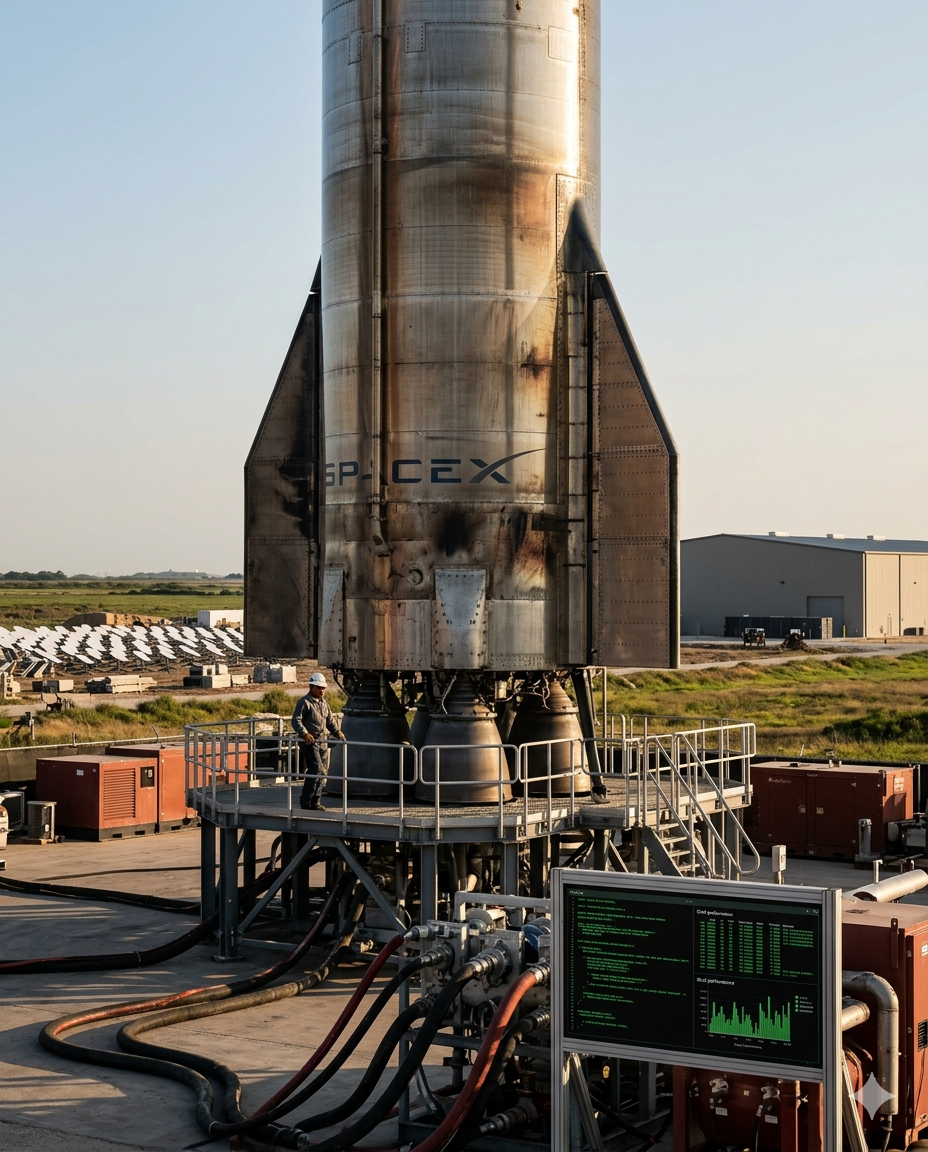
The Space division comprises the legacy launch services, including the workhorse Falcon 9, Falcon Heavy, and the ongoing development of the next-generation Starship launch system. For the first quarter of 2026, this segment reported an operational loss of 662 million dollars. The negative margins reflect the massive, non-capitalized research and development expenditures dedicated to the Starship platform at Starbase in Boca Chica, Texas. Despite maintaining a near-monopoly on domestic commercial and national security launch manifests, the standalone mechanics of heavy rocket manufacturing and orbital deployment remain structurally unprofitable under current capital allocation models.
The Connectivity division, operating under the Starlink brand, serves as the financial engine of the entire corporate apparatus. Generating 11.4 billion dollars of the companys 18.7 billion dollar total revenue in 2025, Starlink achieved an operating profit of 4.4 billion dollars. This represents an EBITDA margin of approximately 54 percent, positioning the satellite constellation as a highly efficient generator of liquidity. The data confirms that consumer and enterprise satellite broadband has successfully transitioned from a capital sink into a scaled, high-margin utility.
The Artificial Intelligence division represents the newest and most volatile component of the balance sheet. Formed via the acquisition of xAI, this segment recorded a GAAP net loss of 2.5 billion dollars in the first quarter of 2026 alone, following an annualized burn rate exceeding 6 billion dollars throughout 2025. This segment accounts for the vast majority of the companys forward-looking valuation thesis. Management asserts that 93 percent of the companys total addressable market is derived from AI, effectively asking public markets to value the entity not on its existing launch infrastructure or satellite margins, but on its capacity to monetize frontier computational models and orbital data processing.
The Macroeconomics of the 2.0 Trillion Dollar Valuation
To appreciate the scale of the proposed listing, SpaceX is targeting a market capitalization that places it within the absolute upper echelon of global equities. At a valuation range of 1.75 trillion to 2 trillion dollars, the company is seeking a multiple of approximately 94 to 107 times its trailing 2025 revenue of 18.7 billion dollars.
A comparative analysis within the broader equities market underscores the magnitude of this premium. If integrated into the S&P 500 index immediately upon listing, SpaceX would rank as the seventh-largest constituent by market capitalization, positioned alongside or above established technology conglomerates such as Alphabet, Amazon, and Meta Platforms. However, if ranked strictly by annual revenue, the company would place near the bottom third of the index, comparable to consumer staples firms like Kellogg Company.
The justification for this valuation disparity rests entirely on the assumption of hyper-exponential growth across markets that remain largely theoretical. The prospectus outlines a total addressable market of 28.5 trillion dollars, an amount exceeding the current annual gross domestic product of the United States. This macroeconomic framework is segmented into several forward-looking industrial verticals:
Enterprise applications of AI are projected to account for 80 percent of the total addressable market, totaling over 22 trillion dollars. This model presumes that the Grok architecture will achieve systemic penetration across global corporate workflows, directly challenging entrenched software monopolies held by Microsoft, Google, and OpenAI.
The remaining 20 percent of the claimed market is distributed across high-frontier concepts. These include long-haul point-to-point terrestrial travel, which involves deploying Starship configuration vehicles to transport passengers and high-value cargo between international metropolises via suborbital ballistic trajectories in under 30 minutes. Additional verticals detail in-orbit manufacturing facilities leveraging microgravity environments for advanced semiconductor and pharmaceutical synthesis, autonomous asteroid mining operations targeting platinum-group metals, and the establishment of industrial energy production networks on the lunar and Martian surfaces.
Capital Burn, Debt Architecture, and the Use of Proceeds
The underlying financial reality of SpaceX contradicts the conventional narrative of a cash-rich technology titan. The S-1 reveals a corporate structure under severe capital strain, driven by the simultaneous execution of three world-scale engineering programs: the global expansion of the Starlink constellation, the orbital qualification of the Starship vehicle, and the acquisition of Tier-1 artificial intelligence infrastructure.
The company posted a consolidated GAAP net loss of 4.94 billion dollars for the full year 2025. This loss occurred despite the 4.4 billion dollar profit cushion provided by Starlink, meaning the non-connectivity segments consumed more than 9 billion dollars in cash over a 12-month period. Since its inception, SpaceX has accumulated a total deficit of 41.3 billion dollars, representing an unprecedented level of private wealth consumption prior to public listing.
The acceleration of the cash burn is directly linked to a steep increase in capital expenditure, which reached 20.7 billion dollars in 2025, a fivefold increase from 2023 levels. This capital intensity has severely depleted the companys cash reserves, which fell from approximately 25 billion dollars at the end of 2025 to less than 16 billion dollars by March 31, 2026.
To maintain liquidity ahead of the IPO, SpaceX has aggressively utilized debt markets. The company carries 29 billion dollars in total debt on its balance sheet. This includes a critical 20 billion dollar bridge loan secured in March 2026, just eight weeks prior to the public filing. Consequently, a substantial portion of the estimated 50 billion to 75 billion dollars in gross proceeds generated by the IPO will not be allocated to capital projects or interplanetary research. Instead, the prospectus notes that these funds will be directly deployed to extinguish the short-term bridge financing, transferring billions in liquidity straight back to the underwriting consortia.
Furthermore, internal metrics suggest that the core growth engine is experiencing structural margin compression. While top-line revenue grew between 33 and 43 percent year-over-year, the average revenue per user for Starlink dropped by approximately 18 percent since 2023. This decline is attributed to aggressive, high-discount promotional strategies, such as the mid-2026 hardware and service bundles launched in partnership with regional MVNOs like US Mobile. These initiatives succeeded in boosting absolute subscriber counts ahead of the filing but did so at the expense of long-term unit economics.
The AI Imperative: Grok, Compute Leasing, and the Cursor Dilemma
Given that 93 percent of the valuation thesis relies on artificial intelligence, the operational reality of the AI division requires close analysis. The prospectus positions Grok as a premier enterprise utility, yet the disclosure documents reveal significant competitive, technical, and regulatory hurdles.
At the time of filing, Grok held a global enterprise market share of roughly 3.4 percent, with the market heavily dominated by OpenAI, Anthropic, and Google. The primary documented use cases for the model remain tightly bound to the infrastructure of X, the social media platform previously integrated into xAI. The S-1 explicitly warns investors of material risks arising from regulatory actions in European jurisdictions, including Spain, France, and the United Kingdom, stemming from Groks generation of non-consensual imagery and automated disinformation vectors.
The document also hints at internal technical challenges regarding the software stack. Bloomberg disclosures cited in the prospectus indicate that SpaceXs own engineering staff frequently bypassed Grok in favor of specialized third-party developer tools, citing performance deficits in code generation and architectural synthesis. This internal friction explains the extraordinary 250 billion dollar valuation Musk assigned to xAI during the internal merger, followed immediately by a mandate to rebuild the core model architecture from scratch.
To resolve these technical limitations, SpaceX executed a definitive agreement to acquire the AI developer platform Cursor for 60 billion dollars, a transaction scheduled to close 30 days post-IPO. The deal includes an unprecedented 10 billion dollar break fee should regulatory authorities or contractual failures block the acquisition. This maneuver demonstrates that the company is willing to deploy staggering quantities of capital to acquire external engineering talent to validate its broader AI narrative.
Currently, the primary source of near-term cash flow for the AI segment is not organic software licensing, but a massive compute-leasing agreement with Anthropic. This contract generates 15 billion dollars annually, accounting for roughly 40 percent of SpaceXs projected near-term non-connectivity revenue. Under the terms of this arrangement, SpaceX operates essentially as a wholesale graphics processing unit landlord, renting out vast arrays of its proprietary computing clusters to a direct competitor. Critically, the prospectus reveals that Anthropic retains the right to terminate this contract with 90 days notice, presenting a significant threat to the predictability of the segments revenue.
Related-Party Transactions and Corporate Governance
The S-1 prospectus outlines a complex web of related-party transactions that challenge standard principles of public company governance. These arrangements involve the systematic movement of capital, assets, and liabilities between various corporate entities under the unified control of Elon Musk.
A clear example of these internal economic transfers is the commercial relationship between SpaceX and Tesla, Inc. During 2025, SpaceX purchased 650 million dollars in equipment, components, and vehicles from Tesla. This capital deployment included 131 million dollars dedicated to the acquisition of roughly 1,500 Tesla Cybertrucks at full retail pricing, without volume discounts. During the fourth quarter of 2025, SpaceX single-handedly accounted for approximately 18 percent of all Cybertruck registrations in the United States, effectively utilizing its private treasury to support the sales metrics of a publicly traded sister company during a critical macro economic window.
Furthermore, the cross-border tracking of these transactions has revealed material accounting discrepancies. While SpaceX reports purchasing 650 million dollars in goods from Tesla, Teslas independent SEC disclosures over the same period report only 573 million dollars in sales to SpaceX. This leaves a structural variance of 77 million dollars unaccounted for across the corporate boundary, noted in independent financial analyses as an unresolved reporting gap.
More significant from a balance sheet perspective is the relationship between SpaceX and its internal board members. Antonio Gracias, a veteran director of SpaceX and managing partner of Valor Equity Partners, is heavily linked to the financial infrastructure of the AI division. The prospectus reveals that SpaceX and its subsidiaries carry over 20 billion dollars in long-term AI infrastructure lease obligations directly tied to financial entities controlled by Valor.
A significant portion of these transactions are classified under GAAP as failed sale-leasebacks. In a standard sale-leaseback, an enterprise sells an asset to an institutional investor for upfront liquidity and leases it back, shifting the asset and corresponding liability off the primary balance sheet. Because these specific infrastructure deals failed to meet the rigorous accounting criteria for a true transfer of ownership, the physical computing infrastructure remains on SpaceXs books, while the multi-billion-dollar payment stream to the board members fund is recorded as formal corporate debt. This dynamic introduces structural conflicts of interest at the highest level of fiduciary oversight.
The Texas Regulatory Environment and Judicial Defenses
To insulate these complex internal operations from shareholder litigation, Musk executed a comprehensive legal relocation of the corporate entity. Following a high-profile dispute in the Delaware Court of Chancery regarding his compensation infrastructure at Tesla, which judges characterized as a deeply flawed process marked by systemic conflicts of interest, SpaceX was formally reincorporated in the State of Texas.
The S-1 details the defensive legal barriers established under the revised Texas corporate code, creating an environment exceptionally hostile to public shareholder activism:
To initiate a derivative lawsuit on behalf of the corporation against directors or officers, an individual or coalition of shareholders must maintain a minimum equity stake of 3 percent of the outstanding shares. At the projected IPO valuation, this threshold requires a minimum capital position of 52 billion to 60 billion dollars, effectively preventing retail investors and standard institutional pension funds from pursuing unilateral legal remedies.
Should an investor meet this multi-billion-dollar entry threshold, the substantive standard of proof required to secure a judgment has been significantly raised. Under Texas law, a plaintiff cannot prevail merely by demonstrating a breach of fiduciary duty or a conflicted transaction lacking independent board oversight. The statutory framework demands definitive proof of actual fraud, intentional criminal misconduct, or a knowing, deliberate violation of written law.
Furthermore, the discovery mechanisms available to shareholders have been severely restricted. The revised Texas corporate statues explicitly exclude internal electronic communications, emails, and direct text messages from standard shareholder books-and-records discovery requests. This statutory shield effectively prevents the extraction of internal communications that have historically served as the foundational evidence in high-profile corporate governance disputes.
Additionally, the prospectus establishes an aggressive forum-selection clause. It bans class-action lawsuits and mandates that all disputes relating to federal securities laws be routed exclusively into either the Texas state court system or resolved through private, binding arbitration. This structure represents a direct challenge to long-standing SEC preferences against forcing public equity holders into non-public arbitration environments.
The Architecture of Dynastic Hegemony
The voting architecture constructed for SPCX establishes a corporate dictatorship without parallel in modern capital markets. The company will deploy a dual-class equity framework designed to permanently decouple capital contribution from governance authority.
Public market participants will receive Class A common stock, carrying one vote per share. Elon Musk retains exclusive ownership of Class B common stock, which carries ten votes per share. Under this distribution, while Musks absolute economic ownership of the entity sits at approximately 41 percent, he commands more than 85 percent of the total voting power. This concentration ensures that the founder cannot be removed, replaced, or altered in his execution of corporate policy by any combination of public institutional or retail opposition.
To further entrench this control, the prospectus reveals the authorization of a Class C non-voting stock structure. This equity class will be utilized as the primary vehicle for future corporate acquisitions and employee stock-based compensation. By deploying non-voting paper for forward M&A transactions, such as the upcoming Cursor buyout, the company can expand its corporate footprint and dilute public economic shares while leaving Musks 85 percent voting majority completely unaffected.
The document also provides for permanent dynastic succession. In the event of Musks departure or death, the super-voting Class B shares are legally structured to transition directly into family-controlled private trusts. This mechanism allows control rights to pass down to his descendants without triggering mandatory conversion clauses into single-vote Class A stock, a standard protection feature in traditional dual-class public listings.
The compensation infrastructure designed for Musk matches the scale of the voting architecture. The prospectus details a performance-based restricted stock grant totaling 1 billion shares. The vesting tranches for these options are tied to two milestones: the attainment of a 7.5 trillion dollar public market capitalization and the formal establishment of a permanent human colony on Mars consisting of at least 1 million inhabitants.
Remarkably, within the body of the prospectus, SpaceX management explicitly defines the probability of achieving these milestones as improbable. Under GAAP accounting rules, this categorization carries a distinct financial advantage. If an executive compensation milestone is deemed probable, the issuing entity must expense the estimated fair value of the equity award across the income statement in the current period, a requirement that would inflict hundreds of billions in paper losses on SpaceXs current financials. By certifying the goals as improbable, the entire 1-billion-share grant is carried on the books at zero accounting cost.
However, the legal architecture ensures that Musk receives immediate utility from these unvested, improbable shares. The terms of the grant specify that from day one, Musk is empowered to vote the entire block of 1 billion shares, collect any discretionary dividends authorized by the board, and pledge the unvested equity as primary collateral to institutional banks to secure billions in tax-free personal cash loans.
Critically, the prospectus includes a corporate opportunity waiver. Under this provision, SpaceX formally renounces its rights to any business or technological innovations developed by Musk or his affiliates outside the company. The clause states that Musk has no fiduciary obligation to present novel commercial opportunities to SpaceX before pursuing them via independent private vehicles. This clause codifies the structural risk previously demonstrated when Musk repositioned Teslas internal AI initiatives into xAI as a separate entity.
The Starship Monoculture: The Ultimate Single-Point Failure Risk
Beneath the complex layers of artificial intelligence marketing, related-party debt structures, and structural legal defenses lies an uncompromising engineering reality: the entire 1.75 trillion dollar corporate valuation depends entirely on the operational success of a single launch vehicle: Starship.
The prospectus leaves no room for ambiguity on this dependency. Every forward-looking financial projection—including the economic viability of the AI division, the expansion of the connectivity segment, and the execution of deep-space logistics—is predicated on Starship achieving an unprecedented launch cadence and cost efficiency.
The architectural evolution of Starlink illustrates this vulnerability. The upcoming Starlink Version 3 satellites, designed to deliver a twenty-fold increase in data throughput and power orbital data centers, are physically too large and heavy to fit within the payload fairings of the current Falcon 9 or Falcon Heavy rocket fleets. These advanced assets can only be deployed via the massive internal volume of the Starship payload bay. If Starship development stalls, the technological roadmap for the entire profitable Connectivity division is put at risk.
Furthermore, the economic modeling given to institutional investors assumes an insane flight rate consisting of hundreds of launches per year, with each vehicle carrying 200 tons of cargo into low Earth orbit at a fraction of current legacy launch costs. This frequency is essential to build the orbital infrastructure required to support the compute-heavy workloads outlined in the AI strategy.
At the time of the public S-1 filing, however, Starship has not achieved stable commercial operations. The development program continues to operate within an experimental testing phase, marked by repeated atmospheric and orbital disintegrations. The vehicle has yet to successfully demonstrate its core operational requirements: the reliable deployment of commercial payloads into stable orbits, the execution of complex in-orbit cryogenic propellant transfers necessary for deep-space transit, and the autonomous vertical landing of both the Super Heavy booster and the upper stage spacecraft without catastrophic structural failure.
The investment thesis presented in the S-1 assumes that this complex aerospace system will function perfectly, on schedule, with zero long-term engineering or safety setbacks. History suggests that the development of heavy-lift orbital infrastructure is rarely smooth. If the realized flight rate achieves only half of the projected cadence, or if the refurbishment costs of the reusable thermal protection systems exceed management targets, the fundamental assumptions underlying the 1.75 trillion dollar valuation model will fall apart.
The Fundraising Horizon: Understanding the True Use of Proceeds
A detailed review of the footnotes and internal capital expenditure models within the S-1 indicates that the upcoming IPO is not a final capital raise, but rather the opening phase of a massive corporate fundraising cycle.
While the public float is expected to secure between 50 billion and 75 billion dollars in gross capital, the document outlines structural commitments that far exceed this influx of liquidity. When accounting for the mandatory retirement of the 20 billion dollar short-term bridge loan, the ongoing capital requirements of the Starlink network expansion, the deployment of global AI data center complexes, and the procurement commitments owed to entities linked to Valor Equity Partners, SpaceX requires a minimum of 235 billion dollars in cash over the next three to five years.
Consequently, public market investors participating in the initial offering must accept that their capital will be quickly consumed by existing short-term debts and infrastructure costs. The company will remain dependent on continuous access to public debt markets, dilutive follow-on equity offerings, and high-yield institutional credit lines to sustain its operations. The SPCX IPO does not represent a mature enterprise offering self-sustaining liquidity to the public; it represents a massive, high-risk bet on a future tech empire, requiring continuous capital injections to avoid structural insolvency.
Ultimately, the SpaceX S-1 prospectus forces institutional and retail investors to make a fundamental choice. It asks them to set aside standard valuation metrics, traditional corporate governance, and established legal protections in exchange for direct participation in a historic, founder-controlled technological vision. The document makes it clear that those who buy the stock are not buying structural oversight or voting rights; they are purchasing a ticket on an unpredictable ride led by Elon Musk, where the final destination is either the creation of a multi-planetary technology monopoly or a historic collapse of public market capital.
For a deeper understanding of the institutional shifts occurring across alternative capital networks, you can review this analysis of the structural dynamics within modern private credit markets:
Understanding Private Credit Growth
This briefing provides critical context on how large-scale corporate entities navigate complex debt markets outside traditional banking channels prior to launching public equity offerings.
1
0
0
0

Kommentarer