
Vill du förbättra sidans innehåll? Föreslå en ändring.
From May 11 to 13, 1957, President Dwight D. Eisenhower ("Ike") and British Field Marshal Viscount Sir Bernard Law Montgomery ("Monty") toured the Gettysburg battlefield together.
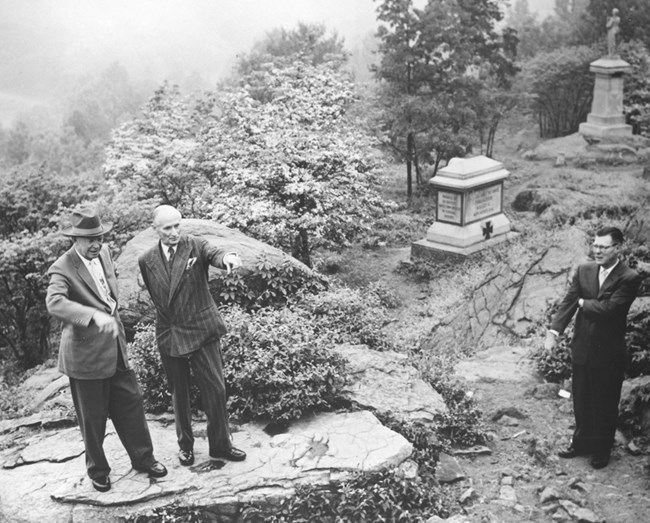
Eisenhower and Montgomery on Little Round Top, May 1957. Eisenhower National Historic Site
A promise delayed
In World War II, Montgomery commanded the British and Canadian 21st Army Group under Eisenhower, the Supreme Commander of the Allied Expeditionary Force in Europe. The two sometimes talked about Gettysburg, and Ike promised more than once to show Monty the field.
- November 1954: at Thanksgiving in Augusta, Georgia, Monty said he'd love to see it, and Ike invited him for the following autumn, once the Eisenhowers' Gettysburg home was renovated.
- September 1955: Ike had a major heart attack while visiting Mamie's family in Denver; Monty visited him at Fitzsimmons Army Hospital instead.
- Spring 1957: Monty, now Deputy Supreme Allied Commander of NATO in Paris, arrived in New York on May 7 for NATO talks and a speaking tour — and arranged the visit at last.
Saturday, May 11
The day before, in Baltimore, Monty had told reporters he'd read all about the battle and would have "sacked" both Lee and Meade — Lee for failing to press his advantage, Meade for not keeping Union forces under control. The remark would come up again.
Ike and Monty left the White House at 8:35 a.m. and landed at the tiny Gettysburg airport at 9:20 in a twin-engine Aero Commander, met by a crowd of photographers. The president's physician, Maj. Gen. Howard M. Snyder, stepped off first. After a stop at the Eisenhower farm, the tour began just after 10:00 at the Eternal Light Peace Memorial, on the first day's field, where they looked at two Whitworth breech-loading cannon the Confederates had acquired from England. They then made short stops at the National Cemetery, the Angle, Meade's headquarters, the 1st Minnesota monument, Little Round Top and Devil's Den. No one recorded what they said, though the New York Times guessed they discussed what happened — and what might have — at the Civil War's turning point.
The rest of the day was spent at the farm, looking over cattle at neighboring farms, with Mamie, close friend George Allen and others; that evening the Eisenhowers and Monty dined alone.
Sunday, May 12
At 8:18 a.m., 21 reporters and 16 photographers waited outside the Gettysburg National Museum, owned by the Rosensteel family (later the park's visitor center, demolished in 2008). Ike and Monty watched the Electric Map — a 3D plaster map with flashing lights and narration — and received two books from Mrs. Rosensteel. Monty asked the prices of Ike and Mamie plates and mugs in the gift shop but didn't buy any.
In fog and drizzle they climbed Culp's Hill, where Monty insisted on going up the 70-foot observation tower built by the War Department in 1895. On the fourth landing, jostled by the press, he told the reporters there were too many people up there, and everyone filed back down.
At the bottom, a reporter asked whether he still thought Lee and Meade should have been sacked. Monty said he wouldn't have fought the battle that way himself. Ike shot back:
"If you had, I would have sacked you."
Everyone roared, Ike and Monty loudest of all.
At the Angle they tramped through wet grass to Meade's equestrian statue — the Gettysburg Times reported they were having a wonderful time — then climbed Little Round Top, where near Gouverneur K. Warren's statue Ike pointed out key ground as they discussed tactics.
Their last stop was the Virginia Memorial, looking across the field of Pickett's Charge. Ike said:
"Why Lee would have gone across that field, I don't know. … Maybe he got so darned mad he wanted to hit them with a brick."
Pointing to the Round Tops, he added that he'd never know why Lee didn't go around there. Monty called the charge monstrous, and said he'd have swung a right hook around Little Round Top, where there was plenty of cover, with a small feint to draw the Union's attention. Asked if he agreed, Ike laughed:
"Oh no, you don't get me into that. Look, I live here with the North and the South!"
Softening Monty's verdict, Ike told reporters that "some of the finest troop movements in military history" happened at Gettysburg, "but everything seemed to break to pieces on coordination, unfortunately for the South," and that if the generals who fought there were alive, they'd probably criticize how he and Monty had fought. Monty nodded.
They were back at the farm by 10:18, went with Mamie to Mother's Day services at Gettysburg's Presbyterian Church, and at 11:00 a.m. the next day Monty returned to Washington.
The fallout
By criticizing the Union and Confederate commanders, the two generals had walked into a minefield. Monty was faulted for not grasping Gettysburg's symbolic importance to Americans, or how thoroughly historians had studied it; Ike had to handle the reaction to Monty's words and to his own misunderstood remarks about Lee.
More damaging was Montgomery's memoir, published a year later. It praised Ike's character but was harsh about him as a commander, which hurt Ike and badly strained their friendship. A White House source was quoted as saying Monty wouldn't be invited to Gettysburg again — and he never returned.
Sources
Based on "The Generals Take the Field: Eisenhower and Montgomery at Gettysburg, 1957," National Park Service; a work of the United States government in the public domain. Montgomery's words and those of the newspapers are paraphrased; President Eisenhower's are quoted.
I dessa samlingarEisenhower National Historic SiteGettysburg National Military Park
Licens: CC0 1.0 (allmän egendom) · Bearbetat efter www.nps.gov
1
0
0
0

Kommentarer


