
Vill du förbättra nodens innehåll? Försök att göra en redigeringsbegäran.
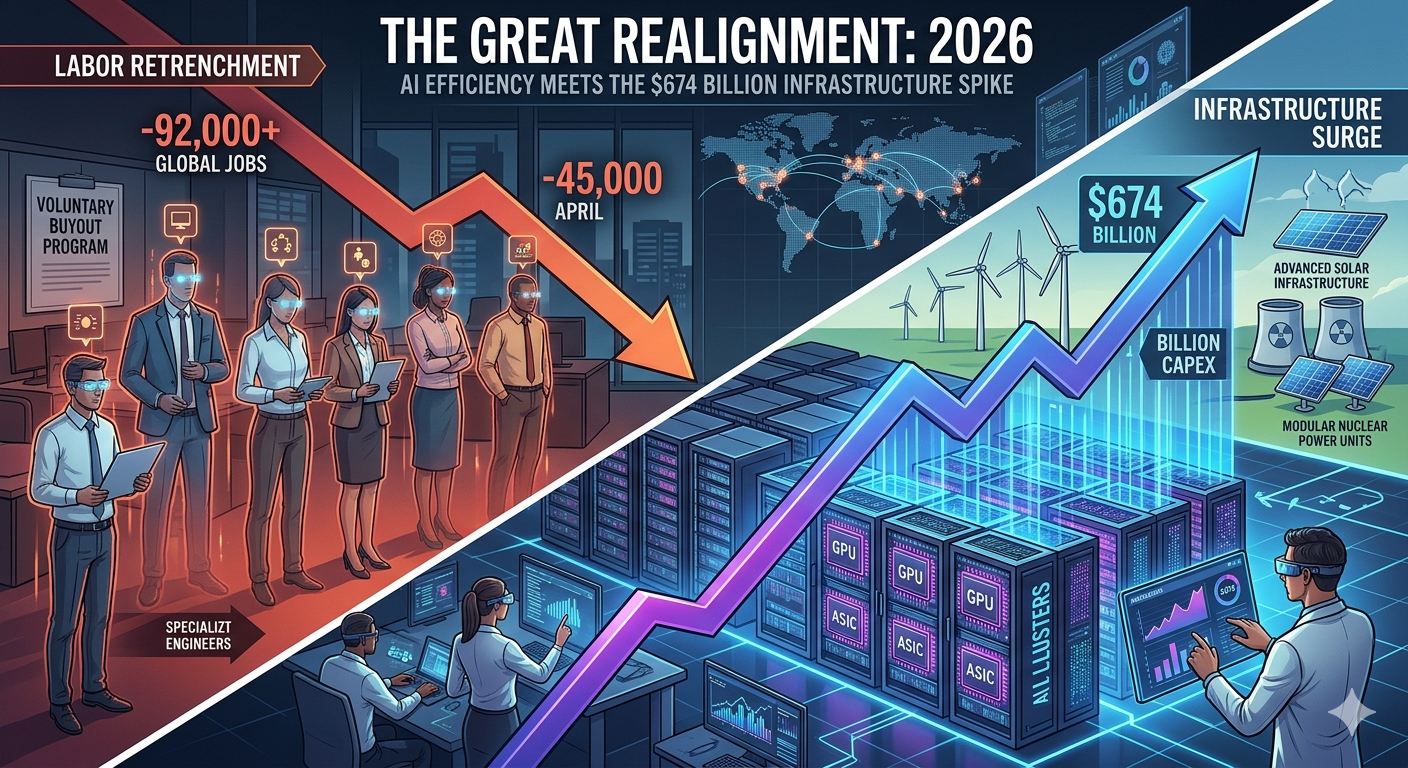
The technology sector is undergoing a massive structural overhaul, marked by a stark contrast between heavy capital expenditure and widespread workforce reductions. By May 16, 2026, tech sector layoffs have surpassed 92,000 global job cuts within the first five months of the year alone. April 2026 registered as the single worst month for industry downsizing in over two years, seeing more than 45,000 workers displaced. Silicon Valley heavyweights—including Meta, Microsoft, Amazon, Alphabet, and Snap—are driving this aggressive restructuring. Unlike the macroeconomic over-hiring corrections of 2022 and 2023, the 2026 downsizing is directly attributed to advanced artificial intelligence systems automating core corporate workflows. Enterprise adoption of frontier models, such as OpenAI’s GPT-5.5 and Anthropic’s Claude 4.7, has rapidly progressed from experimental research pilots to direct integration within production environments. Corporate leaders report that generative AI now autonomously writes, tests, and debugs substantial portions of software code—reaching up to 65% in some corporate pipelines—while streamlining operations across customer engineering, marketing, and administration. Concurrently, tech conglomerates are doubling down on infrastructure investments. **Combined corporate capital expenditure among the top five tech firms is projected to hit a record-shattering $674 billion by the end of 2026. This capital is being deployed to secure advanced data centers, procure high-end silicon, and capture proprietary enterprise workloads. The industry is moving away from human-resource scaling toward an asset-intensive, machine-driven ecosystem. As companies shift funding from administrative payrolls to processing power, the job market faces a prolonged cooling period, and enterprise operations are experiencing a fundamental permanent realignment.
The Corporate Metamorphosis of 2026
The global technology sector is experiencing an unprecedented structural evolution. As of mid-May 2026, the prevailing industry narrative has shifted from the growth-at-all-costs metrics of the previous decade to an aggressive paradigm centered around computational efficiency, workflow automation, and infrastructure consolidation.
For years, the technology market operated under an implicit thesis: human capital scale correlated directly with innovation capacity and corporate valuation. In 2026, that thesis has been decisively dismantled. Tech companies are actively shrinking their human labor footprints while simultaneously executing the largest capital expenditure campaigns in corporate history.
This economic divergence is not a cyclical reaction to high interest rates or inflation, but rather a direct structural consequence of enterprise-ready, frontier-grade artificial intelligence. Systems that were categorized as highly advanced research demos or non-critical productivity assistants in 2024 and 2025 have been deeply woven into the transactional fabric of corporate IT architectures.
The resulting workforce dislocations are deep and systematic. By mid-May, the aggregate tally of eliminated tech roles for the year has breached the 92,000 threshold, turning the first half of 2026 into one of the most volatile periods for tech employment since the post-pandemic corrections.
However, viewing this trend purely through the lens of cost-cutting obscures the broader economic reality. The capital being stripped out of corporate payrolls is not being returned to shareholders or held in cash reserves. Instead, it is being funneled into data center real estate, specialized AI accelerators, energy procurement contracts, and proprietary model licensing.
The technology sector is transitioning from an industry defined by its variable labor costs to an asset-heavy, capital-intensive infrastructure industry. This transition presents significant strategic implications for enterprise software engineering, global labor markets, and the macroeconomic valuation of the digital economy.
The Quantitative Reality: Layoffs and Capital Surges
To understand the scale of this structural pivot, one must examine the stark divergence between labor reductions and capital expenditures. The quantitative indicators from the first two quarters of 2026 reveal an industry funding its technical future through aggressive operational downsizing.
+-------------------------------------------------------------------------+
|                  THE 2026 TECH SECTOR ECONOMIC DIVERGENCE                |
+-------------------------------------------------------------------------+
|                                                                         |
|  LABOR RETRENCHMENT                             INFRASTRUCTURE SURGE    |
|  [0-5 Months of 2026]                           [Projected Full Year]   |
|                                                                         |
|  92,000+ Total Job Cuts                         $674 Billion Capex      |
|                                                                         |
|  * April Peak: 45,000+ positions eliminated                             |
|  * Meta: 8,000 roles (10% of global workforce)                          |
|  * Snap: 1,000 roles (16% of full-time staff)                           |
|  * Microsoft: First voluntary retirement buyout program in 50 years     |
|                                                                         |
+-------------------------------------------------------------------------+
The Scale of the Retrenchment
The velocity of tech layoffs has caught market analysts by surprise. After a relative stabilization of the labor market in late 2025, the first five months of 2026 saw a massive acceleration in staff reductions:
- Aggregate Workforce Impact: More than 92,000 workers across hardware, software, and digital services have been terminated or offered buyouts between January and May 2026.
- The April Surge: April 2026 represented the apex of this trend, accounting for over 45,000 of those total cuts. This marked the single highest contraction month for tech labor since early 2023.
- Corporate Specifics:
- Meta: Announced a major operational tightening that affected 8,000 employees, representing roughly 10% of its global workforce, with terminations finalized in mid-May.
- Snap: Eliminated approximately 1,000 active roles (16% of its full-time workforce) while permanently retiring an additional 300 open positions.
- Microsoft: Initiated a voluntary exit and retirement buyout program targeting long-serving personnel in the United States. This program, the first of its scale in Microsoft’s 50-year history, is positioned to reduce its domestic headcount by up to 8,750 employees (roughly 7% of its US workforce).
- Amazon, Alphabet, and Oracle: Continued rolling, division-by-division adjustments, targeting mid-level management, product marketing, and internal enterprise support.
The $674 Billion Infrastructure Commitment
While human capital budgets are being aggressively dismantled, capital expenditure (CapEx) accounts are expanding at an unprecedented rate.** The world’s primary hyperscalers—Alphabet, Microsoft, Meta, and Amazon—alongside key tier-two enterprise cloud providers, are on track to spend an aggregate $674 billion in capital investments over the course of 2026.
This figure represents more than double the combined annual capital expenditure of these same organizations from just two years prior, a period when AI spending was already considered highly aggressive by Wall Street standards.
This capital is highly concentrated, targeted almost exclusively at three core buckets:
- Advanced Silicon Procurement: Securing allocations of next-generation graphics processing units (GPUs) and custom application-specific integrated circuits (ASICs) designed for high-density training and low-latency inference workloads.
- High-Density Data Centers: Building and retrofitting facilities capable of supporting power densities exceeding 40kW to 100kW per rack, a necessity for modern frontier clusters.
- Energy Infrastructure and Power Grid Integration: Directly financing nuclear, geothermal, and advanced solar projects to guarantee uninterrupted, gigawatt-scale electrical power to long-term facility pipelines.
The financial trade-off is explicit: tech companies are substituting variable human labor costs with fixed, depreciable computational infrastructure.
Drivers of Automation: Frontier Models in Production
The underlying catalysts for this massive corporate realignment are the advanced frontier models launched and matured over the preceding quarters. Systems such as OpenAI's GPT-5.5 family (including GPT-5.5 Instant and GPT-5.5 Cyber) and Anthropic's Claude 4.7 and Mythos models have moved past basic text generation. They now act as highly autonomous enterprise engines capable of execution across complex, multi-step environments.
The Maturity of Code Generation
The most immediate operational impact of these systems has occurred within software engineering groups. For years, AI-assisted coding was restricted to boilerplate generation and auto-completion. In 2026, autonomous code generation engines routinely manage full software development lifecycles.
For example, Snap Chief Executive Officer Evan Spiegel publicly noted that advanced AI models now generate upwards of 65% of the code deployed across Snap's internal production environments. This level of automation has changed the structural requirements of engineering teams.
Instead of large pools of junior engineers writing raw code and a secondary tier of mid-level engineers debugging it, compact, highly focused teams of senior system architects act as editors and reviewers. They oversee codebases generated and verified by AI models at a fraction of the traditional cost and time.
Advanced Capabilities: Minimizing Hallucinations and Long Context Management
The migration of AI tools from peripheral utilities to core infrastructure is driven by substantial improvements in architectural performance:
- Hallucination Reductions: Models like GPT-5.5 Instant have integrated real-time verification loops, reducing factual and logical hallucinations by more than 50% in high-stakes scenarios. This reliability allows systems to interact directly with internal databases, accounting systems, and customer records without continuous human intervention.
- Context Expansion and Integration: Advanced context window scaling allows modern enterprise models to ingest entire codebases, multi-year financial statements, or complex legal compliance structures in a single prompt. Furthermore, native integrations with corporate communication networks (such as Slack and Microsoft Teams) and productivity suites (such as Google Workspace and Microsoft 365) allow models to monitor corporate data flows continuously, updating documentation and taking actions in real time.
The Agentic Shift and the "Dreaming" Paradigm
The defining technical evolution of early 2026 is the transition from passive chatbot interfaces to autonomous agentic frameworks. The "Agentic Wars" have intensified as Google, Meta, Microsoft, and specialized startups release systems capable of independent multi-step execution.
Traditional RAG / Chatbot (2024-2025)
[User Query] -> [Vector Search] -> [Model Inference] -> [Static Text Output]
* Requires constant human evaluation and sequential prompt-response steps.

Autonomous Agentic Framework with "Dreaming" (2026)
[High-Level Objective] -> [Agent Decomposition] -> [Tool/Environment Execution]
                               ^                                  |
                               |---- [Between-Session "Dreaming"] <|
                                     - Review prior behavior
                                     - Optimize execution paths
                                     - Self-correct error states
A core breakthrough in this space is Anthropic’s "dreaming" technique, introduced as a research preview for long-running workflows across software engineering, quantitative finance, and corporate law. This methodology introduces a distinct processing phase between operational executions.
During this phase, an autonomous agent reviews its own logs, analyzes its execution paths, identifies systematic bottlenecks or logical errors, and updates its operational parameters. This self-contained optimization cycle allows agents to handle complex multi-week corporate tasks with Minimal human oversight, creating a steep decline in traditional white-collar labor demands.
Enterprise Case Studies: Restructuring in Action
The systemic shift toward AI-dominated workflows is best illustrated through real-world deployments across major tech organizations and enterprise early adopters.
Meta: The Lean Infrastructure Machine
Meta's recent elimination of 8,000 corporate positions represents a calculated move toward an AI-driven organizational structure. Internal reports indicate that Meta has heavily automated its product management and content moderation pipelines using customized versions of its Llama architecture.
By utilizing autonomous agents to analyze user engagement patterns, generate targeted ad copy variations, and manage policy-enforcement queues, Meta has maintained its platform expansion rates while significantly reducing its global operations payroll. The targeted savings are being redirected into its open-source foundational model training runs and specialized Llama-centric data center arrays.
Microsoft: Strategic Reallocation and Voluntary Buyouts
Microsoft’s unprecedented retirement buyout program for 7% of its domestic workforce reflects a deliberate long-term strategy to replace legacy talent profiles with specialized AI engineering expertise.
Simultaneously, Microsoft has aggressively consolidated top-tier talent from the open-source community, recently absorbing a significant contingent of researchers and systems engineers from the Allen Institute for AI (Ai2), specifically targeting individuals from the OLMo open-source model initiative. These professionals are being integrated into Microsoft’s core Superintelligence division, signaling that every dollar saved from operational buying programs is being re-allocated toward building foundational infrastructure.
Novo Nordisk and OpenAI: Accelerating Pharma Workflows
The impact of this technological shift extends far beyond traditional tech companies, as evidenced by Novo Nordisk's strategic enterprise-wide partnership with OpenAI. Planned for full operational scale by the end of 2026, this collaboration embeds customized OpenAI models into every stage of Novo Nordisk's corporate and scientific operations.
In drug discovery, autonomous models analyze vast biochemical datasets to predict compound efficacy and optimize molecular structures for next-generation obesity and diabetes treatments. In the corporate office, AI agents manage clinical trial compliance workflows, automate global supply chain forecasting, and generate regulatory filing documentation. This deep integration allows the pharmaceutical giant to scale its research and production output exponentially without requiring a linear expansion of its administrative or data-analysis staff.
Cybersecurity and Code Security: The New AI Battleground
The rapid deployment of frontier AI models has fundamentally altered the threat and defense vectors within enterprise cybersecurity, forcing organizations to re-evaluate how software vulnerabilities are discovered, disclosed, and mitigated.
Real-Time Vulnerability Identification and Exploitation
Frontier systems have demonstrated an extraordinary ability to perform automated source-code audits. In security environments, models like Anthropic's Claude Mythos and OpenAI's GPT-5.5-Cyber can scan millions of lines of proprietary code, trace input execution pathways, and identify zero-day vulnerabilities in near-real-time.
Crucially, these models do not merely flag potential security issues; they generate fully functional exploit payloads to prove the vulnerability's existence. This capability introduces a severe temporal bottleneck for enterprise defenders: if a frontier model can discover a flaw and write an exploit script in seconds, traditional human patch cycles spanning days or weeks are no longer viable defenses.
Case Study: Palo Alto Networks and AI-Driven Remediation
The practical reality of this shift was highlighted in Palo Alto Networks' May 2026 security advisory updates. As an early testing partner for advanced frontier defensive integrations, the organization conducted a comprehensive, automated scan of over 130 core products across its SaaS and customer-operated platforms.
+-------------------------------------------------------------------------+
|                  PALO ALTO NETWORKS VULNERABILITY MITIGATION             |
+-------------------------------------------------------------------------+
|                                                                         |
|  LEGACY PROCESS (Historical)                     AI-DRIVEN PROCESS (2026) |
|  * Manual Auditing / Static Tools               * Frontier Model Scanning |
|  * Multi-Week Evaluation Cycles                  * Real-Time Analysis     |
|  * Low-Volume Monthly Batches                    * High-Volume Automated  |
|                                                                         |
|  ---------------------------------------------------------------------  |
|  MAY 2026 RESULTS:                                                       |
|  * 26 CVEs Identifed (Representing 75 Individual Technical Issues)       |
|  * 100% of SaaS Delivered Products Patched on Day of Discovery         |
|  * Customer-Operated Product Remediations Distributed Simultaneously   |
|                                                                         |
+-------------------------------------------------------------------------+
The enterprise-wide scan resulted in the identification and documentation of 26 common vulnerabilities and exposures (CVEs), mapping directly to 75 distinct underlying code issues. Historically, discovering, validating, and addressing a codebase vulnerability volume of this magnitude would require months of dedicated human security engineering labor.
By leveraging frontier AI scanners, Palo Alto Networks identified the issues simultaneously and generated verified software patches programmatically. By the time the public advisories were released, 100% of the vulnerabilities across their SaaS infrastructure had been hot-patched, and remediation updates were immediately distributed to all customer-operated deployments.
This shift points toward a broader industry trend: code security is becoming an automated arms race. Organizations are forced to deploy defensive AI systems to continuously monitor, test, and patch codebases to neutralize automated offensive tools operated by malicious actors.
Macroeconomic Implications: The Shift to Capital-Intensive Tech
The simultaneous occurrence of mass tech layoffs and record-breaking infrastructure spending marks a permanent macroeconomic evolution in the technology sector. The industry is effectively shedding its identity as a labor-first ecosystem and adopting the economic characteristics of a capital-intensive utility provider.
Capital-for-Labor Substitution
For decades, tech startups and tech conglomerates alike enjoyed high margins because software replication costs were near zero, and human talent was the primary driver of market differentiation. In 2026, foundational intellectual property is increasingly concentrated within massive, multi-billion-dollar models running on globally distributed cloud fabrics.
As a result, marginal returns on additional human labor are diminishing, while marginal returns on infrastructure scaling continue to rise. This capital-for-labor substitution alters the financial profile of tech organizations, shifting operating expenditures (OpEx) related to personnel salaries into long-term capital investments (CapEx) tied to physical hardware and energy assets.
Venture Capital and the Rise of Vertical AI Startups
This macroeconomic shift is re-shaping the venture capital ecosystem. The traditional software-as-a-service (SaaS) business model—built around extensive sales teams and large engineering cohorts—is losing its appeal to investors. Instead, venture capital is flowing heavily into two distinct categories:
- Foundational Infrastructure: Multi-billion-dollar financing rounds dedicated to companies building raw compute layers, advanced cooling systems, or novel chip architectures.
- Lean, Vertical AI Startups: Small, highly optimized teams targeting specific industry domains (such as legal automation, specialized financial compliance, or localized medical diagnostic routing).
These vertical AI startups require minimal initial human headcount to achieve operational scale. By leveraging API endpoints from frontier providers or fine-tuning highly efficient open-source models, a startup of fewer than ten individuals can successfully capture enterprise markets that previously required hundreds of employees. Consequently, capital efficiency metrics are being rewritten across Wall Street and Silicon Valley.
Regulatory and Societal Impacts: The End of "Move Fast and Break Things"
As artificial intelligence assumes a core role in corporate infrastructure, global governments are stepping up their regulatory oversight. The historical tech sector operating mantra—"move fast and break things"—is facing intense pushback from international lawmakers, regulatory bodies, and security consortiums.
Pre-Release Model Verification and Sovereign Oversight
A major policy shift in May 2026 centers on mandatory pre-release testing for frontier AI systems. Under mounting pressure from international security agencies, prominent AI developers—including Microsoft, OpenAI, Anthropic, and xAI—have formally agreed to provide government regulators with early access to upcoming models prior to public or commercial deployment.
These regulatory evaluation periods are designed to scrutinize next-generation architectures for high-risk capabilities, including:
- Autonomous Cyber-Offensive Operations: The ability of models to independently write, distribute, and orchestrate zero-day exploits across public networks.
- Chemical, Biological, Radiological, and Nuclear (CBRN) Knowledge Amplification: Evaluating whether a model can provide actionable, non-public operational instructions for weaponizing dangerous materials.
- Systemic Financial Risk Generation: Testing if autonomous algorithmic agents deployed across financial markets could inadvertently trigger flash-crash scenarios through high-frequency, uncoordinated multi-agent interactions.
Sovereign Data Crises and Privacy Debates: The Bill C-22 Precedent
Simultaneously, the friction between government surveillance ambitions and corporate digital infrastructure security is reaching a boiling point. A clear manifestation of this conflict is the international standoff surrounding Canada's proposed Bill C-22 legislative package.
+-------------------------------------------------------------------------+
|               BILL C-22: THE CANADIAN DIGITAL STANDOFF (2026)           |
+-------------------------------------------------------------------------+
|                                                                         |
|  GOVERNMENT LEGISLATIVE GOALS              GLOBAL TECH INDUSTRY REACTION |
|  * Expanded Law Enforcement Powers          * Severe Warnings of Capital Flight|
|  * Broad Data Interception Access           * Rejection of Product Backdoors  |
|  * Enhanced Domestic Surveillance           * Threats of Complete Market Exit |
|                                                                         |
|  ---------------------------------------------------------------------  |
|  KEY CORPORATE RESPONSES:                                                |
|  * Apple: Stated it will never insert encryption backdoors into products. |
|  * Meta: Warned against "conscripting private companies into spyware."    |
|  * Signal: Confirmed willingness to withdraw entirely from the region.   |
|                                                                         |
+-------------------------------------------------------------------------+
The proposed legislation seeks to expand domestic surveillance capabilities and grant law enforcement agencies broader intercept access to digital communications. The response from global tech infrastructure providers has been unified and severe, elevating the issue into a significant economic dispute regarding sovereign competitiveness:
- Apple: Issued a direct, public policy statement affirming that it will never compromise its cryptographic architectures or insert software backdoors to comply with regional surveillance mandates.
- Meta: Warned parliamentary committees that the legislation could force companies to engineer internal monitoring mechanisms, effectively conscripting private technology firms into service as an arm of state surveillance apparatuses.
- Signal: Executive leadership explicitly stated that the platform would completely terminate its operations within the Canadian market rather than compromise its end-to-end encryption architecture.
- Economic Fallout: Tech investors and economic analysts warn that regions passing laws hostile to end-to-end encryption face immediate capital and infrastructure flight. In an era where corporate data sovereignty and secure cloud infrastructure are non-negotiable requirements for enterprise AI deployments, regulatory frameworks that compromise data privacy could alienate global technology capital, driving talent and computing infrastructure to alternative jurisdictions.
Navigating the Autonomous Enterprise Era
The events and data points dominating the technology landscape in mid-May 2026 indicate a permanent transition into an autonomous enterprise era. The synchronous combination of massive workforce downsizings and historic capital investment spikes confirms that major tech players are successfully executing a fundamental shift in their underlying business models.
Labor-based scaling is being replaced by infrastructure-based scaling. This transition offers clear benefits for corporate profitability and operational efficiency, but it simultaneously introduces profound challenges for global employment structures, software engineering career paths, and data privacy regulation.
For technology executives, enterprise leaders, and institutional investors, the mandate for the remainder of 2026 is clear: human resource counts are no longer a reliable proxy for corporate capability. Success in this new market environment belongs to organizations that build lean human operational footprints around highly autonomous, thoroughly secured, and heavily capitalized computational fabrics. As the industry advances through this structural overhaul, the division between companies treating AI as a basic personal assistant and those leveraging it as a core infrastructure replacement will define the competitive hierarchy for the next decade.
1
0
0
0

Kommentarer