
Vill du förbättra nodens innehåll? Försök att göra en redigeringsbegäran.
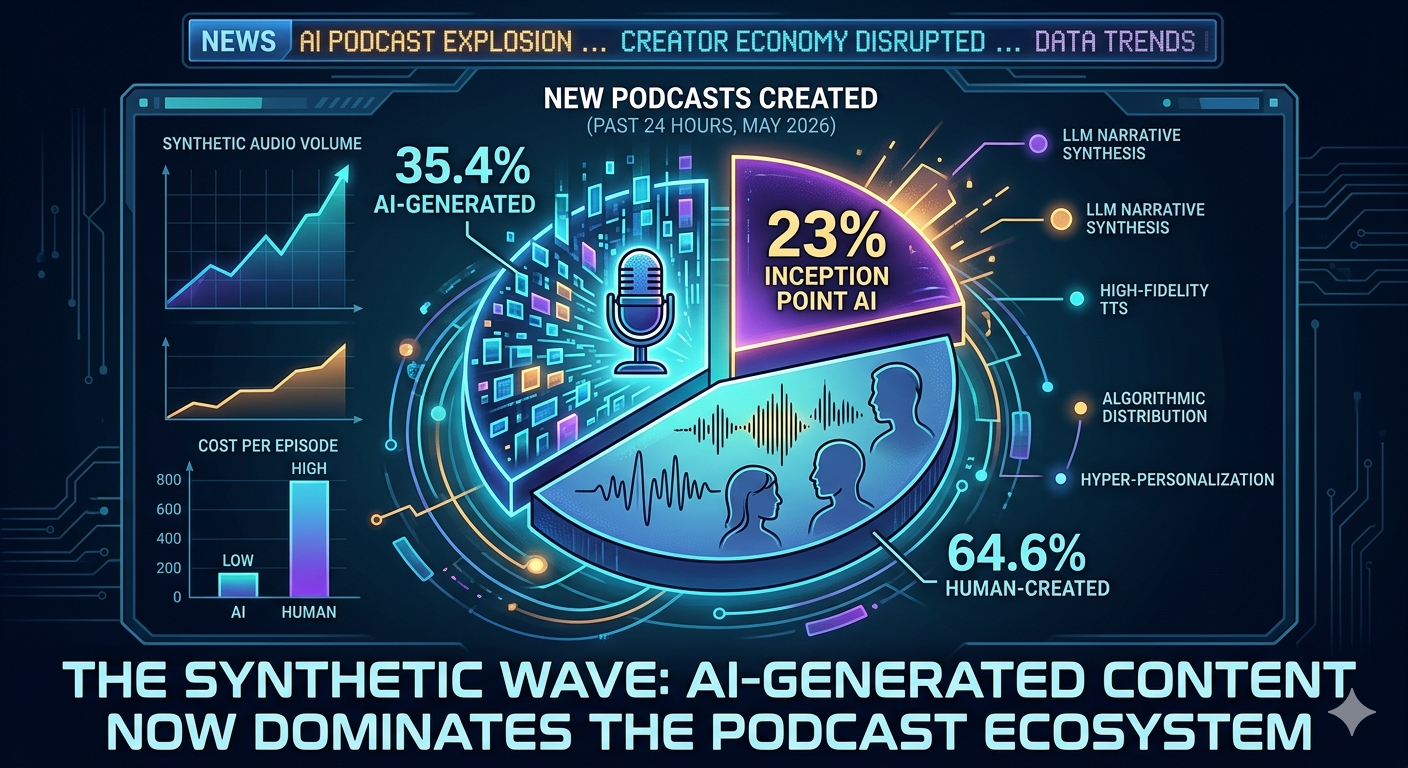
The barrier between human-created media and machine-generated content has effectively collapsed. According to the latest data from the Podcast Index as of May 3, 2026, a staggering 35.4% of all new podcasts created in the past 24 hours are entirely AI-generated. This seismic shift marks a departure from the experimental phase of generative audio into a full-scale industrialization of synthetic media. The primary driver of this trend is a concentrated push by automated publishing entities, most notably Inception Point AI, which currently accounts for nearly a quarter of all new synthetic podcast output. This phenomenon is not merely an anomaly of low-effort spam; it reflects a broader integration of large language models (LLMs) with high-fidelity text-to-speech engines, creating automated channels that effectively target niche audiences, news aggregation, and long-form narrative content without the overhead of human recording or production. For the creator economy, this represents a fundamental disruption. Traditional podcasters now compete not just against other humans, but against infinite-scale, on-demand audio engines capable of hyper-personalization. For advertisers, the value proposition is shifting from audience trust in human hosts to the algorithmic predictability of AI-generated reach. However, the rapid proliferation of synthetic audio raises profound questions regarding digital authenticity, listener trust, and the future of platform governance. As the "AI-Internet" matures, the podcasting industry finds itself at a crossroads: adapt to the flood of synthetic media, or implement new verification standards that distinguish human craftsmanship from machine efficiency. This report analyzes the data, the economic drivers, and the long-term implications for a media landscape where the creator is increasingly an abstraction.
The Industrialization of Synthetic Audio
The podcasting industry, once heralded as the last bastion of intimate, host-driven media, is undergoing a profound transformation. As of early May 2026, the data provided by industry monitors paints a picture of a media landscape flooded by generative outputs. The critical statistic—that over one-third of new podcast feeds are AI-generated—is not just a milestone; it is a signal of the maturation of AI infrastructure.
For years, the generative AI movement was defined by text and image synthesis. Audio was the "final frontier" due to the high latency of high-quality synthesis and the difficulty of maintaining consistent persona and emotion. By mid-2026, those technical barriers have been systematically dismantled. We are no longer seeing clumsy, robotic monotone feeds. We are seeing sophisticated, multi-host, conversational, and narratively complex audio productions that are indistinguishable from human podcasts to the average listener.
The Dynamics of Scale: The "Inception Point" Phenomenon
The concentration of this output is telling. When a single entity—Inception Point AI—is responsible for over 23% of the total new AI-generated podcast volume, it confirms that we are dealing with a shift from decentralized amateur creation to centralized industrial production. This is the "Factory Model" applied to audio.
Companies like Inception Point AI utilize integrated pipelines:
- News and Data Scraping: Real-time aggregation of trending topics, financial data, or specialized niche information.
- LLM Narrative Synthesis: Sophisticated prompting that turns raw text into a conversational script, complete with banter, interruptions, and stylistic nuances.
- Voice-Print Synthesis: Using high-fidelity, licensed, or synthetic voice models that maintain consistent personas across episodes.
- Algorithmic Distribution: Automated RSS feed generation and submission to podcast directories, optimized for SEO and algorithmic discovery.
This pipeline allows a single studio to "publish" hundreds of shows daily. Each show can be micro-targeted to specific demographics—a "tech news" podcast for senior software engineers, a "history" podcast for students, or a "true crime" narrative for commuters. The cost-to-output ratio is negligible compared to the human equivalent, allowing these entities to saturate the search results of major podcast directories.
The Economic Shift: From Influence to Throughput
The traditional podcasting business model was predicated on "influence"—the trust built between a human host and the listener, which advertisers bought access to. The synthetic podcast model operates on "throughput"—the sheer volume of content and the precision of audience targeting.
This creates a dual-track media economy:
- The Trust Economy (Human-Centric): Remains valuable for high-stakes interviews, comedy, and personality-driven content. The scarcity of human time keeps these podcasts at a premium.
- The Attention Economy (AI-Centric): Dominates search, utility, and information-dense media. Advertisers are increasingly drawn to this model because AI-generated shows can be dynamically updated with real-time ads that shift to match the listener’s immediate intent, a level of granularity human shows cannot easily match.
The danger here is "audience dilution." As synthetic content consumes more of the available listener time, the discoverability of human-made shows declines, not because they are lower quality, but because they are "slower" to produce and lack the constant algorithmic refreshing that characterizes synthetic feeds.
The Authenticity Crisis and Platform Governance
The proliferation of synthetic media forces a critical question: what constitutes a "creator"? If an AI publishes a podcast, it has no lived experience, no ethics, and no responsibility. It is a mirror reflecting the data it was trained on.
Platform regulators, including Apple, Spotify, and the Podcast Index, are currently struggling with the "verification paradox." If they clamp down on AI-generated content, they risk alienating a new generation of creators who use these tools to augment their capabilities. If they allow it to flourish, they risk turning their platforms into a "synthetic noise" environment where users struggle to find authentic voices.
We are already seeing early moves toward:
- Metadata Labeling: Mandatory "AI-Generated" tags in RSS feeds.
- Trust Scoring: Platforms may begin to rank content based on a "humanity score," prioritizing creators with verified histories.
- Feed Quality Filtering: Aggressive pruning of feeds that exhibit high-frequency, low-variance patterns—the hallmark of automated synthesis.
The Future of the Creator
The rise of the "Synthetic Creator" does not necessarily spell the end for human podcasters. In fact, it forces human creators to double down on what machines cannot do: vulnerability, true spontaneity, and non-linear thinking. AI thrives on patterns. It mimics existing knowledge. It struggles with truly new, chaotic, or counter-intuitive human insights. The human creator who survives this transition will be the one who leverages AI to handle the rote production tasks (research, editing, sound engineering) while focusing their energy on the unique, messy, and deeply personal aspects of content creation.
The next six months will be pivotal. We expect to see a market correction where "AI fatigue" sets in among listeners, creating a surge in demand for, and a premium pricing model for, verified human-created content. Simultaneously, we will see the rise of "Hybrid Creators"—professionals who utilize synthetic tools to mass-produce evergreen content, while keeping a core, human-centric show as their brand anchor.
Strategic Conclusion for Stakeholders
For the industry, the takeaway is clear: the floor for entry has disappeared. Creating a podcast is no longer an act of technical production; it is an act of curating algorithms.
- For Creators: If you are not already utilizing AI tools for your workflow, you are at a massive competitive disadvantage regarding speed and scale. Learn to be a "Director" rather than just a "Host."
- For Advertisers: The metrics of success are changing. "Listen time" in an AI world is cheap; "Engagement intensity" is the new gold. Focus on shows that have high listener retention, regardless of whether the voice is human or synthetic.
- For Listeners: We are entering an era of "media provenance." Just as we verify food labels for ingredients, listeners will soon need to check the "provenance" of their audio feeds. If the content is synthetic, be aware that it is designed to optimize for engagement, not necessarily for truth.
The AI-generated podcast wave is not a passing trend; it is the infrastructure of the next decade of media. We are shifting from a world of content creation to a world of content orchestration. Those who master the orchestration will define the soundscape of 2026 and beyond.
1
0
0
0

Kommentarer