
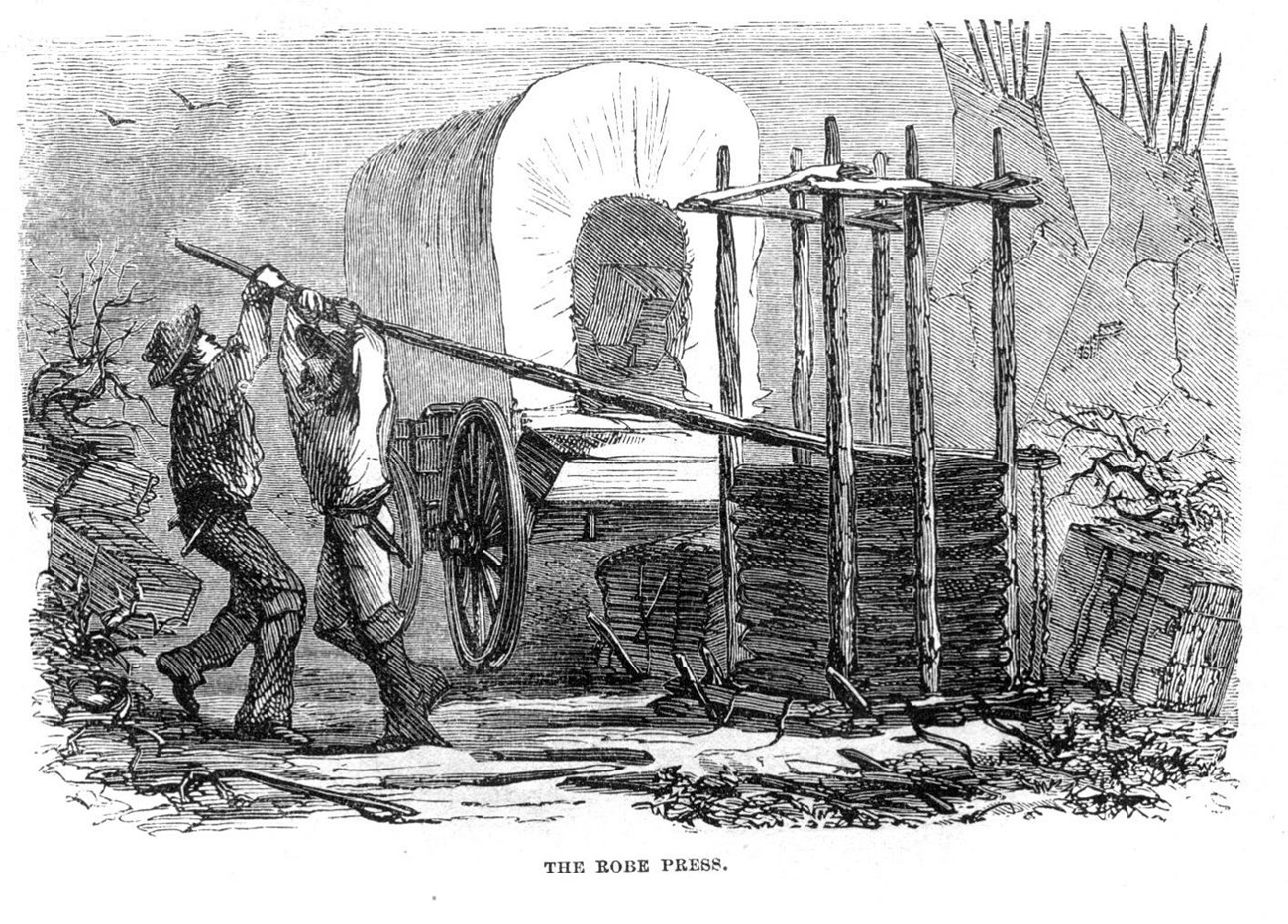
A fur press at a trading camp, after a sketch by Theodore Davis. Harper's New Monthly Magazine, January 1869.
Bison robes bought by traders traveled east in compressed, bound bales called "packs." One contemporary wrote that a "pack of robes generally embraces ten skins, and weighs about eighty pounds" — though packs might hold as many as twelve robes, and packs of smaller calf robes up to twenty.
Pressing and marking
- Packs were made with a press. In Native camps, a simple one could be built from saplings and a chain; a sturdier screw press stood in the plaza of Bent's Fort, its metal parts no doubt made back East.
- Some traders tied packs with rawhide, but rawhide drew worms that then attacked the robes. Hemp or manila cord solved the problem, and large coils of both appear on surviving Bent, St. Vrain & Co. invoices.
- Robes seem to have been folded hair-side in before pressing, and packs were marked on the outside to show ownership — invoices also list "marking brushes."
Sorting and grading
It's unclear how much sorting happened in the camps, but packs were surely opened at Bent's Fort and sorted by quality, size and quantity. The American Fur Company's 1830s letters show why: its St. Louis associates were told not to ship packs of all "seasonable" or all summer robes, since summer robes alone were hard to sell. Instead, each pack should hold eleven seasonable and one summer robe; calf packs, eighteen seasonable and two summer. Consistency was everything. As Ramsay Crooks warned in 1838: "If a Summer, and a very short-haired Robe, are found in a Pack of 11 & 1, suspicion attaches to the whole parcel, though that may be the only pack in a hundred containing a skin of doubtful character."
- Robes were graded first, second or third quality. William Boggs described superior "silk robes" — "very fine haired and shined like satin, of a slightly lighter color," worth double a common robe.
- "Soiled" robes lost value.
- A few came painted with Indian designs or decorated with porcupine quills, but they were a tiny share of the market. As Theodore Davis explained, decorating a robe took much time and raised its price, and was "generally only expended upon a robe that is to be used in the family, and not a means of obtaining sugar, coffee, calico, and other coveted articles."
The spring caravan
Every robe the firm collected over the winter — including those traded at Fort St. Vrain on the South Platte — came to Bent's Fort on the Arkansas, and in spring was loaded with other furs into freight wagons for the trip east. According to Thomas Farnham, one of the firm's partners led the caravan with fifteen to twenty employees and ten to fifteen wagons drawn by oxen and mules.
What a robe was worth
Robe prices rose and fell with supply and demand — and with the American Fur Company's efforts to control the eastern market.
| Source | Price quoted |
|---|---|
| Charles Augustus Murray, 1835 | Three and a half dollars at the Missouri agencies, five in St. Louis, six and a half to ten in Atlantic cities |
| Capt. Lemuel Ford, 1835 | $5–$6 in St. Louis for Bent, St. Vrain robes |
| American Fur Company, 1835–1839 | $4.00–$4.75 per robe on the East Coast for "11 & 1" packs; only "Extra Size" seasonable robes topped $5 |
| Pierre Chouteau Jr. & Co., 1842 | Credited Bent, St. Vrain $2.70 per regular robe and $1.25 per calf robe — $7,790.30 in all |
Murray's and Ford's figures look high, or reflect retail prices. Traders like Bent, St. Vrain & Co. had no eastern stores; they sold through larger firms that took a commission. The American Fur Company marketed the robes of Pratte, Chouteau & Co., by far the biggest U.S. supplier in the 1830s. From 1839, Bent, St. Vrain & Co. sold through Pratte, Chouteau & Co. and its successor, Pierre Chouteau Jr. & Co.; earlier it apparently used their rivals, Powell, Lamont & Co.
Profits — and costs
Ford grumbled that the firm got each robe "for about 25 cents worth of goods," and William Gordon admitted that, counting only goods against robes, traders often made 200 to 2,000 percent. But Gordon argued real profits fell far short because of "heavy expenses," which he called "immense, and far beyond those of any other business that American citizens are engaged in."
Bent, St. Vrain & Co. had plenty:
- a payroll of up to sixty men — traders, clerks, hunters, cooks, teamsters, craftsmen, herders and adobe plasterers, some doing several jobs;
- wagons and livestock for the trip east;
- steamboat freight to St. Louis, and likely insurance;
- losses from worm damage on the way.
The firm's account books are lost, so its yearly returns can't be known precisely. But Alexander Barclay, the fort's storekeeper and bookkeeper from 1838 to 1842, wrote in 1840 that his employers "made an annual return of from twenty to forty thousand dollars in peltries collected from the Indians, chiefly buffaloe robes." Such returns must have been worthwhile — the partners were sharp businessmen who stayed in the trade.
Sources
Based on "Packing Bison Hides for Trade," part of the series The Business of Bison, Bent's Old Fort National Historic Site, National Park Service, adapted from Mark L. Gardner's 2004 Historic Resource Study Bent's Old Fort on the Arkansas; a work of the United States government in the public domain.
收录于这些合集Bent's Old Fort National Historic SiteSanta Fe National Historic TrailThe Business of Bison
许可协议: CC0 1.0(公有领域) · 改编自 www.nps.gov
1
0
0
0

留言


