
The grounds of the Desert Research Learning Center (DRLC), the Tucson base of the National Park Service's Sonoran Desert Network, are a working demonstration of how to live in a desert without wrecking it. The water used on the grounds is harvested from the roof, with city water only as a backup. There is a tortoise, a pupfish that survives water twice as salty as the sea, an orchard descended from mission trees, and a garden watered by buried clay pots. The walk has fourteen stops, starting at the tortoise enclosure by the main entrance and circling west and north around the building. Each comes with something you could do at home.

Boss Pinkley. Please don't feed or approach any animal at the centre.
| Stop | What's there | The idea |
|---|---|---|
| 1 | Desert tortoise habitat | a candidate for the endangered list |
| 2 | Pollinator garden | 17 desert plants for bees, butterflies, birds and bats |
| 3 | Bee boxes | the Tucson area has one of the most diverse bee faunas on Earth |
| 4 | Rain tank | 1,400 gallons from the roof |
| 5 | Heritage orchard | fruit trees descended from the missions' |
| 6 | Water features | a closed system fed by rain |
| 7 | Tinaja | a desert rock pool, fenced against bullfrogs |
| 8 | Tinaja residents | lowland leopard frog, Rio Sonoyta pupfish |
| 9 | Sustainable foods garden | drip lines and olla pots |
| 10 | Stream | habitat for fish that need flowing water |
| 11 | Cistern | 6,500 gallons, again from the roof |
| 12 | Catchment basins | berms and mulch to soak rain into the ground |
| 13 | Stream residents | speckled dace, desert sucker |
| 14 | Ramada | shade built the O'odham way |
Animals
The tortoise (stop 1). Boss Pinkley is a Sonoran desert tortoise (Gopherus morafkai) that came through the Desert Tortoise Adoption Program, which rehomes captive tortoises with qualified custodians — a captive tortoise can never be returned to the wild. You'll be lucky to see him: these tortoises spend up to 98% of their lives underground, sheltering from ground temperatures that can pass 140°F. His enclosure has two burrows of soil under concrete caps — a winter one in the sun against the warm building, and a summer one under a tree beside a cool wall.
In the wild they live 50–80 years on rocky hillsides and alluvial fans, rarely wandering more than a few miles from where they hatched unless looking for a mate. They have no teeth and push food back with a large tongue, eat grasses and native flowers, and can sense rain coming — they wait in low spots for the water. They are threatened by lost habitat, invasive plants, poaching, released pets, disease and climate change: drought means less food and fewer eggs, and hot soil produces more females, which could shrink future generations.
He is named for Frank Pinkley, first custodian of Casa Grande Ruins from 1901 and, from 1924, superintendent of the Southwestern National Monuments — 14 at first, eventually 27 units in four states covering 1,143.35 square miles. He was known, affectionately, as "The Boss."
Tortoise or turtle? Tortoises live only on land, have column-like hind legs and no flippers, and mostly eat plants. Turtles spend time in water and tend to eat plants and animals.
The tinaja and stream (stops 8 and 13).
| Species | Size | Where it lives | Status |
|---|---|---|---|
| Lowland leopard frog (Rana yavapaiensis) | 1.8–3.4 in | permanent canyon pools and streams; breeds all year, tadpoles take a year or more to mature | species of concern; illegal to collect in Arizona without a permit |
| Rio Sonoyta pupfish (Cyprinodon eremus) | 1.5–2 in | once from northern Mexico to the lower Colorado; now wild only in Rio Sonoyta (Sonora) and Quitobaquito Springs (Organ Pipe Cactus NM). Tolerates 113°F, little oxygen and water twice as salty as the sea; males turn bright blue when courting | endangered |
| Speckled dace (Rhinichthys osculus) | up to 3 in | shallow, smaller rivers; chubby and speckled in the southern Gila system, larger and sleeker north of the Mogollon Rim | least concern |
| Desert sucker (Catostomus clarki) | about 13 in | Bill Williams, Gila, Salt and Verde rivers; scrapes algae off the bottom with a ridge of cartilage under its lip | least concern |
The frog is an indicator of a healthy desert water, so protecting it protects everything else that drinks there. The pupfish here came from Rio Sonoyta; the Park Service has a four-minute video about it.
Pollinators
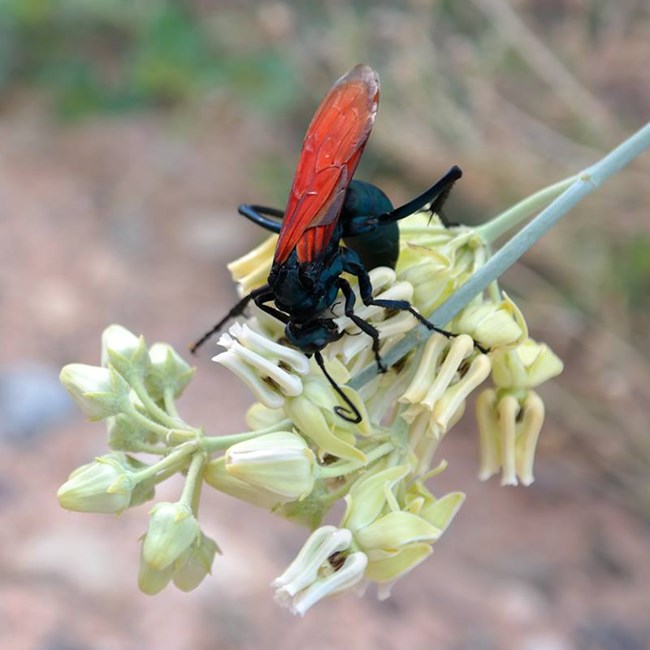
The garden (stop 2). Pollinators keep more than 75% of the world's flowering plants going — more than 1,200 food crops and 180,000 other species — and one bite in three of what you eat depends on them. They are declining as habitat is broken into pieces too small to support them, native flowers lose ground to non-native ones, and pesticides spread. The garden here grows brittlebush, candy barrel cactus, chuparosa, desert lavender, desert marigold, desert willow, fairy duster, fleabane, Graham's nipple cactus, mesquite mistletoe, ocotillo, teddy bear cholla, trailing dalea, whitestem milkweed, butterfly bush, yellow bells and yellow palo verde.
The bee boxes (stop 3). About 1,000 of the world's estimated 20,000 bee species live in the Sonoran Desert, from Perdita minima, under 2 mm long, to carpenter bees of 40 mm. Around Tucson there are at least 45 genera in 7 families. Most nest in burrows, hollow stems or old beetle tunnels and produce one generation a year. A bee foraging will rarely sting unless it is swatted, stepped on or alarmed.

Bee, yellowjacket, wasp. USGS / J. Giersch
Tell them apart: bees are plump and furry and tuck their legs up in flight; yellowjackets, hornets and wasps are smooth and slimmer, with two long legs dangling. Bees are mostly mild; the others, and Africanized bees, are not.
Water
Rain tank (stop 4). A 1,400-gallon tank fills from the roof gutters in even a light shower; the first 30 gallons are diverted to keep dust out, and the overflow runs into the planted basins. In Arizona, with about 13 inches of rain a year, a 2,500-square-foot roof can collect about 20,000 gallons a year. Every gallon saved is one less pumped from the ground, and over-pumping dries up wells, springs and wetlands and makes the ground sink.
Water features and tinaja (stops 6 and 7). The tinaja and stream raise sensitive and threatened species, some of which go on to parks and other protected land, and are where professional and volunteer scientists learn to monitor water. Each is a closed loop: a float valve tops it up from the rain cistern as water evaporates, switching to city water only if the cistern runs dry.
A tinaja ("little jar") is a pool scoured into bedrock by water, sand and gravel — a vital water source in the dry season, used by people from the ancient Hohokam and today's Tohono O'odham to Spanish, Mexican and American ranchers. They are threatened by sprawl, falling water tables, buffelgrass-fuelled fires and a changing climate. This one is rubber-lined recycled concrete, plastered, carved and painted to match the local rock, and took more than 1,000 volunteer hours. Its tall fence keeps out American bullfrogs, eastern natives that have spread across the Southwest, eaten native frogs and garter snakes to local extinction and spread chytrid fungus. Close the gate behind you.

Stream (stop 10). Flowing water is cooler, clearer and richer in oxygen than a pond, and some fish feed facing upstream. In the desert, streams matter far beyond their size: habitat, flood control, drinking water, filtering. This one is rubber-lined, pumped and recirculated; its deepest parts, six feet down, are filled with rock-covered crates that give fish cover and meet safety rules.
Cistern (stop 11). A galvanized steel tank with a polyethylene liner holds 6,500 gallons, feeding the water features and drip irrigation for the landscape, garden and orchard. Since 1980 drought has cost the U.S. economy about $226 billion — among weather and climate disasters, only hurricanes cost more. Future rainfall is uncertain; hotter temperatures, which raise both demand and evaporation, are not, and Tucson is already seeing heat beyond its natural range.
Basins (stop 12). The simplest harvest needs no tank: berms along the contour and a basin around each plant slow the water so it soaks in rather than running off, recharging the ground and stopping erosion. Mulch — leaves, bark, compost or gravel — holds water like a sponge; organic mulch also feeds the plants as it rots, so it needs topping up.

Food and shade
Heritage orchard (stop 5). Catholic missionaries brought fruit trees to the Sonoran Desert in the late 1600s and early 1700s; Mission San José de Tumacácori, about 60 miles south, grew peach, quince, pear, apple, pecan, walnut, fig and pomegranate. These trees come from a project to trace and replant the mission stocks, run with the Arizona-Sonora Desert Museum and Desert Survivors, and local nurseries sell them. They mark a turning point in Arizona's history — and a living reminder that colonialism is still written on the land.
Sustainable foods garden (stop 9). Seeds come from Native Seeds/SEARCH, a Tucson seed bank holding crops from more than 50 Indigenous communities and later arrivals; staff save seed from every crop and give some to visitors who ask. Drip lines water the roots directly, and buried ollas — unglazed clay pots — release water only as the drying soil and thirsty roots draw it out. Summer (late April to August) brings melons, squash, corn, beans and chiles; the ancient Sonoran practice of growing corn, beans and squash together still makes sense, since the corn holds up the beans, the squash leaves shade the soil and the beans fertilise it. In the cooler season Old World greens and wheat — Swiss chard, mustard, dill, broccoli — have fed the centre's staff and partners.

Ramada (stop 14). The picnic tables are shaded by an ocotillo-roofed ramada modelled on the O'odham wa:ato. In summer, when adobe and pit houses were too hot inside, families cooked and slept under a wa:ato outside the ki, the house, and moved back in for winter. This one departs from tradition to last longer: tamarisk legs instead of mesquite, set in concrete with rebar.

NPS / E. Schnaubelt
Try it at home
- Leave wild tortoises wild and never release a captive one — it's illegal in Arizona, and released pets spread disease. Don't breed them. Help one across a road only if it's safe, lifted just off the ground, in the direction it was going.
- Pull weeds that harm tortoises: split grass, Russian thistle, red brome and cheatgrass.
- Plant natives that flower at different times and in different shapes, in clumps; leave a shallow dish of water with stones to perch on; provide nesting spots. The North American Pollinator Protection Campaign has free planting guides by zip code.
- Go easy on pesticides: not on open flowers, and at night if at all.
- Harvest rain. A system is a roof, gutters and a tank. Tucson offers rebates and a grant and loan programme, and Arizona a tax credit of up to $1,000.
- Dig basins around your plants and mulch them.
- Water early or late, fix leaks, fit efficient fixtures.
- Never release pet frogs or buy bullfrogs at any stage.
Sources
Written from "Self-Guided Tour of the Desert Research Learning Center", National Park Service Sonoran Desert Network Inventory and Monitoring program, a work of the United States government in the public domain. The water-policy point about groundwater pumping is Robert Glennon's, as quoted there.
许可协议: CC0 1.0(公有领域) · 改编自 www.nps.gov
1
0
0
0

留言


