Acute Flaccid Myelitis (AFM)
Recognize symptoms. Hospitalize immediately.
Most patients first sought care at an emergency department.
Most patients with AFM were hospitalized.
Over half were admitted to the ICU. 1 in 4 hospitalized patients required a ventilator.
Overview
Acute flaccid myelitis (AFM) is an uncommon, but life-threatening neurologic condition that affects mostly children and can lead to permanent paralysis. Enteroviruses, particularly EV-D68, are likely responsible for the increase in cases every two years since 2014. AFM is a medical emergency and patients must be hospitalized and monitored in case they progress to respiratory failure. Prompt recognition and immediate action by pediatricians, and emergency department and urgent care providers are critical to achieving the best possible outcomes.
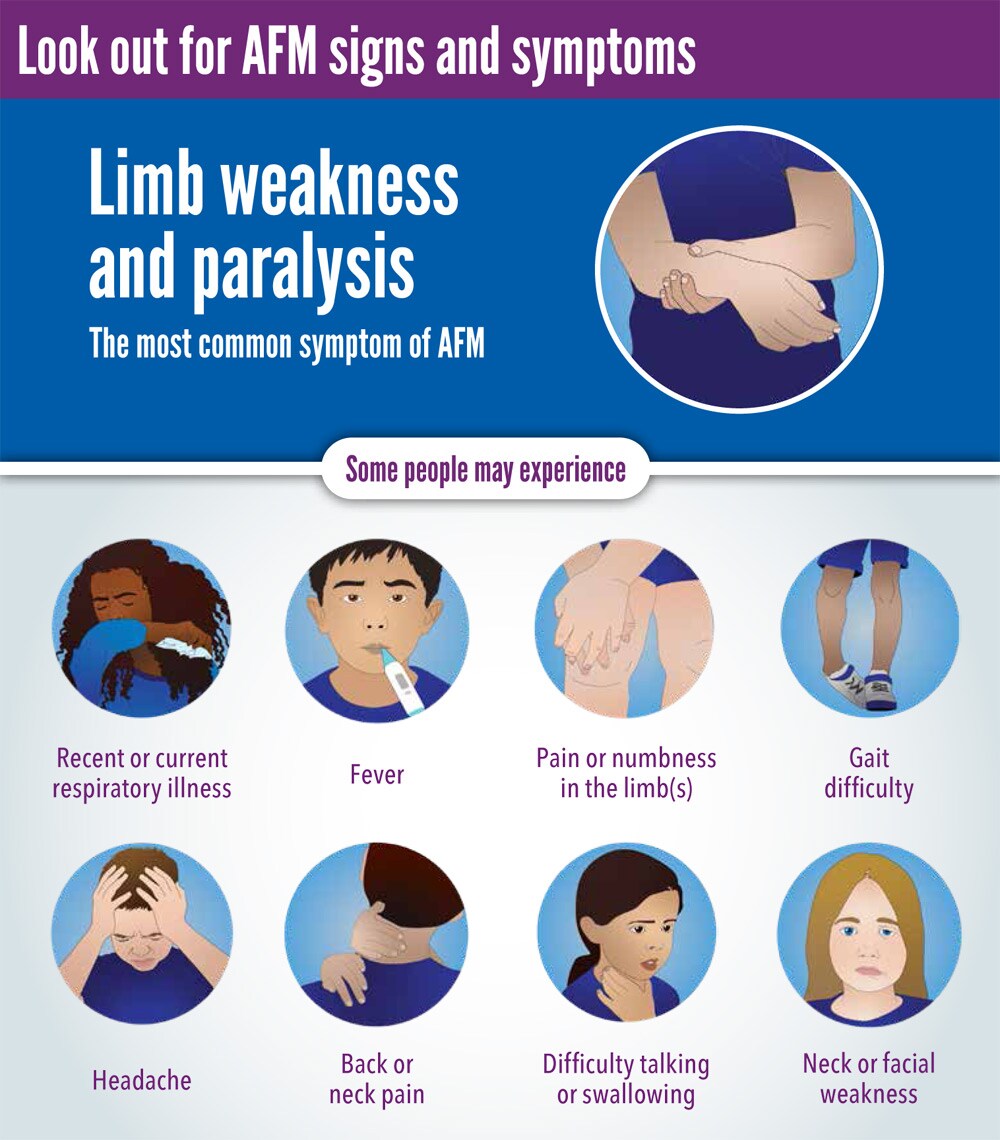
- AFM typically presents with sudden limb weakness. Most patients had respiratory illness or fever before AFM onset.
- Patient health can decline quickly, resulting in paralysis or the need for a ventilator. AFM can lead to permanent disability.
- Patients who tested positive for EV-D68 typically had more severe AFM illness, requiring hospitalized intensive care and ventilation.
- Most cases occur between August and November.
Close
Download Image[JPG]
SOURCE: MMWR, August 2020.
Problem
Delays in recognition can put patients at risk
A third of patients were hospitalized two or more days after limb weakness.
When clinicians recognize AFM early, they can quickly
- Hospitalize patients and provide optimal medical management and rehabilitation.
- Collect clinical specimens and order a brain and spinal cord MRI. Done early, these help detect the cause and distinguish AFM from other conditions with limb weakness.
The Way Forward
Healthcare Providers Can:
- Suspect AFM in patients with sudden limb weakness, especially between August and November.
- Collect clinical specimens immediately and report cases to the state health department.
- Request specialty consultations such as infectious disease and neurology.
Health Departments Can:
- Communicate information about AFM to healthcare providers.
- Work with CDC to collect medical information, specimens, MRI images, and classify cases.
Parents Can:
- Seek medical care immediately if a child develops sudden arm or leg weakness.
- Seek support from other parents and families affected by AFM.
- Visit CDC’s AFM parent webpage
Contact AFM Specialists through the AFM Physician Consult and Support Portal
Evaluation checklist for possible AFM
Age-appropriate neurological exam
- Muscle strength in all four limbs (What is their strength? Can they move the limb against gravity with resistance?)
- Muscle tone (Is it loose/floppy?)
- Reflexes (Are they hypo-, hyper-, or absent?)
- Cranial nerve assessment (Are there any cranial nerve deficits?)
Issue Details
Related Pages and Resources
- Vital Signs: Press Release – Los CDC prevén brote de la potencialmente mortal mielitis flácida aguda en el 2020 [Spanish]
- Vital Signs: Clinical Characteristics of Patients with Confirmed Acute Flaccid Myelitis, United States, 2018 — United States, Morbidity and Mortality Weekly Report (MMWR)
- AFM Cases and Outbreaks
- For Clinicians and Health Departments
- Specimen Collection Instructions
- Interim Considerations for Clinical Management
- Job Aid on how to send information to the health department about a patient under investigation (PUI) for AFM [444 KB, 2 pages]
- For Parents of Children with AFM
- Public Health Grand Rounds: Acute Flaccid Myelitis
Other Sites
- Siegal Rare Neuroimmune Association AFM Physician Consult and Support Portal
- Siegal Rare Neuroimmune Association Patient Resources
- AFM Association
- AFM, American Academy of Pediatrics
Science Behind the Issue
For More Information
1-800-CDC-INFO (232-4636)
TTY: 1-888-232-6348
Web: www.cdc.gov
Centers for Disease Control and Prevention
1600 Clifton Road NE
Atlanta, GA 30333
Publication date: August 4, 2020
Content provided and maintained by the US Centers for Disease Control and Prevention (CDC). Please see our system usage guidelines and disclaimer.
Where this page came from
This page was imported from Centers for Disease Control and Prevention. Material produced by the Centers for Disease Control and Prevention is a work of the United States government and is in the public domain.
Nobody has written it yet — it is the source material at a new address, which is why search engines are asked to skip it and why no one earns from it. It is up for grabs: take it on, and it is yours to rewrite and to earn from.
许可协议: CC0 1.0(公有领域) · 改编自 www.cdc.gov
1
0
0
0

留言