
Some 5,000 light years (2,900 trillion miles) from Earth, in the constellation Puppis, is the 1.4 light years (more than 8 trillion miles) long Calabash Nebula, referred to as the Rotten Egg Nebula because of its sulfur content which would produce an awful odor if one could smell in space. This image of the nebula captured by NASA's Hubble Space Telescope (HST) depicts violent gas collisions that produced supersonic shock fronts in a dying star. Stars, like our sun, will eventually die and expel most of their material outward into shells of gas and dust These shells eventually form some of the most beautiful objects in the universe, called planetary nebulae. The yellow in the image depicts the material ejected from the central star zooming away at speeds up to one and a half million kilometers per hour (one million miles per hour).
Due to the high speeds of the gas, shock-fronts are formed on impact and heat the surrounding gas. Although computer calculations have predicted the existence and structure of such shocks for some time, previous observations have not been able to prove the theory.
Where this page came from
This page was imported from NASA. NASA material is generally not copyrighted and is in the public domain.
Nobody has written it yet — it is the source material at a new address, which is why search engines are asked to skip it and why no one earns from it. It is up for grabs: take it on, and it is yours to rewrite and to earn from.
许可协议: CC0 1.0(公有领域) · 改编自 images.nasa.gov
1
0
0
0

留言
接着读
- Planetary NebulaThe Ring Nebula's distinctive shape makes it a popular illustration for astronomy books. But new observations by NASA's Hubble Space Telescope of the glowing gas shroud around an old, dying, sun-like star reveal a new twist. "The nebula is not like a bagel, but rather, it's like a jelly doughnut, be

- Doradus NebulaA panoramic view of a vast, sculpted area of gas and dust where thousands of stars are being born has been captured by NASA's Hubble Space Telescope. The image, taken by Hubble's Wide Field and Planetary Camera 2, is online at The camera was designed and built by NASA's Jet Propulsion Laboratory, Pa
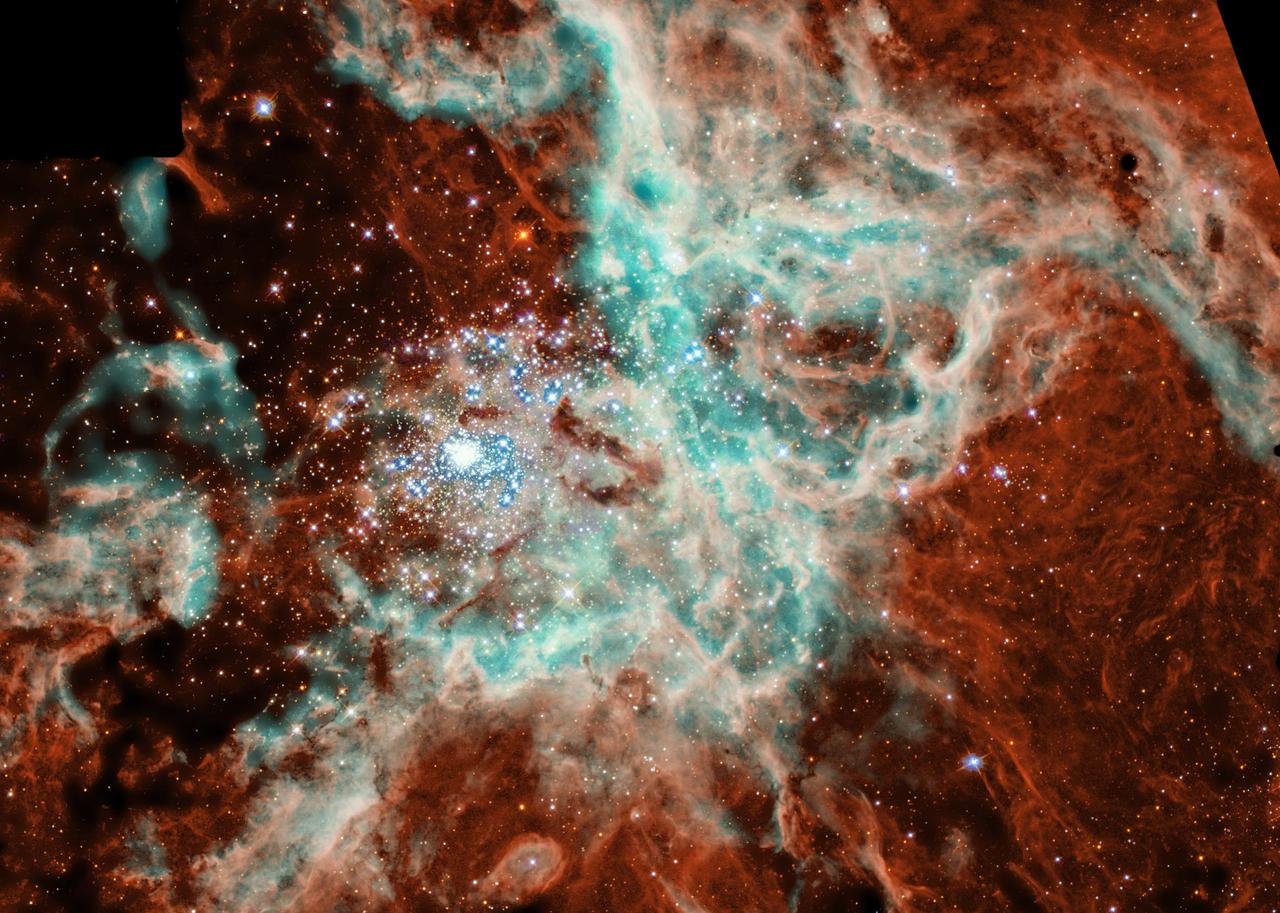
- The Tarantula NebulaNASA Spitzer Space Telescope, formerly known as the Space Infrared Telescope Facility, has captured in stunning detail the spidery filaments and newborn stars of theTarantula Nebula, a rich star-forming region also known as 30 Doradus. This cloud of glowing dust and gas is located in the Large Magel


