
Geologists tell time in more than one way. Some methods establish the order in which things happened; others pin events to a particular time in the past. Rock units and geologic events are described both with names and with numeric ages, and understanding both is key to understanding the ages of Grand Canyon's rocks. This page draws on the National Park Service report Telling Time at Grand Canyon: 2020 Update.
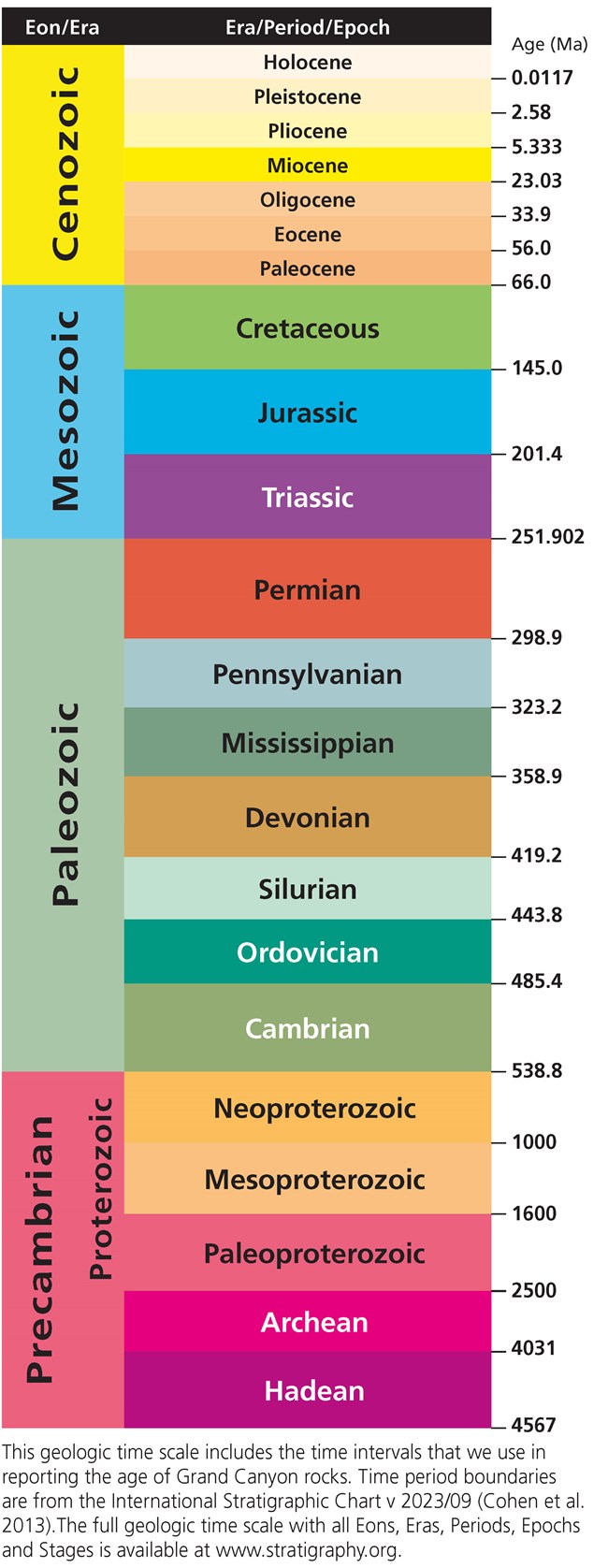
The geologic timescale, divided into eons, eras, periods and epochs, largely by changes in life. Boundaries follow the International Stratigraphic Chart, v2020/01. From the NPS report.
The geologic timescale
Historians use names like the Stone Age or the Renaissance, which most people can place without dates. Geologists have their own names — Paleoproterozoic, Mississippian, Pliocene — but few people could put those in order.
The timescale was built in the 1800s, before the discovery of radioactive decay, which now supplies the clock for many dating methods. So it rested entirely on relative dating and stratigraphic principles: superposition, lateral continuity, and faunal succession, the change in fossil assemblages over time. Index fossils — fossils or assemblages characteristic of a particular time — and biozones, rock units defined by their fossils, help set the relative ages of fossil-bearing rocks. Most of Grand Canyon's Paleozoic sedimentary rocks have a rich fossil record that helps date them. The timescale is refined regularly; the report uses the International Stratigraphic Chart, version 2020/01.
The main divisions follow major events in the history of life and the planet:
| Division | Meaning of the name |
|---|---|
| Hadean Eon | the underworld |
| Archean Eon | beginning life |
| Proterozoic Eon | earlier life |
| Paleozoic Era | old life |
| Mesozoic Era | middle life |
| Cenozoic Era | recent life |
Grand Canyon holds important records from the Proterozoic and the Paleozoic.
Relative and numeric dating
- Relative dating puts events in order — layers deposited bottom to top, then a young canyon cut through them — but cannot say how long ago they happened.
- Numeric dating says when, in years. Geologists prefer "numeric" to "absolute" because the ages keep being refined as methods improve. Radioactive elements each decay at a characteristic rate, or half-life; different ones suit different time spans and can cross-check each other. Methods are named for the radioactive parent and stable daughter — uranium-lead (U-Pb), potassium-argon (K-Ar), rubidium-strontium (Rb-Sr), rhenium-osmium (Re-Os) — and all have been used on Grand Canyon rocks.
Dating different kinds of rock
Igneous rocks are dated to when their minerals crystallized from magma, essentially when the rock formed. Metamorphic rocks usually date to when minerals grew during metamorphism or when the rock cooled afterward.
Sedimentary rocks are harder, because most of their grains formed long before the sediment was laid down. Several situations help:
- Volcanic ash layers. Ash from a distant eruption, deposited with the sediment, contains datable igneous minerals. A 1-cm ash bed high in the Chuar Group gives a date of 729 ± 0.9 million years. If ash was reworked by rivers or the sea before settling, its age is a maximum for the surrounding rock, since the ash fell first.
- Cross-cutting intrusions. An igneous dike that cuts through a sedimentary layer is younger than it, so its age is a minimum for the layer. A black dike cutting the reddish Hakatai Shale is dated to 1,104 ± 2 million years.
- Detrital zircons. Zircon crystals eroded from igneous rocks and deposited in sediment help constrain a sedimentary rock's age by giving its maximum depositional age, bracketed by the youngest dated grains.
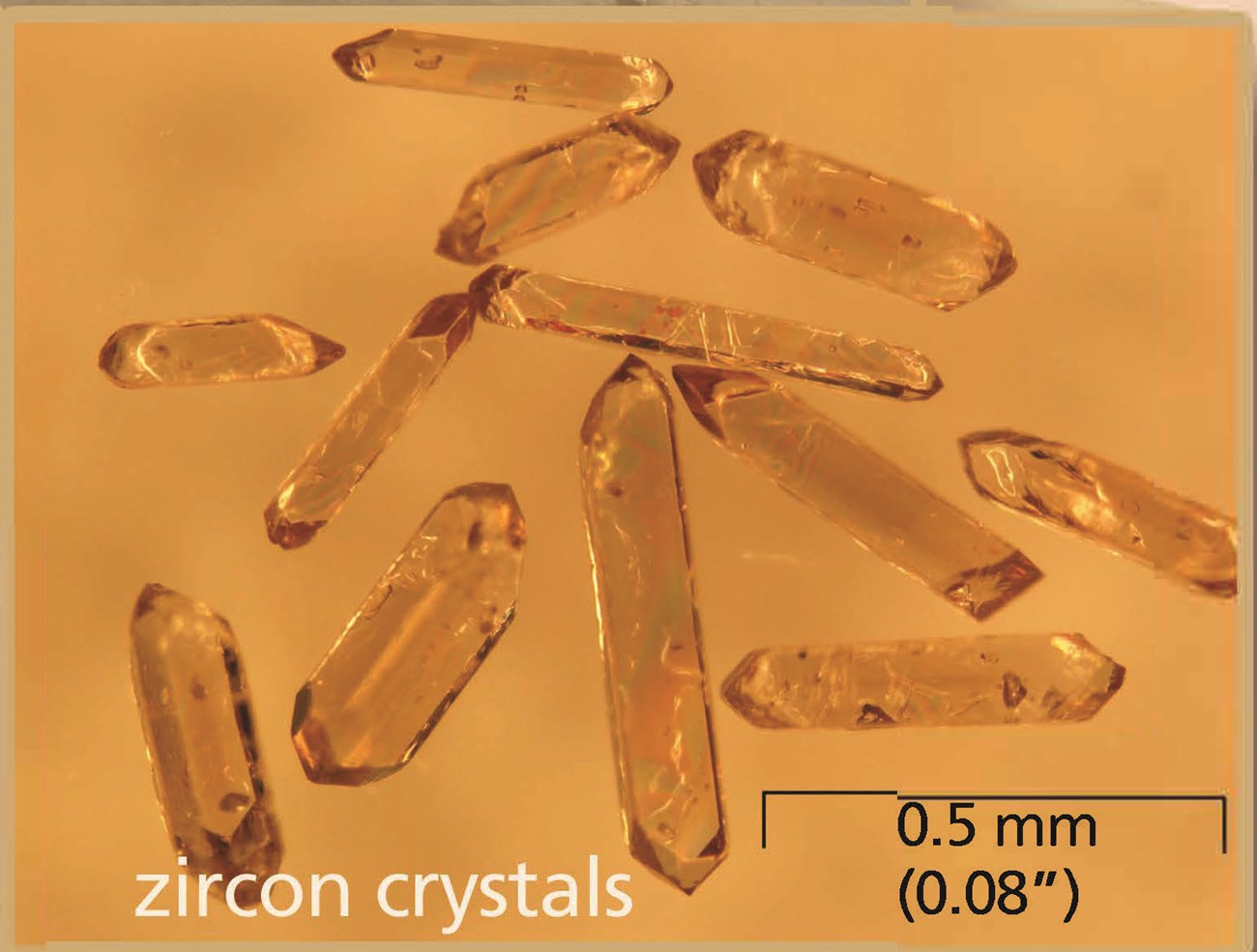
Detrital zircon grains; the youngest dated grains in a sediment bracket its age. Image from the National Park Service's page.
Precision and accuracy
Every measurement has an analytical error, reported as plus or minus. Precision reflects the limits of the laboratory equipment; accuracy, how close a date is to the true age, depends on geologic factors and on sound observation and interpretation. Geologists improve both by refining lab methods, accounting for geologic complications and using several methods where they can, so recent ages tend to be more precise and more accurate than older published ones. And each new date in a sequence brackets the ages of the units above and below it, so every new result cross-checks the others and sharpens the picture.
Sources
Rewritten from the National Park Service article "Geologic Timescale, Geologic Dating Techniques, and Numeric Ages," part of a series adapted from Karlstrom, K., L. Crossey, A. Mathis and C. Bowman, 2021, Telling Time at Grand Canyon National Park: 2020 Update, Natural Resource Report NPS/GRCA/NRR—2021/2246 (public domain), in hubnx's own words. Photographs credited only to a named photographer, and the report cover, are not reproduced.
收录于这些专栏Grand Canyon National ParkTelling Time at Grand Canyon National Park
许可协议: CC0 1.0(公有领域) · 改编自 www.nps.gov
1
0
0
0

留言


