此页面是公开的。
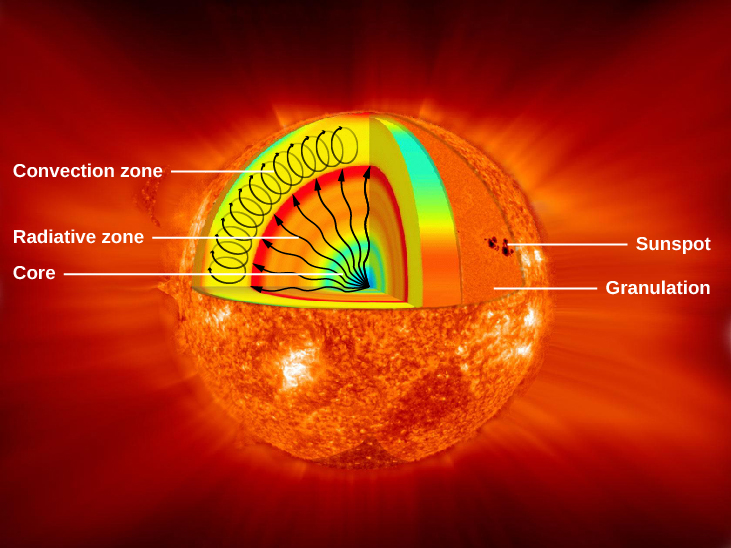
The Sun’s interior: fusion in the core, energy carried outward by radiation, then by convection near the surface. Illustration: OpenStax, modified from NASA/Goddard, CC BY 4.0.
Hydrogen fuses into helium at the centre of the Sun only if the temperature there is above 12 million K. How can we know it is that hot? No one can see inside the Sun, so astronomers build a computer model: a program holding everything they know about the physics of its interior, which calculates the temperature and pressure at every point — and how the Sun will change as its core slowly turns hydrogen into helium. Here is some of the physics that goes into it.
A ball of plasma
The Sun is so hot that all its material is plasma, an ionized gas. Plasma behaves much like a hot gas, which is easier to describe mathematically than a liquid or a solid. Its particles move fast and collide constantly, and that bombardment is the gas's pressure: more particles, or faster ones — that is, a higher temperature — mean more pressure.
Why the Sun does not collapse
Like most stars, the Sun is stable: it is neither expanding nor contracting. Gravity pulls all its parts toward the centre with tremendous force, yet the Sun has shone at about the same rate for billions of years. Something must push back, and that is the pressure of its gases. To hold the Sun up, the gas at its centre must be at about 15 million K.
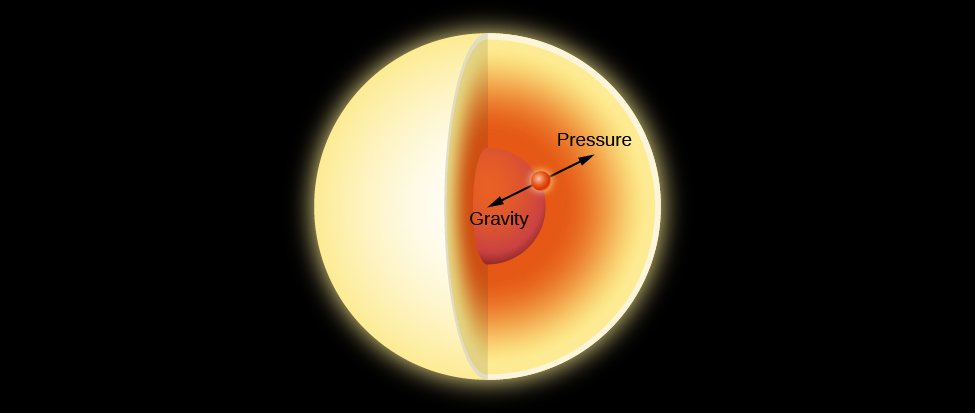
Hydrostatic equilibrium: at every point, the inward pull of gravity is balanced by the outward push of gas pressure. Illustration: OpenStax, CC BY 4.0.
The balance corrects itself. If the pressure were too weak to bear the weight of the layers above, the star would contract a little, raising its internal pressure; if too strong, it would expand, lowering it — like a balloon adjusting until the pressure inside matches the pressure outside.
Why it does not cool down
Heat always flows from hot to cold. Energy flows outward through a star, so the temperature must be highest at the centre and fall toward the surface. That outflow would cool the star unless the lost energy were replaced — just as an unplugged iron cools. The Sun's replacement is the continuing fusion of hydrogen into helium in its core.
How energy gets out
Energy can move in three ways: conduction, as particles pass energy to their neighbours by collision; convection, as warm material rises and carries its heat with it; and radiation, as photons travel from hot matter to cooler matter.
Inside the Sun, radiation is slow going. The gas is so opaque that a photon typically travels only about 0.01 metre before it is absorbed, and when it is re-emitted it can go off in any direction. The energy zigzags almost at random, and its journey from centre to surface probably takes between 100,000 and 1,000,000 years. Without that constant absorbing, it would take a little over 2 seconds — as it does for neutrinos, which pass straight through.
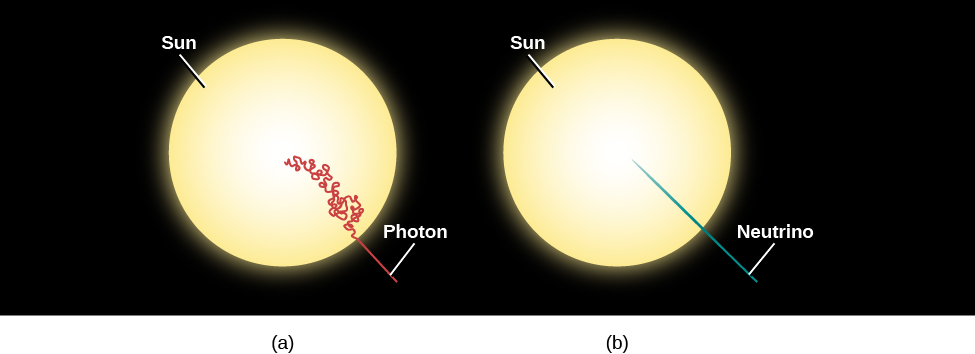
A photon’s random walk out of the Sun (a) against a neutrino’s straight path (b). Illustration: OpenStax, CC BY 4.0.
Convection is far more efficient: currents of hot gas rise while cooler gas sinks, carrying heat outward without moving any net mass, much as a fireplace stirs the air in a room.
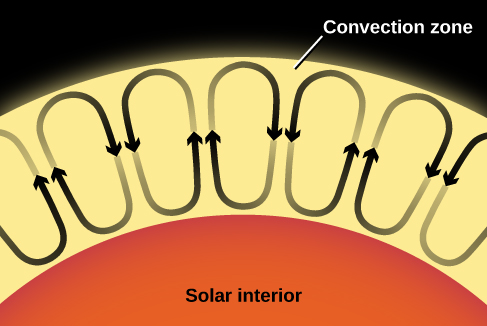
Convection cells carry heat up to the surface while cooler material sinks. Illustration: OpenStax, CC BY 4.0.
The model Sun
Put this physics into equations, solve them for temperature, pressure, density and opacity throughout the Sun, and you get a theoretical model of its interior. In it, energy is made in the core, which reaches only about a quarter of the way to the surface but holds about a third of the Sun's mass; at the centre the temperature is about 15 million K and the density nearly 150 times that of water. The energy travels outward by radiation until about 70 percent of the way to the surface, where convection takes over and carries it the rest of the way in rising columns of hot gas.
Sources
- Andrew Fraknoi, David Morrison and Sidney C. Wolff, Astronomy, section 16.3, "The Solar Interior: Theory", OpenStax (Rice University), licensed under CC BY 4.0. Changed: rewritten in hubnx's own words and shortened, the cooking feature left out; the illustrations and their credits are the book's. This page is shared under the same licence.
收录于这些专栏Astronomy (OpenStax)
许可协议: CC BY 4.0 · 改编自 openstax.org
留言