
During Ramadan 2024 (March 10 – April 8), 30 million pilgrims performed Umrah in Mecca, about 13.5 million of them from abroad. In the weeks after, cases of invasive meningococcal disease began turning up among returning travelers in three countries. Nine of the twelve patients were unvaccinated, and the vaccination status of the other three was unknown.
The disease
Invasive meningococcal disease, caused by the bacterium Neisseria meningitidis, usually takes the form of meningitis or septicemia and can be severe and life-threatening. Six serogroups — A, B, C, W, X and Y — cause most cases. It spreads from person to person through respiratory droplets and throat secretions, and people who carry it without symptoms can pass it on. Large gatherings can set off outbreaks, and vaccines prevent it.
| Signs of meningitis | Signs of meningococcemia (bloodstream infection) |
|---|---|
| Fever, headache, stiff neck, nausea, vomiting, sensitivity to light, confusion | Fever, chills, fatigue, vomiting, cold hands and feet, severe aches, fast breathing, diarrhea — and later a dark purple rash |
A long record, and a hard rule to enforce
Hajj and Umrah draw millions of travelers a year from more than 184 countries, and large meningococcal outbreaks linked to them were reported in 1987, 1992 and 2000–2001. Since 2002, Saudi Arabia has required every pilgrim aged 1 or older to show a quadrivalent (MenACWY) vaccine — polysaccharide within 3 years, or conjugate within 5 years — given at least 10 days before arrival. But Umrah can be made any time of year, many pilgrims don't travel on an Umrah visa, and one study put vaccination compliance for Umrah at 41%.
The 2024 cases
CDC heard of two U.S. cases on April 17; the United Kingdom and France reported more on April 23; and on April 24 CDC asked U.S. jurisdictions to report any Saudi Arabia–linked cases. By May 29:
| Cases | 12 — United States 5, France 4, United Kingdom 3 |
| Sex | 7 male, 5 female |
| Age | 0–12: 2 · 25–44: 4 · 45–64: 4 · 65+: 2 |
| Travel | The 10 adults had traveled; the 2 children were household contacts of an adult traveler who wasn't sick |
| Timing | Travel March–May 2024; illness began after returning home, in April and May |
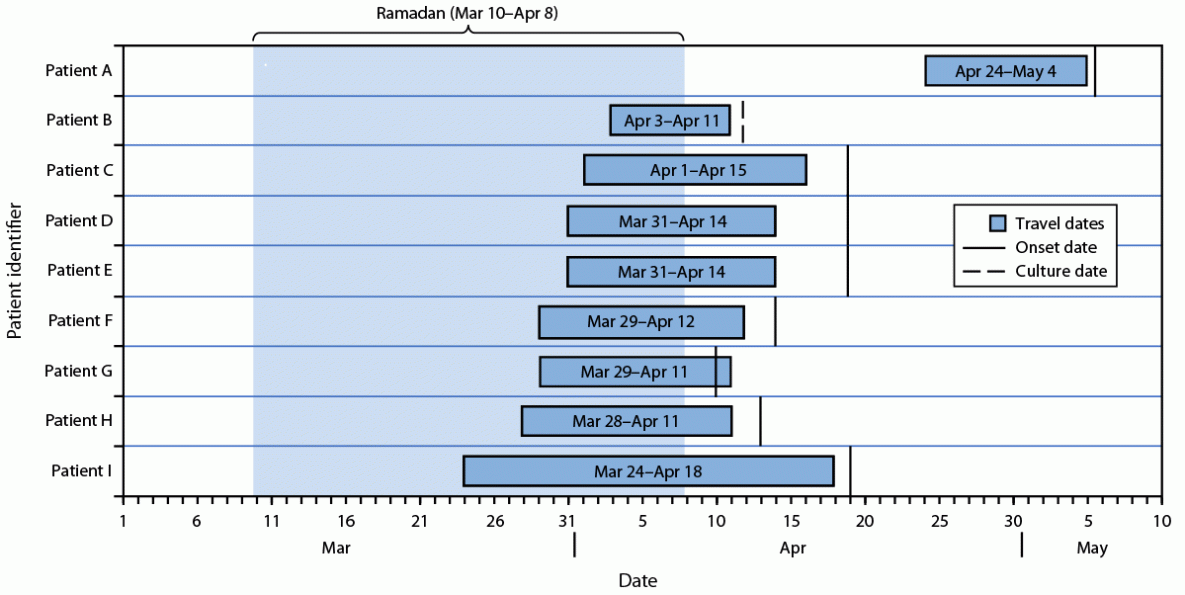
Umrah-related travel and symptom onset for nine of the patients, March–May 2024. CDC.
The strains
Whole genomes were sequenced from 11 isolates: 10 were serogroup W (ST-11, clonal complex CC11) and 1, from a U.S. patient, was serogroup C (ST-12790, CC4821). Three — the U.S. serogroup C isolate and one serogroup W isolate each from the United States and France — carried the gyrA T91I marker for ciprofloxacin resistance, and susceptibility testing of nine serogroup W isolates confirmed resistance in two.
What to do
- Travelers: see a health care provider before Hajj or Umrah and make sure anyone 1 or older has had a MenACWY vaccine within 3–5 years (depending on type) and at least 10 days before entering Saudi Arabia. Seek care immediately for any sign of meningococcal disease.
- Health departments: ask patients whether they, or someone close to them, traveled to Saudi Arabia.
- Close contacts need antibiotic prophylaxis as soon as possible — ideally within 24 hours of the case being identified — whatever their vaccination status. Because of the resistant strains, rifampin, ceftriaxone or azithromycin should be considered instead of ciprofloxacin for contacts of Saudi Arabia–linked cases.
Sources
Based on Vachon MS, Barret AS, Lucidarme J, et al., "Cases of Meningococcal Disease Associated with Travel to Saudi Arabia for Umrah Pilgrimage — United States, United Kingdom, and France, 2024," MMWR Morbidity and Mortality Weekly Report volume 73, number 22, Centers for Disease Control and Prevention; a work of the United States government in the public domain. The imported copy was cut short; the missing text is from the report's full text in PubMed Central (PMC11166255).
许可协议: CC0 1.0(公有领域) · 改编自 www.cdc.gov
1
0
0
0

留言


