此页面是公开的。
The Right to Repair is a movement and philosophy spearheaded by repair professionals and consumers who believe in equal access to repair. Modern devices have become increasingly difficult to repair as manufacturers' products have become more complex[1][2]. Right to Repair advocates claim that manufacturers are exploiting complexity in product designs and legal mechanisms to inhibit refurbishing, repair, and latently, reuse and recycling. They are fighting to raise public awareness and for legislative action that will compel manufacturers to provide documentation and parts needed for repair while making their products repair-friendly. Opponents of the Right to Repair benefit by keeping all repairs in house and creating continuous sales from the replacement of their "old" products via purchase of their new and more expensive products.
History
Planned Obsolescence
Planned obsolesce refers to the practice of engineering a product to fail after a predetermined period. The Phoebus Cartel is an early adopter of the strategym functioning primarily in the 1920's and 1930's. The Cartel, comprised of a group of light bulb manufacturers, conspired to set the lifetime of a light bulb to 1000 hours, only 50 to 66% of the contemporary bulb's life3]. The phrase "planned obsolesce" was coined by Bernard London, a New York real estate broker in [Ending the Depression Through Planned Obsolescence. The idea gained popularity during the Great Depression and WWII as a method for stimulating economic growth by increasing product failure, therefore increasing product purchases. The lightbulbs rose to popularity as they were brighter than competitors products, albeit more expensive with a shorter lifespan, justified by the Cartel as a trade-off of quality, brightness and efficiency vs. longevity and lower prices. Brooks Stevens, an industrial designer, popularized the phrase in 1954 when he used it in a talk [4]. More recently, it has been applied to technology companies such as Apple and Samsung[5]. Planned obsolesce is often cited by Right To Repair advocates as justification of the need for regulatory action. They claim planned obsolescence has worsened the quality of goods and made repair more difficult[6].
Public Response
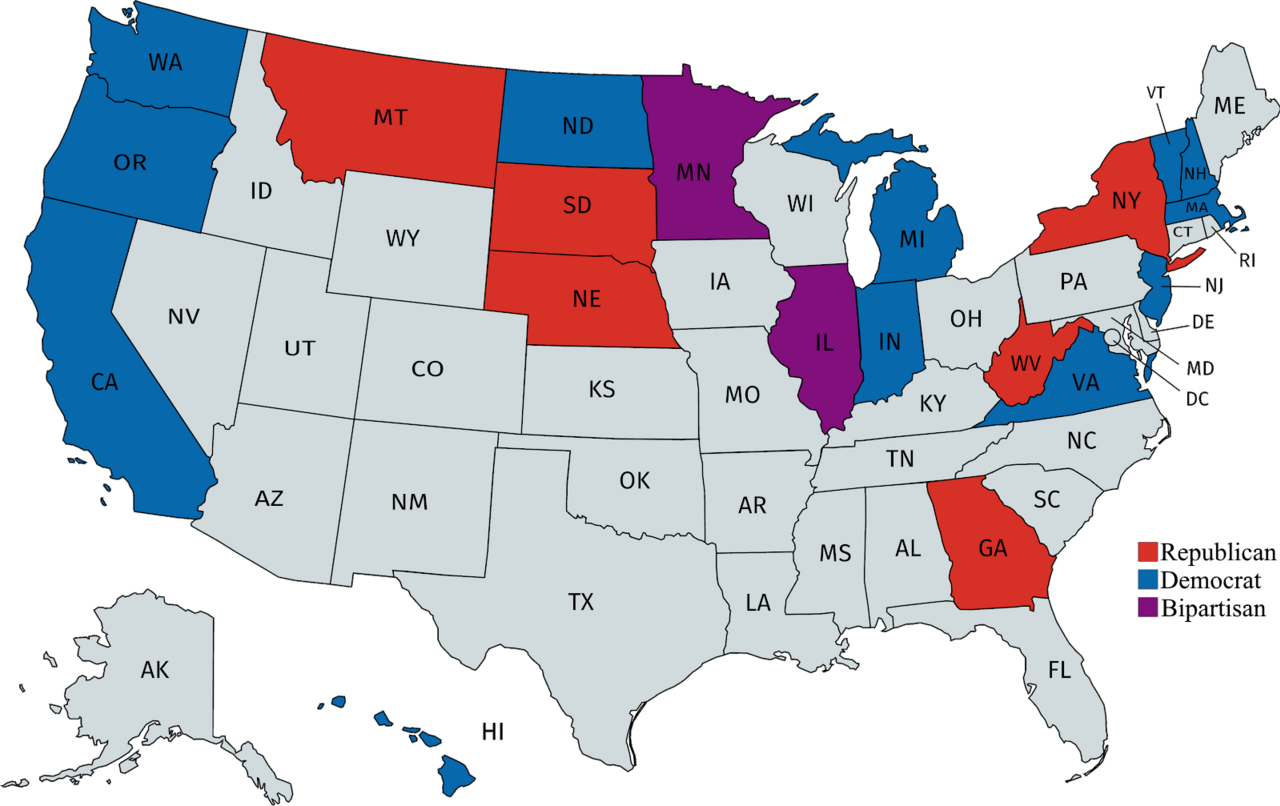
Map of Right to Repair Legislation in the U.S: Red - Republican introduced legislation, blue - Democrat introduced legislation, purple - bipartisan coalition introduced legislation. (Image: Bac6vx, CC BY-SA 4.0)
The public has shown high levels of support for the right to repair. In Massachusetts, 74% voted yes to Right To Repair for vehicles[7]. Ting found that 64% of consumers said they would buy repair kits from manufacturers[8]. Twenty states currently have pending legislation on Right To Repair[9]. The issue has been bipartisan with both Democrats and Republicans sponsoring bills in different states. There has also been federal legislation proposed in H.R. 1449 [10].
There has been related regulation and judicial opinion that supports Right To Repair's goals. The Library of Congress issued a decision that exempts repair of privately owned devices from copyright protection [11]. The Supreme Court ruled in 2016 that once a product is sold, patent protection does not restrict modification of the item [12].
Some have pushed back against Right To Repair. Tech journalist Lance Ulandoff scoffs at consumers' ability to repair complicated devices, like smart phones, themselves[13]. The Security Innovation Center published survey results suggesting that repair could introduce security risks for some devices[14].
Critical Players Against
Apple, John Deere, and the Entertainment Software Association are large players in opposition to Right To Repair. In an effort to avoid negative PR, public statements from these players in regard their stance cannot be expected. Therefore their actions will serve as primary evidence for their stance.
Apple
Owning a significant market share in several industries (including notebooks/laptops, tablets, smartphones, and computers[15]) Apple provides no official statement on their opinion of Right to Repair. However their actions illustrate they are strongly opposed.
In 2018, Apple's T2 chip debuted in the 2018 Macbook.16] The chip "enables a new level of security ... and provides the foundation for new encrypted storage and secure boot capabilities."[17] The ASIC serves as a secure bridge between hardware peripherals and the core system,[18] but its inclusion has the side-effect of disabling features or preventing the system from booting up following certain modifications[19]. Apple actively moderates their [online support forum and censors users that provide repair or data-recovery methods outside of Apple's official services.20] While Competitors such as Samsung[21] and HP[22] make parts and repair guides available to consumers, Apple do not, instead redirecting consumers to warranty and insurance services such as [Apple Care. Nearly all components inside Apple devices contain the Apple trademark logo, enabling Apple to leverage government power to seize counterfeit goods due to trademark protection laws. In October 2018, Louis Rossmann, a small but vocal independent repair shop owner, published a video showing that Apple had seized a large number of imported batteries under the provisions of 19 USC 1526(e).[23] Apple also sued Henrik Huseby for purchasing refurbished "counterfeit" iPhone displays on the grounds of trademark law.[24]
As industry leaders, Apple has reached market saturation and are now competing against themselves, as their iPhone sales figures remained stagnant since Q1 2015.[25][26] In the letter "From Tim Cook to Apple Investors," Apple attributes the recent 2018 to 2019 drop in quarterly revenue projections to a variety of factors including the practice of refurbishing iPhones with new batteries.[27] The appears to suggest apple is strongly against Right to Repair in order to encourage consumers to buy new iPhones rather than refurbished models.
As mentioned above, Apple wants users to buy new iPhones instead of getting ones that have been repaired or even getting their own device repaired. Apple makes much more money on purchases rather than repairs. In many cases, the parts are glued together and cannot be repaired without damaging other parts. One could say that Apple purposefully makes their devices difficult to repair in order to prompt consumers to buy newer models. Other times, unnecessary repairs are performed to drive up costs and increase profits. "Kevin Purdy, a writer for iFixit, hits even harder, saying some of the repairs Apple performs are “disingenuous.” He says there are instances when a repair to a solid-state drive or a Touch ID sensor on a Mac laptop will result in the replacement of the motherboard," [28]. These costly repairs prompt consumers to consider simply buying a new device instead of sinking money into expensive repairs.
There are additional reasons for Apple to opppose personal repair besides the economic factors mentioned above. Personal repair grants users complete control over the software on their devices. If normal users can gain complete control over their devices, so can hackers. Software programmers must be diligent to prevent unintended back doors into their systems. Apple secures their devices to prevent hackers from accessing users' information. If Apple gave everyone a way into their system, hackers could easily exploit this. Bank accounts being emptied and personal information stolen would be just some of the consequences.
Entertainment Software Association (ESA)
The Entertainment Software Association is an interest group that represents companies including Microsoft, Nintendo, and Nvidia[29]. Michale Warnecke, a lawyer working for the ESA, testified in Nebraska against the Right To Repair, claiming "it would allow third parties to modify [devices]...in a way that would compromise...vital security features." [30] If people were able access the and modify the underlying software on these systems, there would be severe consequences for the profits of these companies. One of the main products of these companies is video game consoles. These consoles have proprietary software that allows them to run video games. If users were able to repair their consoles, they would need access to that software. Otherwise, they would not be able to perform any repairs. Given this ability, hackers could steal the software of the video games and create copies allowing anyone to play them for free. This would destroy these companies because people would never spend money to purchase any of their products. Therefore, these companies joined the ESA to protect themselves against this possibility. By acting through interest groups like the ESA, companies can avoid bad PR while still fighting Right To Repair legislation.
Microsoft, Sony, Nintendo, Nvidia have large market-shares in the video game industry[31], and have a general interest to maintain control over piracy of games. It's likely that while do not directly oppose Right to Repair, they believe Right to Repair legislation will make system modifications more accessible and consequentially increase difficultly of enforcing Digital Rights Management, or DRM. DRM prevents users from creating additional copies of their software to distribute.
John Deere
John Deere, a farm equipment manufacturer, sells equipment that requires proprietary software to fix or repair[32]. The company's products are not affordable for the average farmer. As a result, most farmers opt for a lease or loan and John Deere remains the owner of the equipment. They forbid unauthorized repair through a contractual agreement. While John Deere provides OEM parts, software locks require that any repairs be "authorized"[33].
John Deere has good reason to prevent its users from repairing their equipment. First and foremost, it is a liability issue. All of their equipment is laden with software. This software performs many actions with a few inputs from the user. If the user were to attempt to repair the faulty equipment without knowing the software and being able to interface with it, the entire system could break down. This could result in a 20-ton tractor going off course and hitting a barn or even people. John Deere would undoubtedly be sued for this incident. John Deere believes that preventing users from repairing John Deere equipment is the safer choice.
In addition to promoting the rigorous safety guidelines, John Deere has important data embedded within their equipment. Their tractors have many sensors that constantly collect data. John Deere wants to maximize output through the use of this data. "This is farming’s version of big data, and the potential is staggering, enthusiasts say. The efficiency gains of recent decades have increased productivity an estimated 1.4% per year for the past 70 years
", [34]. This data and the software that collects it are extremely important to John Deere's business model. The increasing efficiency provides them a marketable edge against their competition. Their data allows them to definitively say that their equipment is better than the competitors. If customers were allowed to repair their equipment, thereby able to access that underlying software, competitors could access of all that software and its related data; another reason why John Deere opposes the right to repair.
In letter, John Deere publicly opposed a Kansas Right To Repair bill, they claimed it "could negatively impact customer and public safety, as well as the environment," and that legislation is unnecessary, as "manufacturers that are unresponsive to customer needs will risk losing business."35] This reasoning is reminiscent of cases like the FAA's stance towards manufactures like [Convair, McDonnell Douglas, and Boeing or the FDA's approach to pharmaceutical regulation prior to Frances Kelsey's handling of thalidomide.
Modern John Deere equipment are outfitted with proprietary software. Contractually, farmers may own the vehicle but, they do not own the software.
[36]. "Over the last two decades, manufacturers have used the DMCA to argue that consumers do not own the software underpinning the products they buy", [37]. The DMCA, Digital Millennium Copyright Act, prevents owners from modifying the underlying software of many products. This law establishes legal guidelines that John Deere can use to prevent customers from repairing their own equipment. Customers must be able to interface and modify John Deere's proprietary software in order to perform basic services on their equipment. This causes a lot of issues for John Deere's main customer segment, farmers. Farmers can only plant and harvest at extremely specific times. This short time window has the most optimal conditions in order for them to reach a maximum crop output and quality. If a piece of equipment were to break down during this window, a farmer would have to send the equipment to a John Deere repair center and could completely miss the time window. For small operations this could be catastrophic.
Critical Players For
There are a variety of informational, advocacy, and legally-focused groups working to advance the Right to Repair agenda, particularly relating to job creation and sustainability via waste reduction. There is a significant unofficial presence on social media, in addition to official organizations, that work to encourage consumers to repair their products and advocate for the right to do so.
Online Presence
Louis Rossmann started his business and YouTube channel because of his passion for fixing computers. Rossmann's platform focuses primarily on Macbooks, and has publicly bashed Apple for their anti-repair practices. A CBC article documents the price and service disparity between Apple repair stores and the Rossmann store. His channel shows his frustrations with technical,38] as well as legal sabotage.[39] Rossmann's position appeals to his audience. He is 85% upvoted on [Reddit with many positive comments, and has almost a million subscribers to his channel.
Rich Benoit is another YouTuber who documents how he repairs used, and sometimes nearly destroyed, Tesla cars. His videos show him working on drowned Teslas, as well as ones "shaped like a rhombus."40] Benoit also shows how while Tesla should be providing diagnostic and repair manual information under [Massachusetts state law, they intentionally make it almost impossible to access, and the ones available provide vague information.
iFixit
While unorganized online presences are helpful with raising awareness and facilitating some aspects of repair, iFixit, a global community of people who help each other repair things online, goes further than the repair shop and empowers individuals to repair their own products. Their website highlights the environmental and economic benefits of repair, through sustainability and jobs creation[41]. iFixit shares information about the Right To Repair movement and relevant news, and provides manuals, teardown videos, a Q&A forum, and a parts and tools store in a variety of languages for a plethora of products. Founder Kyle Wiens, who previously worked as an Apple technician, created the platform after he realized the gross deficiency of online repair resources.[42] iFixit currently provides more than 60,000 free manuals and 163,000 solutions for 23,000+ different devices. The informs that if one can fix a product without buying a new one, it not only saves the owner of the product money, but also keeps that product out of landfills, reducing waste in a movement toward sustainability.
PIRG
One niche advocate in the Right to Repair is the United States Public Interest Research Group (PIRG). PIRG advocates for the public interest in general, researching a variety of fields and topics including healthcare in the COVID-19 pandemic, the Right to Repair, credit protection, consumer defense and affordable higher education. A member of the Repair Association, PIRG leverages data from its researchers to inform and advocate for reforms to give the consumers of products what they need to fix their items. It focuses on the human rights' part of the Right to Repair as well as the environmental implications, stating that too much waste is generated by humans which is increased by companies who make items harder to repair. PIRG aims to take on large companies and give every consumer and small business access to the parts, tools and service information needed to repair products to increase their usable lifespan and reduce waste.
Research from PIRG helps to identify the scale of the technological waste issue. Their site notes that 416,000 cell phones are disposed of daily, although only 15-20% of the electronic waste is recycled. PIRG mentions that in a survey of 164 small independent repair businesses, there was a 37% surge in battery repair requests in the 5 weeks after Apple announced that they were slowing down phones.
The Repair Association
Aside from technical resources, the Repair Association focuses its efforts on the legal fight for Right to Repair/repair-friendly legislation via lobbying. Founded in 2013, their website educates people on their rights and what industries are involved in the issue. It shows what they can do to advocate and posts news articles and blogs related to their efforts. Similar to iFixit, they emphasize benefits like job creation, and advocate for owner's rights, asserting that when contracts fail to cede control of a product from the seller after a consumer purchases it, the legal rights' of the product buyers/owners are damaged. Job creation is important in the Right to Repair because there is an entire market that rests on the legality and practicality of repairing broken and or used products. Without the opportunity to repair, this whole market is absorbed by the companies that make the products to fail in the first place. The Repair Association also fights to retain value for used products and to reduce electronic waste, noting that irreparable products are instant waste. A number of organizations, including U.S. PIRG and iFixit, are members of the Repair Association. Many trade associations such as the Service Industry Association, the Association of Computer Dealers Inc and their partner National Association of Telecommunications Dealers are also members of the Repair Association. In large part due to the Repair Association and organizations like it, twenty states filed repair-friendly legislation in 2019.
Global Perspectives: Right to Repair in the EU
While the presence of the Right to Repair movement is strongest within the United States, its presence has been increasing within the EU in recent years.[43] Despite having the same goals, however, the primary motivations driving the movement's momentum have pronounced differences.
Economic and Environmental Goals
In the United States, the Right to Repair movement centers around having the freedom and ability to repair appliances you buy without having to depend on the manufacturer. While this sentiment still exists in the EU movement, the primary motivation is actually the desire to make the EU countries more environmentally sustainable. The first notions of Right to Repair in the EU were introduced in July 2017 by the European Parliament when they recommended member states pass laws to allow consumers to repair their own electronics devices as an extension to the Ecodesign Directive established in 2009.[44] It was not until October 2019 that more concrete legislation was passed which mandated manufacturers to provide spare parts for their products to professionals for up to 10 years after being sold.[45] This legislation was passed to support a long-term goal of achieving a circular economy in the EU where materials could be kept within the economy for as long as possible through recycling, repairing, remanufacturing, and reusing.[46] This is in direct contrast to a linear economy where materials within a product are considered waste after the product's lifespan has passed.
Cultural Differences
In most of Europe, particularly Western Europe, there does not exist much of a 'repair' culture.[47] If an appliance breaks, the societal norm is to buy a new one, rather than spend the time repairing the item. Because of this key cultural difference, there is less interest in the Right to Repair movement within the EU than in the United States, which may partially explain why it has only begun to gain momentum in recent years. All the existing legislation regarding Right to Repair in the EU has been centered around fostering a circular economy, showing that the main driving force behind the progress of the movement so far has been the potential environmental benefits of advocating self-repair.[45] As the movement has gained traction, however, there has been an increasing interest in self-repair within the EU. According to Jean-Pierre Schweitzer, a Product Policy and Circular Economy Officer in the European Environmental Bureau, the "counterculture of repair is being revived in Western Europe."[47] In particular, he highlights the increased presence of repair cafes across all of Europe.
Key Stakeholders
Most of the organizations advocating for Right to Repair are members of the Right to Repair EU coalition.[48] iFixit, a major advocate in the United States, is also active in the EU.[41] There are also organizations with similar interests as iFixit which are European-based such as Runder-Tisch Reparteur and The Restart Project.[49][50] Because of the environmental focus, environmental agencies including the European Environmental Bureau and EcoStandard are also major advocates for the movement.[51][52] In contrast, environmental agencies are generally not involved with the movement within the United States.
The main opponents have fewer differences, mainly consisting of corporations with similar motivations as the United States corporations. Many of these companies would prefer customers to continue depending on them for repairs as a source or revenue or would like to keep their manufacturing process confidential. Some major coalitions include Applia (representing home appliance companies like Daikin and Dyson), Digital Europe (representing digital technology companies like Apple and Microsoft), and Lighting Europe (representing lighting companies like Lutron and Ledvance).[53][54][55][56]
Conclusion
Maya Lin and Primo and Segundo's examples show that integrity trumps careerism when defining a professional. Engineers have a duty not just to design to specification, but to design the best product for consumers. The passion Right To Repair advocates show for serving the consumer, despite personal consequences, embodies professionalism. In history, officials like Archer Blood stood up to oppression at the personal expense of their career, setting a standard for how a professional should behave.[57] Currently, this same example of professionalism is upheld by people like Willie Cade, as the grandson of the man who brought John Deere to its initial success, stands up against Deere's involvement in hindering repair,[58] along with Tesla engineers who support Rich Benoit's efforts.[40] Further work could explore the historical evolution of the aforementioned products, noting when and how planned obsolescence started taking effect. It could also include more unorganized participants in this issue.
References
- ↑ Koebler, J. (2017, March 21). Why American farmers are hacking their tractors with Ukrainian firmware. https://motherboard.vice.com/en_us/article/xykkkd/why-american-farmers-are-hacking-their-tractors-with-ukrainian-firmware
- ↑ Chambers, B. (2018, April 14). Making the grade: Does repairability of Mac laptops matter? https://9to5mac.com/2018/04/14/making-the-grade-mac-repairability/
- ↑ Krajewski, M. (2014, September 24). The great lightbulb conspiracy. https://spectrum.ieee.org/tech-history/dawn-of-electronics/the-great-lightbulb-conspiracy
- ↑ Milwaukee Art Museum. (n.d.) Brooks Stevens biography. https://mam.org/collection/archives/brooks/bio.php
- ↑ Brunelli, S. (2018, October 26). Apple and Samsung fined for planned obsolescence. https://www.itworld.com/article/3316958/apple-and-samsung-fined-for-planned-obsolescence.html
- ↑ iFixit. (n.d.). Repairable products make good sense. https://ifixit.org/products
- ↑ Secretary of the Commonwealth of Massachusetts. (n.d.). Statewide ballot questions —
Statistics by year: 1919 – 2018. https://www.sec.state.ma.us/ele/elebalm/balmresults.html
- ↑ Ottoni, C. (2019, April 1). Check out our epic phone fails infographic. https://ting.com/blog/phonefailssurvey/
- ↑ U.S. PIRG (2019, March 18) United States Public Interest Research Group. California becomes 20th state in 2019 to consider right to repair bill. https://uspirg.org/news/usp/california-becomes-20th-state-2019-consider-right-repair-bill
- ↑ Towns, E. (2011, April 12). H.R.1449 - Motor vehicle owners Right To Repair act of 2011. https://www.congress.gov/bill/112th-congress/house-bill/1449/text
- ↑ U.S. Copyright Office. (2018, October 26) Exemption to prohibition on circumvention of copyright protection systems for access control technologies. https://www.federalregister.gov/documents/2018/10/26/2018-23241/exemption-to-prohibition-on-circumvention-of-copyright-protection-systems-for-access-control
- ↑ Supreme Court of the United States. (2017, May 20). Impression Products, Inc. v. Lexmark International, Inc. https://www.supremecourt.gov/opinions/16pdf/15-1189_ebfj.pdf
- ↑ Ulanoff, L. (2017, February 16). No, you shouldn't be allowed to fix your own phone, 'Right-to-Repair' is a dumb idea. https://mashable.com/2017/02/16/right-to-repair-is-ridiculous/
- ↑ Security Innovation Center (2018, February 13). Digital insecurity: As billions of products connect to the Internet, concerned Americans prioritize security and privacy when getting them repaired, study finds. https://securityinnovationcenter.com/digital-insecurity-as-billions-of-products-connect-to-the-internet-concerned-americans-prioritize-security-and-privacy-when-getting-them-repaired-study-finds/
- ↑ Site Map. (n.d.). Retrieved from https://www.apple.com/sitemap/
- ↑ AppleInsider. (2018, August 08). Everything you need to know about Apple's T2 chip in the 2018 Mac mini and MacBook Air. Retrieved from https://appleinsider.com/articles/18/08/08/everything-you-need-to-know-about-apples-t2-chip-in-the-2018-macbook-pro
- ↑ About the Apple T2 Security Chip. (2019, February 06). Retrieved from https://support.apple.com/en-us/HT208862
- ↑ Apple T2 Security Chip Security Overview. (2018, October). Retrieved from https://www.apple.com/mac/docs/Apple_T2_Security_Chip_Overview.pdf
- ↑ Apple Pairs Every Touch ID Sensor To Its A7 Chip To Make Them Super Secure. (2015, July 26). Retrieved from https://www.cultofmac.com/252406/apple-pairs-every-touch-id-sensor-to-its-a7-chip-to-make-them-super-secure/
- ↑ Rossmann, L. (2019, April 04). Apple just won't stop. Retrieved from https://www.youtube.com/watch?v=2yJKix17yYE
- ↑ http://www.samsungparts.com/mobile/
- ↑ HP Notebook PCs - Purchasing a Replacement Battery. (n.d.). Retrieved from https://support.hp.com/us-en/document/c00821572
- ↑ Rossmann, L. (2018, October 18). Apple & Customs STOLE my batteries, that they won't even provide to AASPs. Retrieved from https://www.youtube.com/watch?v=AVL65qwBGnw
- ↑ https://motherboard.vice.com/en_us/article/a3yadk/apple-sued-an-independent-iphone-repair-shop-owner-and-lost
- ↑ Apple Inc Q4 2018 Unaudited Summary Data. (2018). Retrieved from https://www.apple.com/newsroom/pdfs/Q4-18-Data-Summary.pdf
- ↑ Apple iPhone sales 2018. (n.d.). Retrieved from https://www.statista.com/statistics/263401/global-apple-iphone-sales-since-3rd-quarter-2007/
- ↑ Letter from Tim Cook to Apple investors. (2019, April 30). Retrieved from https://www.apple.com/newsroom/2019/01/letter-from-tim-cook-to-apple-investors/
- ↑ Goode, Lauren. “Right-to-Repair Groups Don't Buy Apple's Answers to Congress.” Wired, Conde Nast, 27 Nov. 2019, www.wired.com/story/right-to-repair-apple-answers-congress/
- ↑ About ESA. (n.d.). Retrieved from http://www.theesa.com/about-esa/
- ↑ Warnecke, M. (2017, March 9). Judiciary committee on March 09, 2017. https://www.dataomaha.com/media/FloorDocs/105/PDF/Transcripts/Judiciary/2017-03-09.html
- ↑ Console Operating System Market Share North America. (n.d.). Retrieved May 6, 2019, from http://gs.statcounter.com/os-market-share/console/north-america
- ↑ Koebler, J. (2017, March 21). Why American farmers are hacking their tractors with Ukrainian firmware. https://www.vice.com/en_us/article/xykkkd/why-american-farmers-are-hacking-their-tractors-with-ukrainian-firmware
- ↑ Sessa-Hawkins, M. (2017, June 6). Farmers face uphill battle in Right To Repair tractors. https://www.vice.com/en_us/article/xykkkd/why-american-farmers-are-hacking-their-tractors-with-ukrainian-firmware
- ↑ Waldman, Peter, and Linda Mulvany “Farmers Fight John Deere Over Who Gets to Fix an $800,000 Tractor.” Bloomberg.com, Bloomberg, 5 Mar. 2020, www.bloomberg.com/news/features/2020-03-05/farmers-fight-john-deere-over-who-gets-to-fix-an-800-000-tractor.
- ↑ John Deere. (n.d.). Kansas HB 2122: Digital electronics repair requirements. https://www.scribd.com/document/339340098/John-Deere-letter
- ↑ Waldman, Peter, and Linda Mulvany “Farmers Fight John Deere Over Who Gets to Fix an $800,000 Tractor.” Bloomberg.com, Bloomberg, 5 Mar. 2020, www.bloomberg.com/news/features/2020-03-05/farmers-fight-john-deere-over-who-gets-to-fix-an-800-000-tractor.
- ↑ Wiens, Kyle. “We Can't Let John Deere Destroy the Very Idea of Ownership.” Wired, Conde Nast, 3 June 2017, www.wired.com/2015/04/dmca-ownership-john-deere/
- ↑ Louis Rossmann. (2019). F#%K APPLE! Retrieved from https://www.youtube.com/watch?v=mC5AiUgq2Zg
- ↑ Louis Rossmann. (2018). Apple & Customs STOLE my batteries, that they won’t even provide to AASPs. Retrieved from https://www.youtube.com/watch?v=AVL65qwBGnw
- ↑ a b Lopez, L. (2018). Rich Benoit is not scared of Tesla interview podcast - Business Insider. Retrieved May 6, 2019, from Business Insider website: https://www.businessinsider.com/rich-benoit-is-not-scared-of-tesla-interview-podcast-2018-10
- ↑ a b iFixit.org. (2019). Repair is noble - iFixit. Retrieved May 6, 2019, from https://ifixit.org/
- ↑
Matchar, E. (2016). The Fight for the “Right to Repair.” Retrieved May 6, 2019, from Smithsonian.com website: https://www.smithsonianmag.com/innovation/fight-right-repair-180959764/
- ↑ Open Repair Alliance (2018). 'Towards the Right to Repair in Europe.' Retrieved May 2, 2020, from the Open Repair Alliance website: https://openrepair.org/news/towards-the-right-to-repair-in-europe/
- ↑ Durand, P (2017). 'On a Longer Lifetime for Products: Benefits for Consumers and Companies.' Retrieved May 3, 2020, from the European Parliament website: https://www.europarl.europa.eu/doceo/document/A-8-2017-0214_EN.html?redirect
- ↑ a b European Commission (2019). 'The New Ecodesign Measures Explained.' Retrieved May 3, 2020, from European Commission website: https://ec.europa.eu/commission/presscorner/detail/en/QANDA_19_5889
- ↑ European Parliamentary Research Service. 'Circular Economy' (n.d.). Retrieved May, 3, 2020, from European Parliament website: https://www.europarl.europa.eu/thinktank/infographics/circulareconomy/public/index.html
- ↑ a b Gault, M (2018). 'Protesters are Slowly Winning Electronics Right-to-Repair Battles in Europe.' Retrieved May 3, 2020, from Vice website: https://www.vice.com/en_us/article/9k487p/protesters-are-slowly-winning-electronics-right-to-repair-battles-in-europe
- ↑ Right to Repair (n.d.). Retrieved May 3, 2020, from Right to Repair website: https://repair.eu/
- ↑ Runder-Tisch Reparteur (n.d.). Retrieved May 3, 2020, from Runder-Tisch Reparteur website: https://runder-tisch-reparatur.de/
- ↑ The Restart Project (n.d.). Retrieved May 3, 2020, from The Restart Project website: https://therestartproject.org/right-to-repair/
- ↑ EEB: European Environmental Bureau (n.d.). Retrieved May 3, 2020, from EEB website: https://eeb.org/
- ↑ ECOS: EcoStandard (n.d.). Retrieved May 3, 2020, from ECOS website: https://ecostandard.org/
- ↑ Anastasio, M (2018). 'EU to Deny Citizens Longer Lasting and Repairable Popular Consumer Projects - Media Brief.' Retrieved May 3, 2020, from EEB website: https://eeb.org/eu-to-deny-citizens-longer-lasting-and-repairable-popular-consumer-products-media-brief/
- ↑ Applia: Home Appliance Europe (n.d.). Retrieved May 3, 2020, from Applia website: https://www.applia-europe.eu/
- ↑ Digital Europe (n.d.). Retrieved from Digital Europe website: https://www.digitaleurope.org/corporate/
- ↑ Lighting Europe: the Voice of the Lighting Industry (n.d.). Retrieved May 3, 2020, from Lighting Europe website: https://www.lightingeurope.org/members-and-partners
- ↑ Filkins, D. (2013). ‘The Blood Telegram,’ by Gary J. Bass - The New York Times. Retrieved May 6, 2019, from The New York Times website: https://www.nytimes.com/2013/09/29/books/review/the-blood-telegram-by-gary-j-bass.html
- ↑ Doctorow, C. (2019). Grandson of legendary John Deere engineer defends right-to-repair and condemns Big Ag for “taxing customers.” Retrieved May 6, 2019, from https://boingboing.net/2019/03/22/manure-spreaders.html
Where this page came from
This page was imported from Wikibooks. From “Professionalism” on Wikibooks, by its contributors, under CC BY-SA 4.0. Changed here: set as a page; navigation and edit links left out; each image under its own licence, credited in its caption.
Nobody has written it yet — it is the source material at a new address, which is why search engines are asked to skip it and why no one earns from it. It is up for grabs: take it on, and it is yours to rewrite and to earn from.
收录于这些专栏Professionalism
许可协议: CC BY-SA 4.0 · 改编自 en.wikibooks.org
留言