
Bent's Old Fort was completely reconstructed by the National Park Service as a bicentennial project and dedicated on July 25, 1976. Colorado strongly backed the work, since 1976 was also the centennial of Colorado statehood — fitting for a trading post considered the first Anglo-American settlement in Colorado and pivotal to the early history of the American Southwest. The scale of the rebuilding was an unusual way to mark the nation's 200th birthday, and a reminder of how the United States has remembered its past.
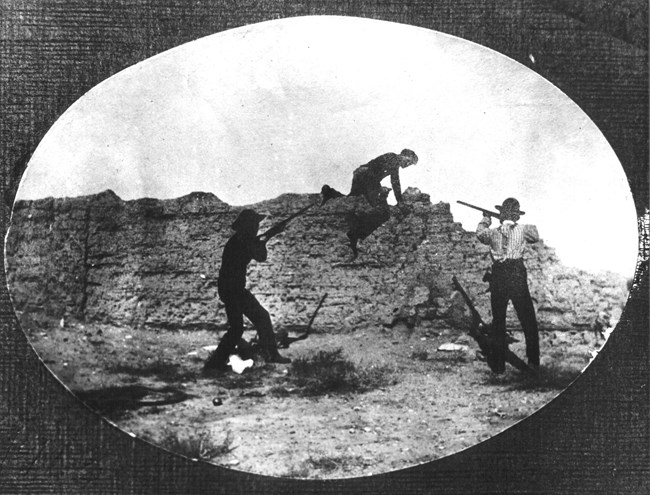
The ruins of Bent's Fort, 1903. NPS photo.
After the Bents
| Date | What happened |
|---|---|
| 1833 | Construction begins on what became the largest trading post in the mountain-plains region |
| August 1849 | After cholera swept the plains, the fort is abandoned and partly destroyed — probably by its owner, William Bent — though much survives |
| 1861–early 1870s | The remaining walls serve as a stagecoach station and post office, until a new Denver–Santa Fe stage line bypasses the fort |
| 1870 | Julia Bent, daughter of William Bent and his first wife, Owl Woman, a Cheyenne, receives title under the Treaty of the Little Arkansas, which granted land to children of white and Indian marriages |
| 1872 | Julia lives there briefly, then sells to cattleman John Prowers — ending the property's last link to William Bent. Prowers uses it as a line camp and cattle stockade |
| 1880s | Arkansas Valley settlers haul off most of the bricks and timbers by the wagonload for homes and barns |
| By 1900 | The fort is a pile of rubble |

Dedication of a marker at the site of Bent's Old Fort, 1912. NPS photo.
The road back
- 1912 — The La Junta Chapter of the Daughters of the American Revolution puts up a marker that still stands near the entrance.
- 1920 — The D.A.R. is given about 4.5 acres holding the ruins, from a farm owned by Colorado pioneer and businessman A. E. Reynolds. The D.A.R. is credited with saving the site and first proposing some form of reconstruction.
- June 14, 1954 — The State of Colorado buys the land for the Colorado Historical Society, which hires Professor Herbert W. Dick of Trinidad State Junior College for 42 days of excavation that summer. State money for rebuilding never comes.
- 1957 — Attention turns to the Park Service, which quickly sees the site's importance to the story of westward expansion.
- June 1, 1960 — President Dwight D. Eisenhower signs the law making Bent's Old Fort part of the National Park System.
Research first
Park Service historian Dwight E. Stinson Jr. hunted for eyewitness diaries and journals and found more than 20 written accounts, plus pen-and-ink drawings and watercolors made in 1845 and 1846 by Army topographical engineer Lt. James Abert — whose measured drawings proved critical. Stinson finished a full historical report on the structure in 1966.
Jackson W. Moore was hired in 1963 for a second excavation, a three-year dig that revealed the fort's layout, identified the likely use of each ground-floor room and turned up some 35,000 artifacts.

The 1960s archeological dig at the remains of Bent's Old Fort. NPS photo.
Whether to rebuild at all was still undecided. In 1965, a four-member Park Service committee split evenly: opponents objected that reconstruction would destroy the surviving remains and rest largely on guesswork. In the end, a full-scale reconstruction won out.
| Basis for the design | Share |
|---|---|
| Historical records — despite conflicting eyewitness accounts, obvious errors and fabrications, and gaps | about 30% |
| Archeology | about 30% |
| Conjecture | 40% |
Building it

Construction of the reconstruction, 1975. NPS photo.
Work began on May 27, 1975.
- Adobe: front-loading tractors mixed clay, sand, straw and water in a 30-by-50-foot pit, and a custom machine that could make 4,000 bricks a day produced 160,000 adobe blocks, each 4 by 9 by 18 inches.
- Protection from water: instead of setting the adobe on bare ground, as was standard, builders poured a concrete foundation against rain and groundwater, and laid floors of concrete, foam and sand beneath packed adobe. Methods and materials were redesigned considerably along the way.
- Timber: craftsmen skilled in old woodworking methods hand-cut 800 cottonwood trees for the massive vigas (roof beams), and more than 112,000 linear feet of ponderosa pine went into the smaller latillas. Doors and windowsills were shaped by hand.
- Iron: two blacksmiths made several hundred pieces of hardware in a reconstructed blacksmith shop.
Built of earth, wood and hand-forged iron, the fort is today one of the nation's most distinctive historical and architectural exhibits.
Sources
Based on "Reconstructing the Castle on the Plains," Bent's Old Fort National Historic Site, National Park Service; a work of the United States government in the public domain.
收录于这些合集Bent's Old Fort National Historic Site
许可协议: CC0 1.0(公有领域) · 改编自 www.nps.gov
1
0
0
0

留言


