
A bison ambles up not far from you. It looks tame — surely a little closer for a selfie won't hurt? It can. A national park is not a zoo: its animals are wild, not pets, and nobody looks after them. Your safety and theirs depend on good judgment and safe viewing.
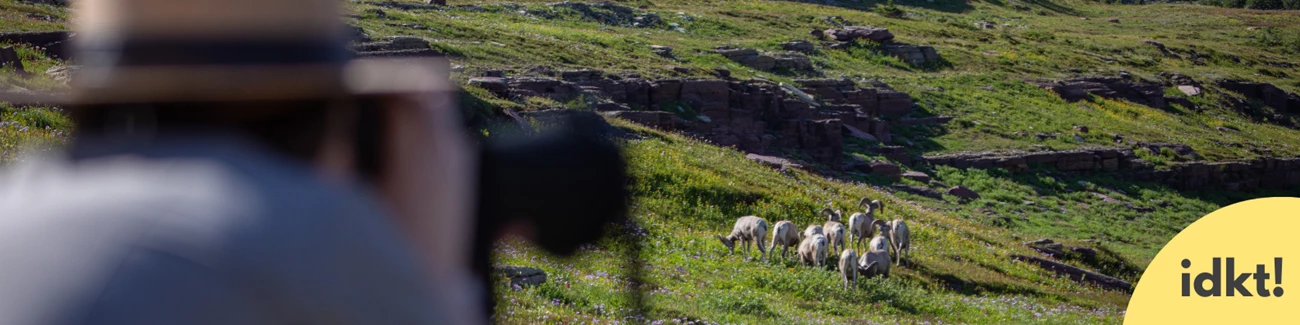
Watching bighorn sheep from a safe distance. Image from the National Park Service's page on respecting wildlife
Respect Wildlife is the sixth of the seven Leave No Trace principles, which aim to leave nature as unchanged by your visit as possible — protecting it, and you, for the generations to come.
Why keep your distance
- For your safety. Wild animals can be unpredictable when disturbed or surprised, and contact can cause injury or disease.
- For theirs. Coming too close stresses animals; fleeing people, they can be hurt, especially near roads; and people and pets can pass them diseases.
- It's the law. It is illegal to feed, touch, tease, frighten or intentionally disturb wildlife (36 CFR § 2.2(a)(2)).

There isn't always a sign so well placed — keeping your distance is up to you. NPS / Jacob W. Frank
1. Know before you go
Every park has its own rules, including minimum viewing distances. Check them before you set out: many parks post their Superintendent's Compendium (park rules) online, usually under "Learn About the Park" › "Management" › "Laws and Policies." If you can't find it, ask a ranger at the visitor center.
2. Give animals room
The safest way to watch is to give animals space to move. As a rule, if an animal reacts to you, you are too close — and if you're close enough for a selfie, you're definitely too close. Use binoculars or a zoom lens, and back away if an animal comes toward you.

A spotting scope or zoom lens gets you a closer look and keeps you safe. NPS photo
How close is too close?
Many parks require you to stay at least 25 yards from most wildlife and 100 yards from predators such as bears and wolves — but check, because rules vary: Olympic National Park requires 50 yards.

"Sometimes the best relationship is a long-distance relationship": about two school-bus lengths (25 yards) from a squirrel, four (50 yards) from deer or elk, and eight (100 yards) from a bear. National Park Service
Judging the distance
- Bus lengths. 75 feet (25 yards, 23 meters) is about two bus lengths; 150 feet (50 yards, 46 meters) about four.
- The rule of thumb. Hold your arm out straight and give the animal a thumbs-up. If your thumb doesn't cover the whole animal, you're too close — step back and try again.
If an animal comes to you
It happens: an animal wanders toward you, or you round a bend and find one close by. Then it is your job to back away slowly and restore the distance — the animal doesn't know better, but you do. Stay aware of your surroundings so you are ready.
3. Do not disturb
Seeing animals in their habitat is a privilege. The best viewing is when they behave naturally, which they do when they don't know you are there.

Watching wildlife in its habitat is amazing — from a distance. NPS / Jacob W. Frank
What you can do
- Pack with the Bring This, Not That checklist.
- Zoom in to photograph animals from afar.
- Bring binoculars or a spotting scope.
- Share your photos of wildlife that is "Amazing from Afar."
- Set a good example for others.

A card to share: know before you go, give wildlife room, do not disturb — and use your zoom, bring binoculars or a spotting scope, and set an example. National Park Service, with Leave No Trace
Sources
Based on "I Didn't Know That!: Leave No Trace Principle #6 – Respect Wildlife," developed with the Leave No Trace Center for Outdoor Ethics, National Park Service; a work of the United States government in the public domain, rewritten in hubnx's own words.
收录于这些专栏I Didn't Know That! Leave No Trace
许可协议: CC0 1.0(公有领域) · 改编自 www.nps.gov
1
0
0
0

留言


