
想要改进节点的内容吗?试试提出一个编辑请求吧。
Today we look at how one company became a rocket company, an AI company, a telecom company, a cloud & infrastructure company, and apparently the future of human civilization. Along with the prospectus, it starts to look like science fiction rather than financial analysis. Does either the WeWork or Web 3 in general ring a bell? There was a time when companies sold products. Today, some companies sell stories. SpaceX may be one of the greatest engineering organizations ever assembled. It may also represent one of the most ambitious exercises in future-selling ever attempted in financial markets. The modern SpaceX investment story is no longer about rockets. Investors are increasingly being asked to believe in Starlink, Starship, xAI, Colossus, orbital computing, artificial general intelligence, planetary communications, and eventually Mars itself. None of those things are necessarily impossible. The question is whether investors are being asked to pay for all of them today. This article explores the growing gap between present-day economics and future expectations, and why history suggests that markets often become most optimistic precisely when reality becomes most expensive.
Today we look at how one company became a rocket company, an AI company, a telecom company, a cloud & infrastructure company, and apparently the future of human civilization. Along with the prospectus, it starts to look like science fiction rather than financial analysis. Does either the WeWork or Web 3 in general ring a bell?
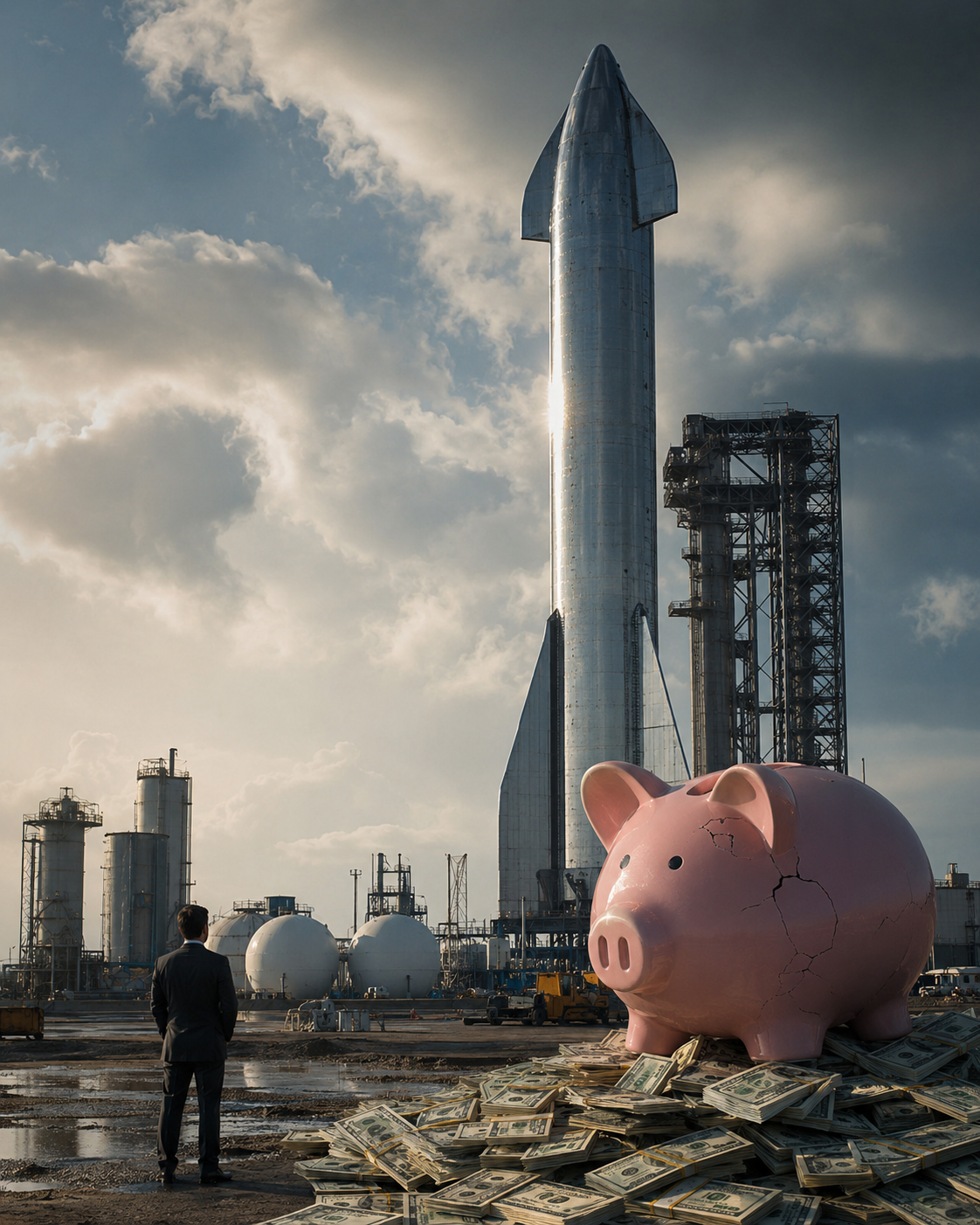
The Law of Tech Gravity
Every decade seems to produce at least one company that appears capable of bending the laws of economics.
In the 1990s it was internet companies.
In the 2000s it was social media.
In the 2010s it was ride-sharing companies somehow discovering that losing money on every ride could still produce multi-billion-dollar valuations.
In the 2020s, the crown belongs to AI and space.
The pitch is simple:
- Build giant rockets.
- Build and scale Starlink
- Build giant AI clusters.
- Build AI.
- Build giant expectations.
- Explain later.
For a while, this works beautifully.
Reality, unfortunately, has a habit of eventually requesting a meeting.
Once Upon a Time, SpaceX Was a Rocket Company
Yes it was a rocket company, before eating up all the buzzword.
The original SpaceX story was refreshingly simple.
Build rockets.
Lower launch costs.
Win commercial and government contracts.
Maybe eventually reach Mars.
Reasonable people could debate the timeline, but the business itself was understandable.
Then something interesting happened.
The story started expanding. The bigger the story, the bigger the valuation.
It looks like today's markets prefer ambition over focus.
They are evaluating:
- Starlink
- Starship
- xAI
- Colossus
- AI infrastructure
- Orbital computing
- Global telecommunications
- Defense applications
- Artificial intelligence
- Future Mars infrastructure
The only thing missing is quantum blockchain metaverse synergy, although there is still time.
Somewhere along the way, investors stopped asking:
"What does this company do?"
And started asking:
"What doesn't this company do?"
At this point the investment thesis resembles a technology-themed buffet where every trillion-dollar opportunity has somehow ended up on the same plate.
Starlink: The Adult in the Room
Every ambitious empire requires one division that actually pays the bills.
For SpaceX, that division appears to be Starlink.
Starlink generates real revenue.
Starlink has real customers.
Starlink provides a service people actually use today.
Even with Starlink’s success, the overall rate of capital expenditure is on a completely different scale.
Let alone if Starlink stopped being profitable tomorrow, how much of the any current valuation would survive? It would be just a pure dream.
Would investors still assign enormous value to:
- Mars colonies
- Orbital data centers
- Future AI infrastructure
- Interplanetary commerce
Or would they suddenly remember that revenue matters?
Starlink increasingly looks less like one business among many and more like the financial engine supporting a growing collection of expensive ambitions.
Colossus and the Infinite GPU Strategy
Every generation invents a new form of industrial arms race.
The railroad boom built tracks.
The telecom boom built fiber.
The AI boom builds GPU clusters.
The logic is beautifully simple.
Buy GPUs.
Then buy more GPUs.
Then announce an even larger cluster.
Then explain that future demand will justify today's spending.
Then raise money to build another cluster.
Repeat until the valuation reaches low Earth orbit.
The challenge is that GPUs are not magic.
Data centers consume astonishing amounts of:
- Capital
- Electricity
- Cooling
- Maintenance
- Talent
Eventually someone asks a deeply offensive question:
"Where are the profits?"
This is generally considered poor manners during a boom.
The xAI Question Nobody Wants to Ask
Artificial intelligence may eventually transform entire industries.
That does not automatically mean every AI investment will succeed.
A recurring feature of modern AI companies is that spending appears immediately while profits remain perpetually scheduled for a future quarter.
Then another future quarter.
Then another.
Then another.
The result is a fascinating financial model:
Gather and spend billions today.
Promise trillions tomorrow.
Why does it sound like a Ponzi Scheme?
Hope nobody asks too many questions in between.
Investors have seen versions of this movie before.
The special effects improve every decade.
The ending remains uncertain.
Why Smart Customers Never Marry Their Suppliers
One narrative occasionally promoted in AI circles is that whoever controls the largest compute infrastructure will control the future.
Perhaps.
Perhaps not.
What history consistently demonstrates is that large enterprises dislike dependency.
Whether the customer is Anthropic, an enterprise software company, or a government agency, concentration risk is rarely viewed as a feature.
If Colossus succeeds, customers will diversify.
If Colossus struggles, customers will diversify.
The outcome is remarkably consistent.
No executive enjoys explaining to shareholders that the company's entire future depends on one supplier, one data center, or one executive's latest tweet.
The Largest Addressable Market in Human History
Every market bubble develops a favorite metric.
This cycle's favorite metric appears to be TAM.
Total Addressable Market.
TAM possesses a magical property.
It can always become larger.
If the valuation looks excessive:
Expand the market.
If the market still looks too small:
Expand the future market.
If the future market remains inadequate:
Move the business model to Mars.
Eventually the numbers become so large that traditional valuation stops functioning.
At that point investors are no longer estimating future cash flows.
They are estimating future civilizations.
The Great Future-Selling Machine
The modern SpaceX investment thesis increasingly rests upon a collection of future achievements:
Future Starship success.
Future AI dominance.
Future orbital infrastructure.
Future planetary communications.
Future transportation networks.
Future data centers.
Future artificial intelligence.
Future Mars settlements.
None of these outcomes are impossible.
Many may eventually happen.
But there is a difference between possibility and probability.
And there is an even larger difference between probability and valuation.
History is littered with companies that successfully changed the world while simultaneously disappointing investors who paid too much for the privilege.
The Trillion-Dollar Burden
The higher a valuation climbs, the less room remains for mistakes.
Delays become dangerous.
Cost overruns become dangerous.
Competition becomes dangerous.
Reality becomes dangerous.
Ironically, a company can execute brilliantly and still fail to justify an extreme valuation.
This is perhaps the greatest risk facing highly celebrated technology companies.
Not failure.
Success.
Ordinary success.
Good success.
Very successful success.
Just not the civilization-changing, economy-redefining, trillion-dollar success already embedded into investor expectations.
To be a Human Revolution or a Scam, the Time would Tell
To answer that question, perhaps the closest comparison is Don't Look Up. Deep down, investors may already know the answer. The real question isn't whether the warning signs or the our basic intuitions exist. It's whether anyone wants to acknowledge them while the party is still going.
SpaceX may continue revolutionizing space launch.
Starlink may continue growing.
Starship may eventually succeed.
xAI may become a major AI platform.
Colossus may become critical infrastructure.
Mars may someday become more than a PowerPoint slide.
The issue is not whether these outcomes are possible.
The issue is whether investors are being asked to pay for all of them today.
When one company is simultaneously valued as:
- A rocket company
- A telecommunications company
- An AI company
- A cloud company
- A defense company
- A transportation company
- A planetary infrastructure company
investors are no longer purchasing a business.
They are purchasing a collection of dreams.
History suggests dreams occasionally become reality.
History also suggests reality rarely arrives on schedule.
And when expectations achieve escape velocity, gravity eventually returns.
Even in space.
Note: This article is opinion and satire. It is not investment advice.
1
0
0
0

留言