
想要改进节点的内容吗?试试提出一个编辑请求吧。
The landscape of the global technology sector reached a defining moment today, April 30, 2026, as the latest round of corporate earnings revealed a widening gap between companies that are successfully turning artificial intelligence into profit and those still struggling with massive overhead. While the industry has spent years in a speculative "hype" phase, the data released today confirms that we have entered the "Execution Era." The standout story is the significant financial surge of Google’s parent company, Alphabet. For the first time, there is clear evidence that AI is not just a cost center but a primary driver of high-margin growth. By integrating proprietary AI models directly into its core advertising and cloud platforms, Alphabet achieved a record-breaking 81% jump in net income. This success has effectively silenced critics who questioned the immediate ROI of the billions spent on specialized data centers and custom silicon. However, this success has also triggered a defensive spending war. Peers in the social media and enterprise software space have officially raised their annual capital expenditure forecasts, with some projected to spend over \$145 billion in 2026 alone. This massive spending is no longer just about training larger models; it is about building the physical foundations for "Agentic AI"—autonomous systems capable of executing complex tasks without human oversight. As the market begins to reward efficiency over mere innovation, the tech sector is shifting from a lean software model to a capital-intensive "Heavy Tech" model. The primary constraints on growth are no longer software talent or algorithmic breakthroughs, but the physical availability of power and specialized hardware. Today marks the day the industry acknowledged that AI is no longer a luxury feature, but a fundamental utility whose success depends on mastering the physical supply chain.
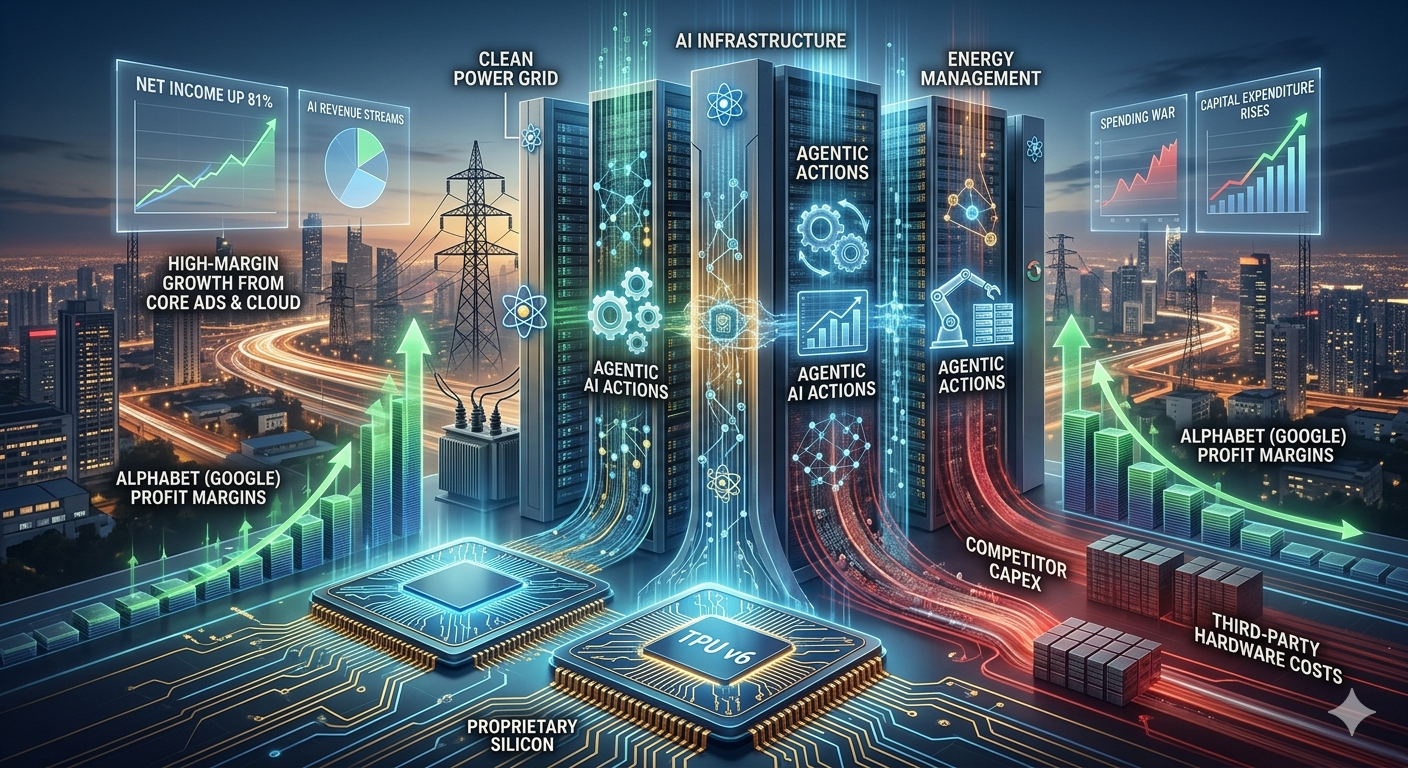
The financial and operational results disclosed today have fundamentally changed the trajectory of the tech industry. We are seeing a move away from "software-only" business models toward a structure that resembles heavy industrial utilities. The main takeaway from today’s developments is that the ability to scale AI is now tied directly to physical infrastructure and energy management.
The Profitability Proof Point
For the last two years, the central question for investors was: When will AI actually show up on the balance sheet? Today, we got the answer. Alphabet’s performance serves as the industry’s first true proof of concept for AI monetization at a global scale. By using its own custom-designed chips to run AI workloads, the company has managed to lower the "cost per query" while simultaneously increasing the value of its advertising units.
This "efficiency-first" approach is the new gold standard. Companies that rely solely on third-party hardware are finding their margins squeezed by the high cost of computing. Those who have built their own "stacks"—from the silicon up to the user interface—are pulling away from the competition.
The Transition to Agentic AI
The massive surge in spending announced by other tech giants today is driven by a shift in what AI is expected to do. We are moving beyond simple chatbots that answer questions. The new focus is "Agentic AI"—systems that can autonomously manage workflows, handle procurement, and solve customer service issues from start to finish.
Supporting these agents requires a total redesign of data centers. Unlike previous workloads, autonomous agents require "always-on" compute power and massive amounts of memory to maintain context over long tasks. This is why capital expenditure is hitting record levels; the industry is essentially building a new, more powerful layer of the internet.
The Power Wall and the Silicon Ceiling
Today’s news highlights two major bottlenecks: electricity and specialized chips. The power demand for a modern AI data center is now comparable to that of a mid-sized city. As a result, tech giants are no longer just software companies; they are becoming energy players. We are seeing a new trend of tech firms investing directly in nuclear power and grid-scale batteries to ensure their growth isn't throttled by local utility limits.
On the hardware side, the "Silicon Ceiling" remains a challenge. While firms are racing to build their own chips, the global supply chain for the high-end components remains tight. This has created a secondary market of winners: the companies that build the cooling systems, the power regulators, and the fiber optics that connect these massive clusters.
The "Heavy Tech" Industrial Model
The most profound shift identified today is the "industrialization" of Silicon Valley. For decades, tech was a "capital-light" business—you wrote code once and sold it a million times. In the AI era, every "sale" requires a physical unit of compute. This means the companies that lead the next decade will be those that manage supply chains as effectively as they manage software engineers.
We are seeing a move toward vertical integration. The companies reporting the highest margins today are those that own their data centers, design their own chips, and generate or secure their own power. This high barrier to entry suggests a period of consolidation is coming. Smaller firms that cannot afford the $100-billion-plus entry fee for infrastructure will likely be forced to pivot to niche applications or merge with the "infrastructure kings."
Market Implications
The market’s reaction today is a warning to the rest of the sector: vague promises about AI are no longer enough. Investors are now looking for measurable improvements in operating margins and clear timelines for infrastructure deployment. The "Great Divergence" seen today between those who are profiting and those who are just spending is likely to define the stock market for the remainder of 2026.
In conclusion, today marks the moment AI transitioned from a speculative technology to an industrial utility. The winners are no longer just the ones with the smartest algorithms, but those with the deepest pockets and the most efficient physical networks. The war for the future is being fought in the data center and on the power grid.
1
0
0
0

留言