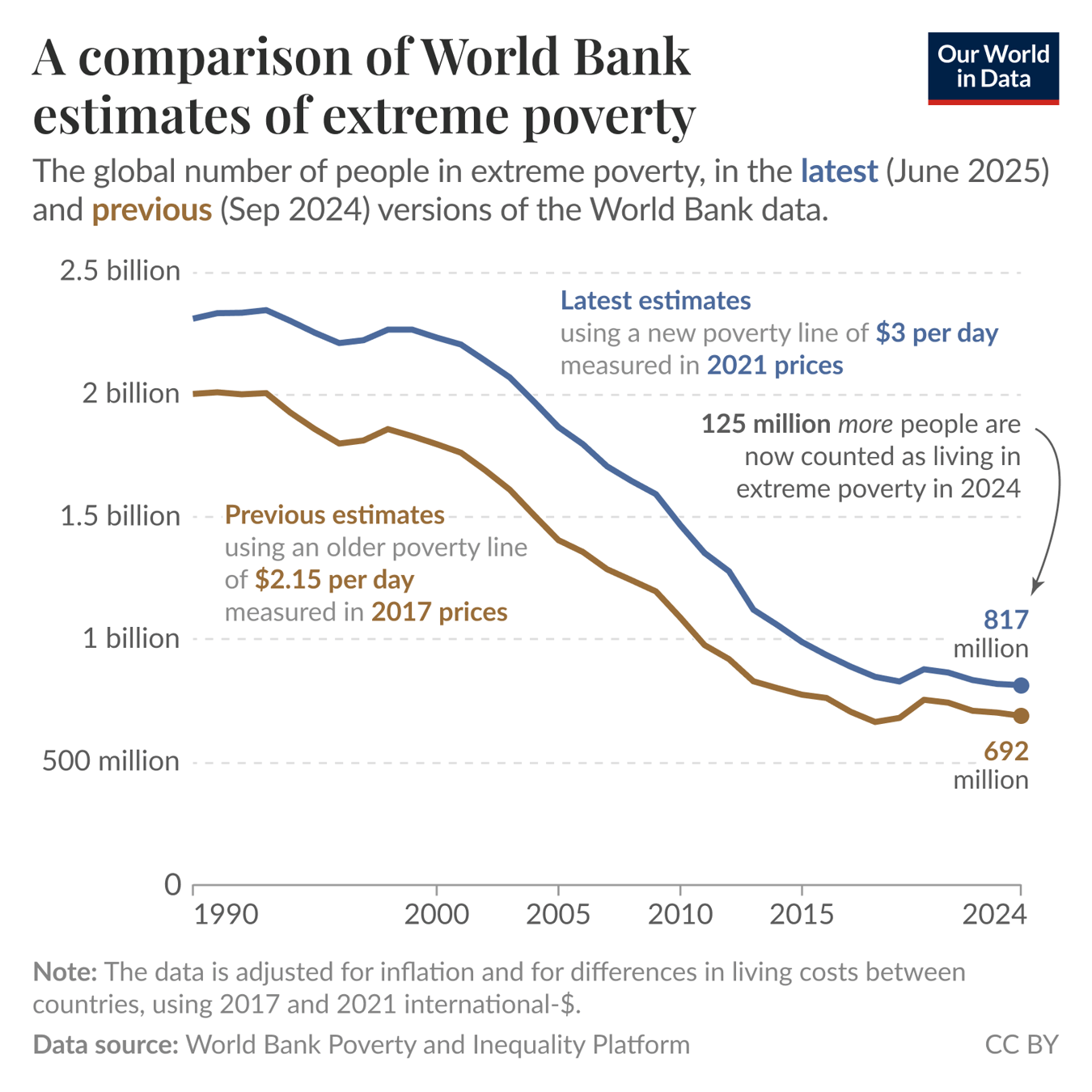
To track progress towards ending extreme poverty, the United Nations relies on World Bank estimates of the number of people living below a poverty threshold called the “International Poverty Line” (IPL).
In June 2025, the World Bank announced a major change to this line, raising it significantly, from $2.15 to $3 per day. As a result, 125 million people who would not have been counted as extremely poor before June are now included.
The increased IPL and the higher poverty estimates are due to a mix of overlapping changes, which we explained in a recent article.
Two things are particularly important to know.
First, the higher estimates of extreme poverty reflect a higher poverty threshold, not** that the world is poorer.** In fact, the latest data shows that incomes among the world’s poorest are actually higher than previously estimated.
Second,** the overall message is the same** whether we look at the new or previous estimates**.** Progress in recent decades has been enormous: well over a billion people have escaped extreme poverty since 1990. But this progress has now stalled. Incomes are stagnant in the places where most of the world’s poorest live. Unless this changes, hundreds of millions of people will be stuck in extreme poverty for years to come.
Read our complete explainer on the new International Poverty Line and World Bank poverty data →
Where this page came from
This page was imported from Our World in Data. “The latest World Bank data counts 125 million more people as living in extreme poverty — but the world has not gotten po” by Joe Hasell, Bertha Rohenkohl, Pablo Arriagada, published by Our World in Data under CC BY 4.0. Changed here: set as a page, its interactive charts shown as pictures. Data from third parties keeps its own licence.
Nobody has written it yet — it is the source material at a new address, which is why search engines are asked to skip it and why no one earns from it. It is up for grabs: take it on, and it is yours to rewrite and to earn from.
许可协议: CC BY 4.0 · 改编自 ourworldindata.org
1
0
0
0

留言