此页面是公开的。
Douglas-Scott-Montagu, John Walter Edward (2nd Baron Montagu of Beaulieu)
“A Southern Scott” (Spy), October 8, 1896
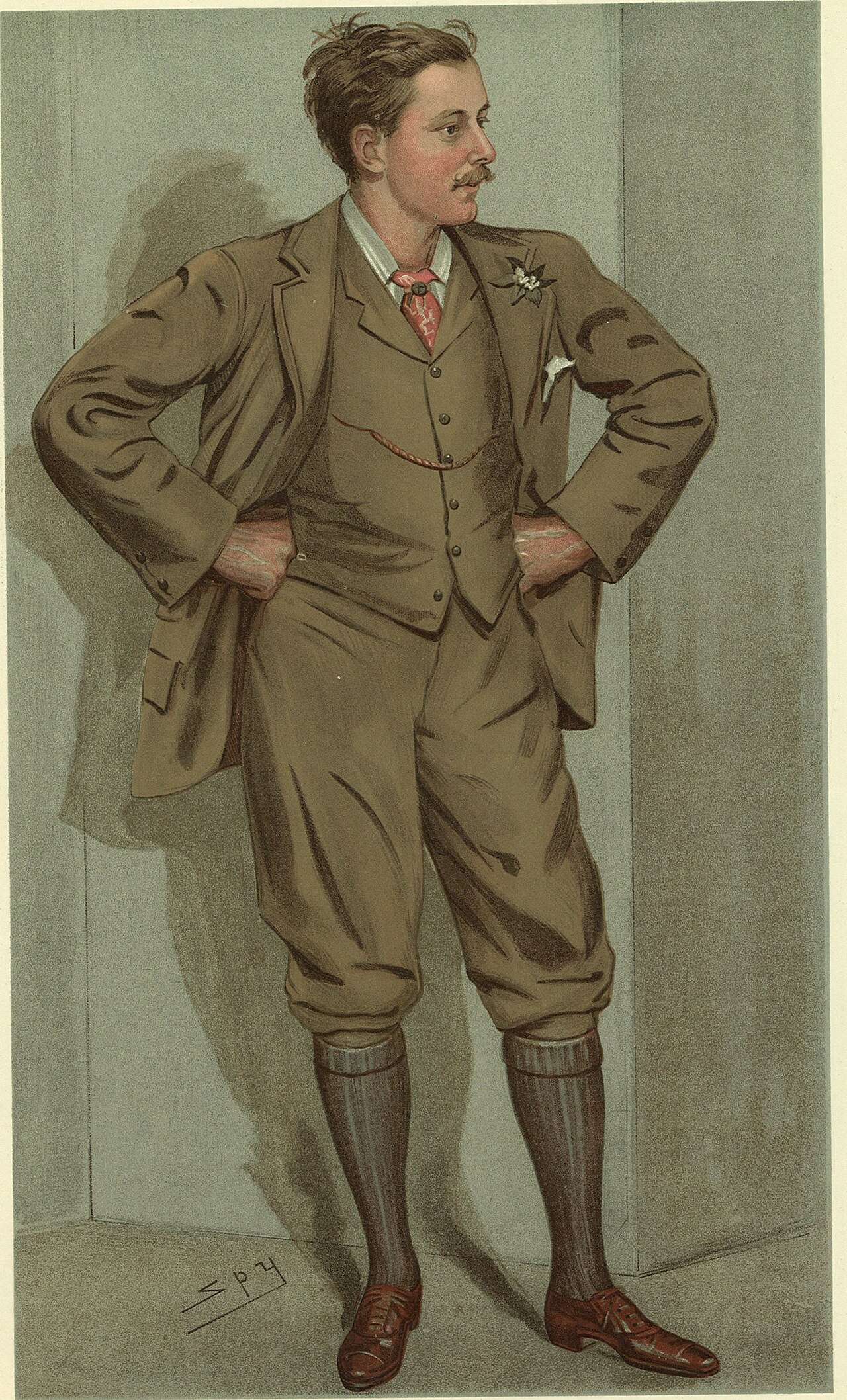
(Image: Leslie Ward, Public domain)
He became the first son of his father (now Lord Montagu of Beaulieu) and grandson of the fifth Duke of Buccleuch thirty years ago; and he has never been still since. So full of energy is he that when he went to Eton he rowed, and shot for his school at Wimbledon; when he went to Oxford he helped the New College boat to the Head of the River; and, after having shown himself something of a scholar as well as a good actor, he worked for a year in the sheds of the London and South-Western Railway Company, and so was made into a practical engineer. Then we went round the world with his cousin, the late Lord Ancrum, and his friend, Lord Ennismore; and when his father was made a Peer, he followed him into Parliament, getting himself returned as the wholesome Tory Member for the New Forest Division of Hampshire: from all which it is clear that he is a versatile young fellow of considerable parts.
He is a good-looking all-round sportsman, a capital shot, a wonderful hand at wild fowling, and almost the only gentleman in England who can scull a gunning-punt. Popular with all classes, he recalls to those who knew it the hearty simplicity of his grandfather. He owns a ranch in America; he has twice been to South Africa (where he is supposed to have studied the railway question); he has acted as correspondent of The Times, and he has interviewed Oom Paul. Consequently he is on the Board of several South African Companies; and, having written a Prize Essay on finance at Oxford, he is as great an authority on money matters as he is on railway difficulties. Yet he yachts partially, cycles with ease, writes fluently for magazines, throws flies quite irresistibly, and talks well with nervous energy. He often steered the Sciola (built by Admiral Victor Montagu) to victory, and he is both a Justice of the Peace and a Captain of Volunteers.
He owns a beautiful collection of shooting coats; some of which are very well worn.
J.W.E. Douglas-Scott-Montagu (1866-1929) rowed for the Oxford Etonians in the 1887 Grand with Guy Nickalls and D.H. McLean. He is remembered as a pioneer of motoring, commemorated by his son in 1950 with the establishment of the National Motor Museum at Beaulieu, the family estate in the New Forest, Hampshire. Douglas-Scott-Montagu was responsible for the iconic Rolls Royce hood ornament, in that the design he commissioned in 1910 from Charles Sykes became the Spirit of Ecstasy that the company eventually adopted as a standard feature.
Where this page came from
This page was imported from Wikibooks. From “The Rowers of Vanity Fair” on Wikibooks, by its contributors, under CC BY-SA 4.0. Changed here: set as a page; navigation and edit links left out; each image under its own licence, credited in its caption.
Nobody has written it yet — it is the source material at a new address, which is why search engines are asked to skip it and why no one earns from it. It is up for grabs: take it on, and it is yours to rewrite and to earn from.
收录于这些专栏The Rowers of Vanity Fair
许可协议: CC BY-SA 4.0 · 改编自 en.wikibooks.org
留言