
想要改进节点的内容吗?试试提出一个编辑请求吧。
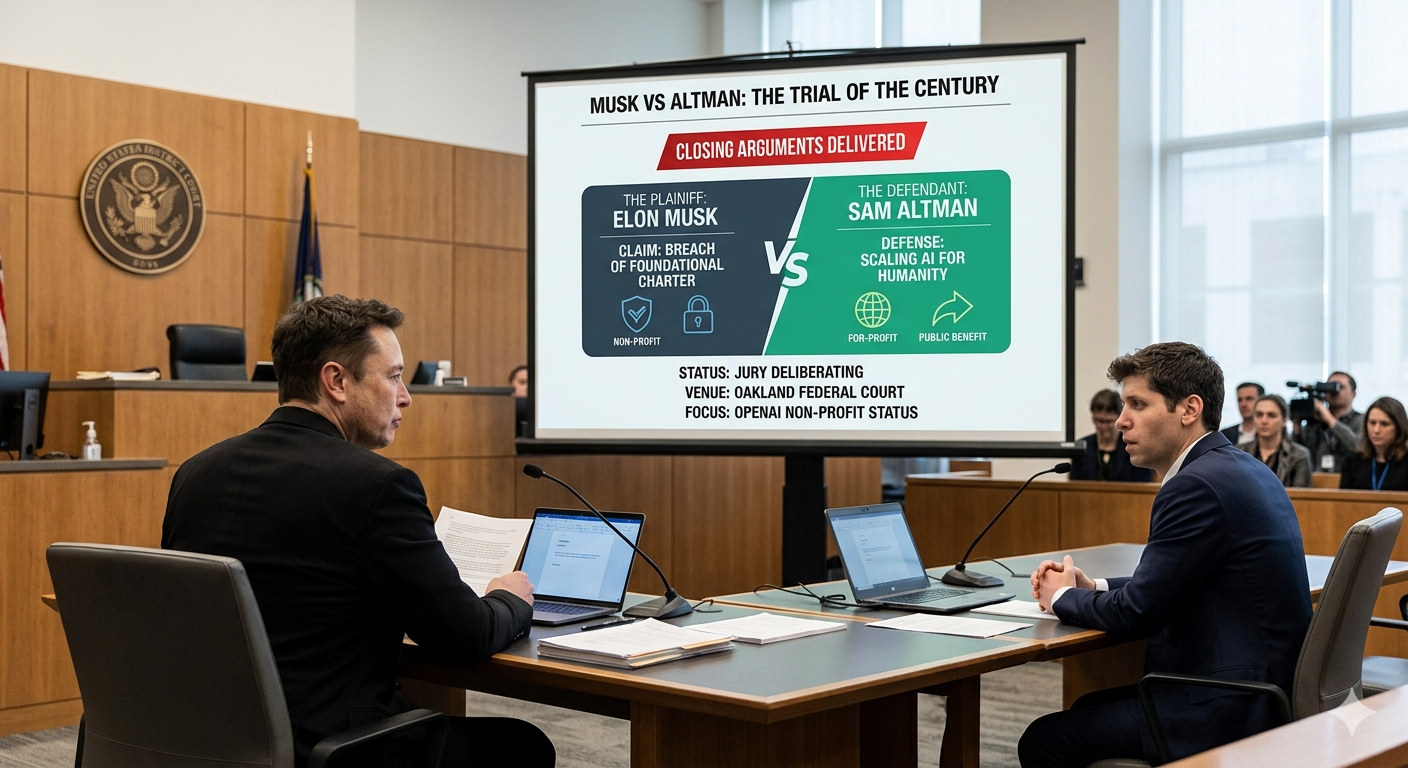
The high-stakes legal battle between Elon Musk and OpenAI CEO Sam Altman reached a dramatic milestone in an Oakland federal court as both sides delivered their closing arguments. The landmark lawsuit, which has laid bare the internal friction, private communications, and corporate maneuvering of Silicon Valley’s elite, now rests in the hands of a nine-person jury. The verdict carries massive implications for the future of artificial intelligence governance, OpenAI's corporate structure, and its anticipated blockbuster initial public offering. At the core of the dispute is Musk’s claim that Altman and co-founder Greg Brockman betrayed OpenAI’s foundational 2015 mission as a open-source, nonprofit research lab. Musk's legal team argues that the executives breached a charitable trust by shifting toward a highly profitable partnership with Microsoft, seeking up to $134 billion in financial disgorgement back into the nonprofit entity alongside the removal of Altman and Brockman. Conversely, OpenAI’s defense emphasizes that no formal contract tying the company to a permanent nonprofit structure ever existed. They characterize Musk’s litigation as a vengeful attempt to derail a successful competitor, pointing to evidence that Musk himself tried to transition OpenAI into a for-profit entity under his own control before exiting the board in 2018. As jury deliberations begin, the tech industry watches closely to see if the court will enforce stricter boundaries on AI altruism or validate the aggressive, commercialized scaling models that currently dominate the sector.
The Billionaire Backstory: From Altruistic Roots to Courtroom Warfare
The roots of Musk v. Altman trace back over a decade to 2015. Alarmed by Google’s rapid and closed acquisition of DeepMind, Elon Musk teamed up with Silicon Valley tech broker Sam Altman, technical expert Greg Brockman, and AI scientist Ilya Sutskever to found OpenAI. The organization was established explicitly as a 501(c)(3) nonprofit research laboratory. Its stated mandate was clear: develop Artificial General Intelligence (AGI) safely and transparently, ensuring its benefits were distributed equitably to humanity rather than locked behind corporate walls.
Musk served as the primary financial engine during these formative years, injecting roughly $38 million into the project to fund early research and recruit top-tier engineering talent. However, ideological and structural friction quickly emerged. By 2017, internal communications revealed deep anxieties over the massive computing capital required to compete with big tech giants.
According to evidence presented during the trial, Musk proposed an aggressive shift: transforming OpenAI into a for-profit commercial entity with himself installed as CEO and majority shareholder, or potentially folding the lab directly into Tesla to leverage the automaker's cash flow.
When Altman, Brockman, and the other co-founders flatly rejected turning total control of frontier AI over to a single individual, the alliance shattered. Musk abruptly resigned from the board in 2018, stopped his planned financial contributions, and publicly predicted that OpenAI had a "0 percent chance of success."
OpenAI Structural Evolution
- 2015: Formed as a pure, open-source 501(c)(3) nonprofit entity.
- 2018: Internal rift over leadership; Musk exits the board and halts donations.
- 2019: OpenAI creates a "capped-profit" commercial subsidiary to raise funding.
- 2019-2023: Microsoft invests $13 billion; ChatGPT launches commercially.
- 2024-2026: Valuations climb toward $1 trillion; Musk files suit to halt commercialization.
Left without its primary benefactor, OpenAI executed a complex corporate restructuring in 2019. The leadership team bolted a commercial, "capped-profit" subsidiary onto the existing nonprofit structure. This legal pivot allowed OpenAI to secure an initial $1 billion investment from Microsoft, a partnership that expanded by an additional $10 billion following the public launch of ChatGPT.
By 2026, this hybrid structure transformed OpenAI from a struggling research lab into an industry titan valued at more than $850 billion. Watching from the sidelines, Musk launched his own commercial AI competitor, xAI, before channeling his frustration into the legal system by filing his blockbuster lawsuit.
Inside the Courtroom: Closing Arguments and Core Legal Strategies
The final phase of the three-week trial before U.S. District Judge Yvonne Gonzalez Rogers centered on two completely divergent narratives. Lawyers for both sides extracted distinct threads from years of internal messages to paint contrasting portraits of corporate governance, intent, and personal integrity.
The Plaintiff’s Case: "They Stole a Charity"
Led by attorney Steven Molo, Musk’s legal team structured its closing argument around corporate transparency and character assessment. Molo repeatedly hammered home a singular, provocative phrase to summarize the case: "They stole a charity."
- The Credibility Factor: Musk’s attorneys put Sam Altman's trustworthiness directly on trial. Molo highlighted under-oath testimony from five separate witnesses—all former OpenAI executives and board members—who explicitly characterized Altman as dishonest or manipulative during their tenures. The plaintiff noted that during his own cross-examination, Altman used evasive, noncommittal language when pressed on whether he had misled his business partners. "Sam Altman's credibility is directly at issue in this case," Molo stated firmly to the jury. "If you cannot trust him, if you don't believe him, they cannot win. It's that simple."
- Unjust Enrichment & Self-Dealing: The summation pointed directly to the staggering wealth accumulated by OpenAI’s current executives. Musk's team drew attention to Greg Brockman’s equity stake, now valued near $30 billion, and noted that while Altman claims to hold no direct equity in OpenAI itself, he has consistently profited from his investments in outside companies that maintain lucrative commercial contracts with OpenAI (such as Helion, Cerebras, and Reddit). "You can't have guys with $30 billion stakes and claim they're entitled to that. You can't have guys doing self-dealing... that's not a nonprofit," Molo argued.
- Aiding and Abetting: Microsoft was also firmly targeted during the closing statements. The defense asserted that Microsoft was fully aware of OpenAI's structural shift away from its public charter every step of the way, actively aiding and abetting the diversion of intellectual property away from the public domain for exclusive corporate gain.
The Defense’s Case: "Selective Amnesia" and Market Jealousy
OpenAI’s lead defense attorney, Sarah Eddy, delivered a scathing counter-argument, dismissing Musk’s claims as a collection of "sound bites and irrelevant false accusations" brought forth by an erratic billionaire experiencing acute seller's remorse.
- The Missing Contract: The core of OpenAI’s defense rested on a fundamental legal reality: there is no signed, formal written contract specifying that OpenAI was legally obligated to remain a pure nonprofit in perpetuity. Eddy argued that Musk’s financial donations came with absolutely no strings attached, a point backed up by the trial testimony of several individuals, including Musk’s close business associate Shivon Zilis. "No documents corroborate Mr. Musk's story," Eddy told the jury. "And that's because no commitments or promises were made."
- The Hypocrisy Argument: OpenAI’s legal team painted Musk as a deeply hypocritical figure who is using the legal system to handicap an industry rival. Eddy presented internal emails from 2017 showing that Musk was actively leading the charge to convert OpenAI into a commercial operation when it suited his interests. The defense argued that if Musk truly believed AGI should solely serve humanity via open-source frameworks, he would not have tried to absorb OpenAI into Tesla, nor would his current venture, xAI, operate under a closed-source, highly commercialized model. "Mr. Musk wanted total control," Eddy asserted, claiming he sued only after his attempts to gain dominion over AGI failed.
- The Statute of Limitations: Finally, the defense emphasized a crucial procedural barrier. Under California law, Musk faced a strict three-year statute of limitations to file his claims. Because internal documents proved Musk was fully aware of OpenAI's restructuring plans and outside funding goals as early as 2018, the defense argued that his 2024 lawsuit was filed years too late to be legally valid.
Key Revelations from the Trial Discovery
The three-week trial served as an unprecedented public window into the secretive world of elite artificial intelligence development. The discovery process unearthed a massive cache of internal group chats, private emails, and executive diaries that exposed severe internal rifts, eccentric leadership styles, and intense power struggles.
- The Alternate Names Emails: Early correspondence between Musk and Altman revealed that OpenAI narrowly escaped being named "Freethank" (Musk’s preference) or "Axon" (Altman’s preference) before settling on OpenAI—a name that critics now ironize as "ClosedAI."
- The 2017 Haunted Mansion Meeting: Testimony from Greg Brockman described a chaotic 2017 meeting held at a newly purchased "haunted mansion" near San Francisco, where Musk attempted to finalize terms for a for-profit pivot. The house was reportedly still littered with party debris from the night before, with actress Amber Heard present serving drinks.
- The Peace Offering Incident: Following a fierce argument where the co-founders rejected Musk's demand for majority control, Ilya Sutskever attempted to present Musk with a custom-commissioned painting of a Tesla as a peace offering. According to testimony, an enraged Musk grabbed the painting and stormed out, demanding to know when the other founders would be leaving the company.
- The November 2023 Firing Texts: Court documents revealed the granular chaos of the infamous four days in November 2023 when Altman was briefly ousted by the board. Chief Scientist Ilya Sutskever wrote an internal memo accusing Altman of a "consistent pattern of lying and pitting executives against each other."
- The "Directionally Very Bad" Exchange: Discovery entered into immortal tech lore a text message exchange from the peak of the 2023 board coup. A panicked Altman texted then-CTO Mira Murati asking if things looked "directionally good or bad." Murati, who was quietly working with the board to replace him, replied bluntly: "Directionally, very bad."
- The "Amateur City" Assessment: Internal communications from Microsoft CEO Satya Nadella exposed deep frustrations during the 2023 OpenAI board coup. Watching $13 billion of Microsoft’s capital hang in the balance due to nonprofit board mechanics, Nadella privately described the entire OpenAI governance structure as "a sort of amateur city."
Market Fallout and High-Stakes Consequences
The ultimate resolution of Musk v. Altman extends far beyond a personal feud between Silicon Valley's most prominent figures; it directly impacts the broader economic landscape of the tech sector.
The Fate of OpenAI’s IPO
For OpenAI, the trial represents a massive structural hurdle. The company has been actively laying the groundwork for a historic Initial Public Offering (IPO) or a formal transition into a traditional for-profit corporation to satisfy its massive capital requirements. A verdict in favor of Musk could completely freeze these plans, tying the company up in ongoing asset-unwinding procedures and throwing its legal structure into chaotic limbo.
Financial and Corporate Precedent
If the jury rules that OpenAI and its executives breached a charitable trust, it will set an incredibly restrictive precedent for the entire tech industry. It would send a warning shot to other highly funded hybrid entities, proving that early nonprofit promises cannot simply be discarded or structured away once a technology becomes immensely profitable. Conversely, an OpenAI victory will likely solidify the legal viability of the "capped-profit" model, signaling to venture capitalists that public-benefit foundations can be safely commercialized.
Industry Public Relations
The trial has heavily damaged the public relations narratives of both camps. While OpenAI has been exposed as an intense, corporate environment driven by immense wealth and executive infighting, Musk’s legal pursuit has been cast by industry analysts as an aggressive, anti-competitive strategy meant to bleed a primary business rival via discovery leaks and legal fees.
What Happens Next?
As the nine-person jury begins its deliberations, legal scholars and industry analysts are closely calculating the odds of a definitive outcome. On political prediction markets like PolyMarket, odds-makers are currently giving Elon Musk roughly a 32% chance of winning a favorable verdict.
Many legal experts view the case as highly uphill for Musk due to several distinct factors:
- The Absence of an Explicit Contract: Contract disputes are notoriously difficult to win when the plaintiff relies entirely on informal emails, verbal understandings, and website marketing copy rather than a signed, formal founding agreement.
- The Standing and Statute Barriers: OpenAI's defense regarding the expiration of the statute of limitations remains a formidable hurdle. Proving that Musk only realized OpenAI was pursuing profit within the last three years is highly difficult given the immense public coverage of the Microsoft partnership back in 2019.
- Judicial Demeanor: Throughout the trial, U.S. District Judge Yvonne Gonzalez Rogers has maintained a highly strict courtroom, actively shutting down attempts by Musk's legal team to turn the proceedings into a philosophical referendum on the AI apocalypse or existential safety. Judge Rogers also sharply reprimanded Musk's counsel during closing arguments for misleadingly implying to the jury that Musk was not seeking money, noting that his demands for billions of dollars in corporate disgorgement constitute a massive financial claim regardless of where the capital is directed.
The jury will attempt to reach a unanimous verdict. Their decision will either clear OpenAI's path toward total corporate transition and a historic public market debut, or fundamentally fracture the operational structure of the world's leading artificial intelligence company.
1
0
0
0

留言