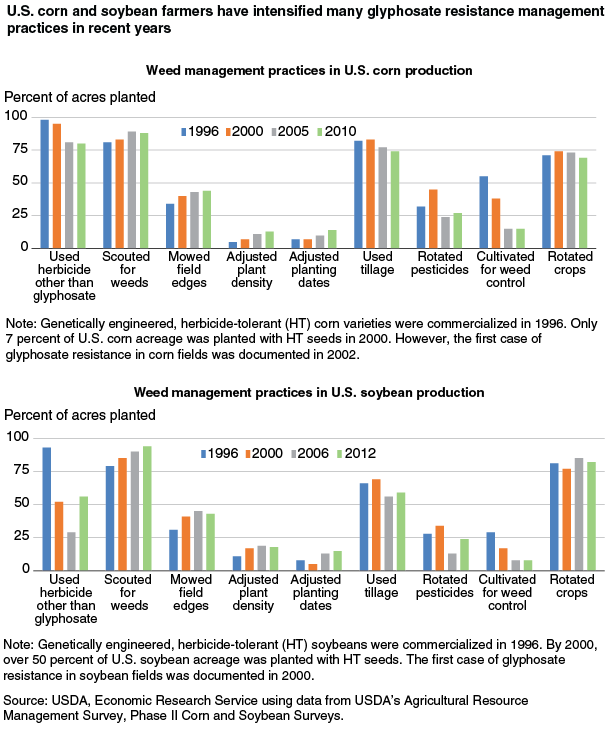
U.S. corn and soybean farmers employ a range of weed control practices. For example, they till soils, rotate their crops, mow their field edges, cultivate for weed control, and carefully consider factors such as plant density and planting dates. That said, most U.S. farmers rely heavily on chemical herbicides for weed control. Herbicides were applied to more than 95 percent of U.S. corn acres planted in 2010 and U.S. soybean acres planted in 2012.
Over the course of the last two decades, U.S. corn and soybean farmers have dramatically increased their use of glyphosate (the active ingredient in popular herbicide products such as Roundup) and decreased their use of herbicide products containing other active ingredients. In 2015, ERS researchers found that the percentage of soybean acres treated with glyphosate, by itself or in combination with other herbicides, increased from approximately 25 percent in 1996 to 95 percent in 2006. The percentage of corn acres treated with glyphosate rose from about 4 percent in 1996 to 35 percent in 2005. This shift in herbicide usage contributed to the development of over 14 glyphosate-resistant weed species in U.S. crop production areas.
The Weed Science Society of America reports that glyphosate resistance can be managed using a diverse set of chemical, cultural, and mechanical methods. Glyphosate resistance management practices (RMPs) include herbicide rotation, tillage, scouting for weeds, crop rotation, and other forms of weed control. ERS found that usage rates for many RMPs (such as scouting for weeds, mowing field edges, adjusting plant density, and adjusting planting dates) increased from 1996 to 2012. For example, there was a 15-percentage-point increase in the share of soybean acres scouted, a 12-point increase in the share of soybean acres with mowed field edges, and 7-point increases in the shares of soybean acreage on which plant density and planting dates were adjusted. There was a 10-percentage-point increase in the share of corn acres scouted, a 10-point increase in the share of corn acres with mowed field edges, and 7- to 8-point increases in the shares of corn acreage on which plant density and planting dates were adjusted. In other cases, RMP use dropped from 1996 to 2005/06 but increased as information about glyphosate-resistant weeds spread. For example, herbicides other than glyphosate were applied on 93 percent of planted soybean acres in 1996 but only 29 percent in 2006. By 2012, this percentage had rebounded to 56 percent.
This article is drawn from:
Livingston, M.,
Fernandez-Cornejo, J.,
Unger, J.,
Osteen, C.,
Schimmelpfennig, D.,
Park, T.
& Lambert, D.
(2015). The Economics of Glyphosate Resistance Management in Corn and Soybean Production.
U.S. Department of Agriculture, Economic Research Service.
ERR-184.
Where this page came from
This page was imported from USDA Economic Research Service. Published by the USDA Economic Research Service and, as a work of the United States government, in the public domain.
Nobody has written it yet — it is the source material at a new address, which is why search engines are asked to skip it and why no one earns from it. It is up for grabs: take it on, and it is yours to rewrite and to earn from.
许可协议: CC0 1.0(公有领域) · 改编自 www.ers.usda.gov
1
0
0
0

留言