
পাতার বিষয়বস্তু আরও ভালো করতে চান? একটি পরিবর্তনের প্রস্তাব দিন।
Part of the Park Service's Teaching Suffrage series, created with the Hard History Project.
| Grade | designed for 4th grade, easy to adapt for any elementary grade |
| Guiding question | What does it mean to picket or protest? |
| Objectives | students recognize unfairness at the individual level (for example, speech) and injustice at the institutional or systemic level (for example, discrimination), and their own responsibility to speak up when they believe something is wrong |
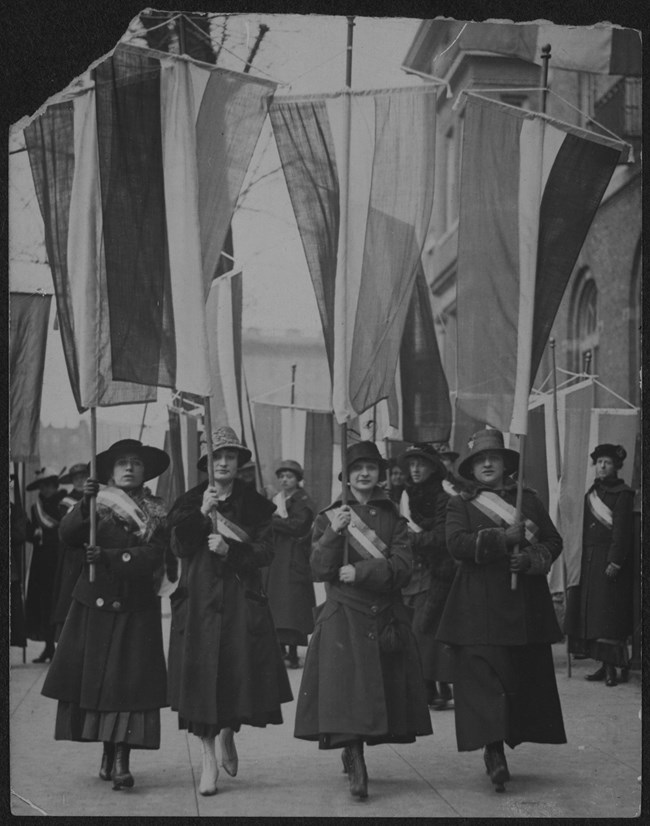
Four wage-earning women picketing in a suffrage procession, February 1917. National Woman's Party Collection, Library of Congress
The story
In January 1917, the Silent Sentinels, organized by Alice Paul and the National Woman's Party (NWP), began standing at the White House gates in all weather with banners asking, "Mr. President, How Long Must Women Wait for Liberty?" They wanted President Woodrow Wilson to support a constitutional amendment giving women the vote.
At first, many people thought the picketers silly, and some suffragists felt they were hurting the cause. Others admired their determination — they came every day for months — and the protests made more Americans aware of woman suffrage.
Then, in April 1917, the U.S. entered World War I, almost three years after it began. The country shifted from neutrality to supporting the war: people bought war bonds, saved food and volunteered with the Red Cross and Salvation Army. Many suffrage groups joined in and even worked with the Wilson administration.
The NWP didn't. Afraid of losing momentum, it kept picketing, with banners asking how Wilson could claim to fight to make the world safe for democracy while refusing to support women's part in democracy at home. Now protesting at the White House looked unpatriotic. Crowds called the women traitors, attacked them, and tore down or stole their banners. Police arrested picketers for blocking the sidewalk, and more than 150 women went to jail over several months. But the NWP kept sending picketers — and kept women's voting rights in the headlines.
Alice Paul explained why they kept going:
"When men are denied justice, they go to war. This is our war, only we are fighting it with banners instead of guns."
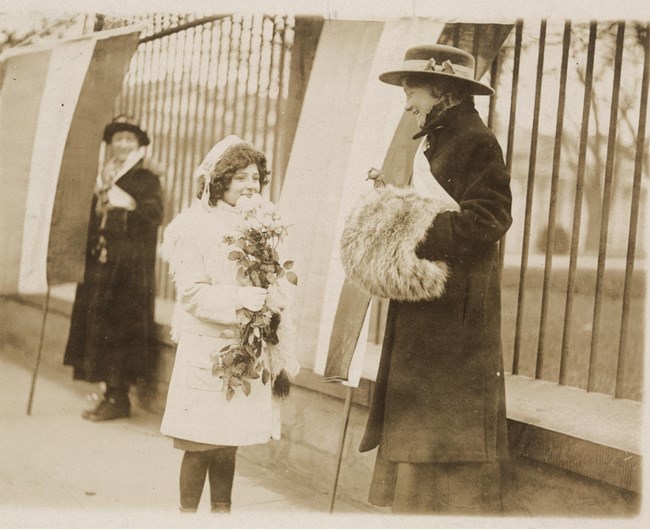
Washington children giving flowers to Congressional Union pickets at the White House, January 1917. National Woman's Party Collection, Library of Congress
Watch
Two Suffrage in 60 Seconds videos:
- Ranger Mannie (1 min 28 s) on picketing as a suffrage tactic — What would you put on your banner?
- Ranger Lorne (1 min 34 s) on the NWP's choice in April 1917: keep pressuring Wilson, or show patriotism by joining the war effort and hope to win the vote that way?
Vocabulary
| Word | Meaning |
|---|---|
| amendment | a change, especially to a document like the Constitution |
| intransigence | stubborn refusal to change |
| mobilize | organize and get ready for something |
| neutrality | not helping either side in a conflict |
| patriot | someone who supports their country and will defend it |
| public sentiment | what people in a community think or believe |
| sentinel | a guard who stands and keeps watch |
| suffrage | the right to vote |
| suffragist | someone who works for the right to vote, especially for women |
| traitor | someone who betrays their country |
| war bonds | a way for governments to raise money for war |
Discuss
- The Silent Sentinels wanted to change the president's mind. When have you changed your mind? What convinced you?
- Did the NWP make the right decision to keep protesting during the war? Were they disrespectful or unpatriotic? Explain.
- Can expanding freedoms be as important as protecting them in wartime?
- For teachers: connect the story to current events — what do students think about the ways people protest today?
More
The 19th Amendment: A Crash Course · National Woman's Party Protests During World War I · Alice Paul · the picture book Let the Children March by Monica Clark-Robinson, illustrated by Frank Morrison · previous in the series: Ida B. Wells in the Suffrage Procession · next: Symbols of Suffrage.
Sources
Based on "Teaching Suffrage: Protest," National Park Service, created with the Hard History Project; a work of the United States government in the public domain; rewritten in hubnx's own words.
যে সংগ্রহগুলোতে আছেNational Mall and Memorial ParksBelmont-Paul Women's Equality National MonumentTeaching Suffrage
লাইসেন্স: CC0 1.0 (পাবলিক ডোমেইন) · গৃহীত হয়েছে www.nps.gov
1
0
0
0

মন্তব্য


