
নোড এর বিষয়বস্তু উন্নত করতে চান? একটি সম্পাদনা অনুরোধ করার চেষ্টা করুন.
In a decisive shift for AI governance, the U.S. government has announced that the National Institute of Standards and Technology (NIST) will conduct rigorous, pre-deployment cybersecurity evaluations of frontier AI models developed by Google, Microsoft, and xAI. This marks a pivotal moment where federal oversight moves from voluntary guidelines to active, "in-the-loop" testing of potentially transformative technology. The initiative, managed by NIST’s Center for AI Standards and Innovation (CAISI), aims to identify systemic vulnerabilities before these high-capability models reach the public. By embedding government testers into the development pipeline, regulators intend to mitigate risks ranging from automated offensive cyber capabilities to the proliferation of biological or chemical threats. This move signals an end to the era of unrestricted "move fast and break things" in the foundation model space. Industry analysts view this as a strategic recalibration: while the tech giants gain a stamp of federal approval—reducing the risk of catastrophic failures—they also cede a degree of autonomy. For the AI sector, this creates a new baseline for "safe" deployment, essentially establishing a certification standard that could shape future market entry. As models become more powerful, the tension between rapid innovation and national security will define the industry trajectory through 2026 and beyond.
The New Era of AI Oversight
The announcement that NIST will begin pre-deployment testing of AI models from Google, Microsoft, and xAI represents a fundamental structural change in the relationship between Silicon Valley and Washington. For the past decade, the tech industry has operated under a model of self-regulation, where internal red-teaming was the primary defense against unforeseen AI hazards. Today’s news signals that the "Wild West" of foundation model development is officially closing.
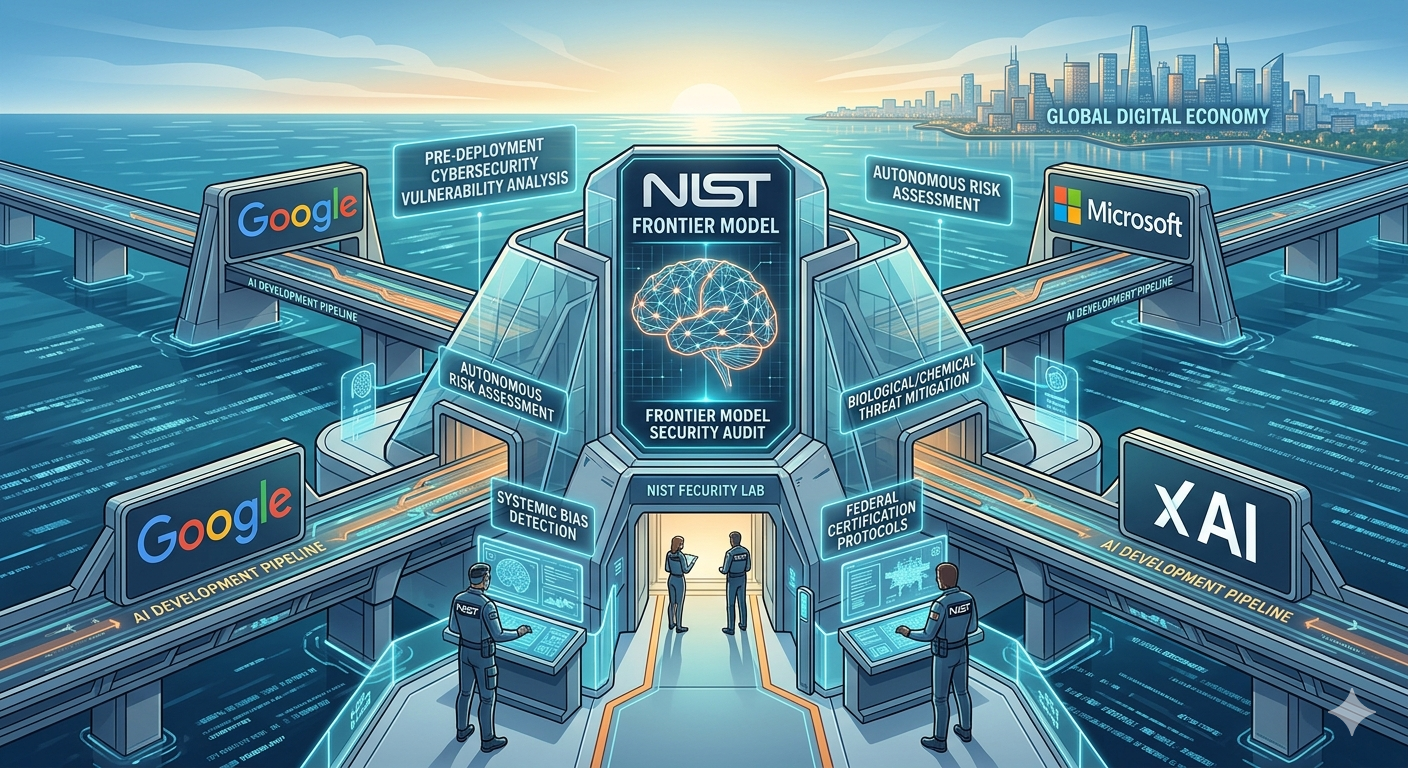
The Shift to Pre-Deployment Accountability
Historically, NIST has focused on defining standards—setting the criteria for "how" models should be tested. By transitioning to conducting the tests themselves, the agency is now assuming the role of an auditor. This is not merely an administrative shift; it is a profound change in the risk profile of AI companies.
By having government officials, potentially including those from intelligence and defense backgrounds, evaluate models in classified settings, companies like Google and Microsoft are essentially outsourcing a portion of their safety verification. This serves two purposes:
- Risk Mitigation: It reduces the likelihood of a catastrophic deployment failure—an "accident" that could trigger a massive public backlash or legislative crackdown.
- Liability Shielding: If a model undergoes NIST evaluation and subsequently causes issues, the companies can argue they met federal safety standards, potentially insulating them from aggressive litigation or regulatory fines.
The Strategic Implications for xAI, Google, and Microsoft
For Google and Microsoft, this is an integration challenge. Both companies have deeply embedded AI across their product suites. Submitting their "frontier" models—the cutting-edge, massive-parameter systems that power their future earnings—to government scrutiny adds friction to their release cycles.
For xAI, the inclusion is perhaps most significant. Elon Musk’s AI venture has been aggressive in its development pace. Engaging in this level of government partnership suggests xAI is aiming to position itself as an institutional-grade provider, moving beyond the "experimental" phase into a core infrastructure layer for the U.S. government.
Technical and Ethical Trade-offs
The "black box" nature of current AI models makes testing inherently difficult. Unlike traditional software, where code paths can be audited, neural networks operate on statistical probabilities that are notoriously opaque. NIST’s challenge will be to develop metrics that can actually detect "emergent" behaviors—abilities the model displays that were not explicitly programmed.
The concern among civil liberties groups is that this level of government access creates a "soft" backdoor into the most powerful cognitive systems ever created. If the government is monitoring model weights or training runs for safety, what prevents that access from creeping into surveillance or industrial espionage? The industry will be watching closely to see how the "red line" between security evaluation and IP protection is drawn.
The Road Ahead
This policy marks the beginning of a "certification" economy for AI. Just as industries like aviation and pharmaceuticals must prove efficacy and safety before market entry, we are seeing the birth of the "AI-Safety-Approved" designation.
Moving forward, the primary metric for tech success will not just be token prediction accuracy or parameter count; it will be the speed at which a company can iterate while satisfying federal security requirements. This will likely favor incumbents with massive operational budgets—Google and Microsoft—who can absorb the cost of compliance, potentially raising the barrier to entry for smaller startups that lack the resources to handle such intense regulatory scrutiny.
As of May 6, 2026, the AI industry has reached a point of maturity where it is now treated as "critical national infrastructure." The coming months of initial NIST testing will provide the first real data on whether the government can effectively police the pace of AI innovation without stifling it. For investors, developers, and the public, the stakes could not be higher.
1
0
0
0

মন্তব্য