
Ser du noget at forbedre? Foreslå en ændring.
Denne side er offentlig.
Learning Objectives
By the end of this section, you will be able to:
- Classify batteries as primary or secondary
- List some of the characteristics and limitations of batteries
- Provide a general description of a fuel cell
A battery is an electrochemical cell or series of cells that produces an electric current. In principle, any galvanic cell could be used as a battery. An ideal battery would never run down, produce an unchanging voltage, and be capable of withstanding environmental extremes of heat and humidity. Real batteries strike a balance between ideal characteristics and practical limitations. For example, the mass of a car battery is about 18 kg or about 1% of the mass of an average car or light-duty truck. This type of battery would supply nearly unlimited energy if used in a smartphone, but would be rejected for this application because of its mass. Thus, no single battery is “best” and batteries are selected for a particular application, keeping things like the mass of the battery, its cost, reliability, and current capacity in mind. There are two basic types of batteries: primary and secondary. A few batteries of each type are described next.
Link to Learning
Visit this site to learn more about batteries.
Primary Batteries
Primary batteries are single-use batteries because they cannot be recharged. A common primary battery is the dry cell (Figure 17.10). The dry cell is a zinc-carbon battery. The zinc can serves as both a container and the negative electrode. The positive electrode is a rod made of carbon that is surrounded by a paste of manganese(IV) oxide, zinc chloride, ammonium chloride, carbon powder, and a small amount of water. The reaction at the anode can be represented as the ordinary oxidation of zinc:
\begin{matrix}\text{Zn} ( s ) \ ⟶ \ {\text{Zn}}^{2+} ( a q ) + 2 {\text{e}}^{\text{−}} & \ {E}_{{\text{Zn}}^{2+} \text{/Zn}}^{°} = −0.76 \text{18 V}\end{matrix}17.110
The reaction at the cathode is more complicated, in part because more than one reaction occurs. The series of reactions that occurs at the cathode is approximately
2 {\text{MnO}}_{2} ( s ) + 2 {\text{NH}}_{4} \text{Cl} ( a q ) + 2 \ {\text{e}}^{\text{−}} \ ⟶ \ {\text{Mn}}_{2} {\text{O}}_{3} ( s ) + 2 {\text{NH}}_{3} ( a q ) + {\text{H}}_{2} \text{O} ( l ) + 2 {\text{Cl}}^{\text{−}}17.111
The overall reaction for the zinc–carbon battery can be represented as {}2 {\text{MnO}}_{2} ( s ) + 2 {\text{NH}}_{4} \text{Cl} ( a q ) + \text{Zn} ( s ) \ ⟶ \ {\text{Zn}}^{2+} ( a q ) + {\text{Mn}}_{2} {\text{O}}_{3} ( s ) + 2 {\text{NH}}_{3} ( a q ) + {\text{H}}_{2} \text{O} ( l ) + 2 {\text{Cl}}^{\text{−}}with an overall cell potential which is initially about 1.5 V, but decreases as the battery is used. It is important to remember that the voltage delivered by a battery is the same regardless of the size of a battery. For this reason, D, C, A, AA, and AAA batteries all have the same voltage rating. However, larger batteries can deliver more moles of electrons. As the zinc container oxidizes, its contents eventually leak out, so this type of battery should not be left in any electrical device for extended periods.
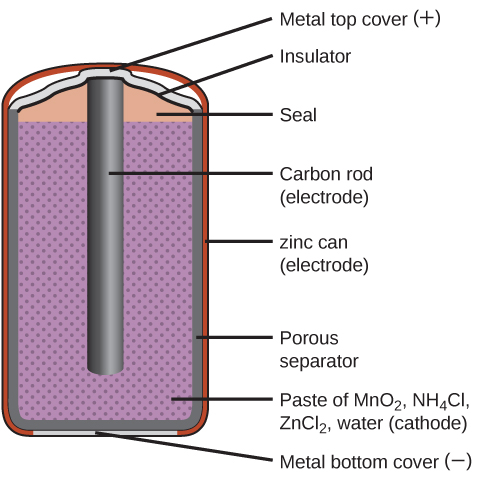
Figure 17.10. The diagram shows a cross section of a flashlight battery, a zinc-carbon dry cell.
Link to Learning
Visit this site to learn more about zinc-carbon batteries.
Alkaline batteries (Figure 17.11) were developed in the 1950s partly to address some of the performance issues with zinc–carbon dry cells. They are manufactured to be exact replacements for zinc-carbon dry cells. As their name suggests, these types of batteries use alkaline electrolytes, often potassium hydroxide. The reactions are
\begin{matrix}{\begin{matrix}\text{anode:} \ \text{Zn} ( s ) + 2 {\text{OH}}^{\text{−}} ( a q ) \ ⟶ \ \text{ZnO} ( s ) + {\text{H}}_{2} \text{O} ( l ) + {\text{2e}}^{\text{−}} \ {E}_{\text{anode}}^{°} = \text{−1.28 V} \\ \text{cathode:} \ 2 {\text{MnO}}_{2} ( s ) + {\text{H}}_{2} \text{O} ( l ) + {\text{2e}}^{\text{−}} \ ⟶ \ {\text{Mn}}_{2} {\text{O}}_{3} ( s ) + {\text{2OH}}^{\text{−}} ( a q ) \ {E}_{\text{cathode}}^{°} = \text{+0.15 V}\end{matrix}}_{¯} \\ \text{overall:} \ \text{Zn} ( s ) + {\text{2MnO}}_{2} ( s ) \ ⟶ \ \text{ZnO} ( s ) + {\text{Mn}}_{2} {\text{O}}_{3} ( s ) \ {E}_{\text{cell}}^{°} = \text{+1.43 V}\end{matrix}17.112
An alkaline battery can deliver about three to five times the energy of a zinc-carbon dry cell of similar size. Alkaline batteries are prone to leaking potassium hydroxide, so these should also be removed from devices for long-term storage. While some alkaline batteries are rechargeable, most are not. Attempts to recharge an alkaline battery that is not rechargeable often leads to rupture of the battery and leakage of the potassium hydroxide electrolyte.
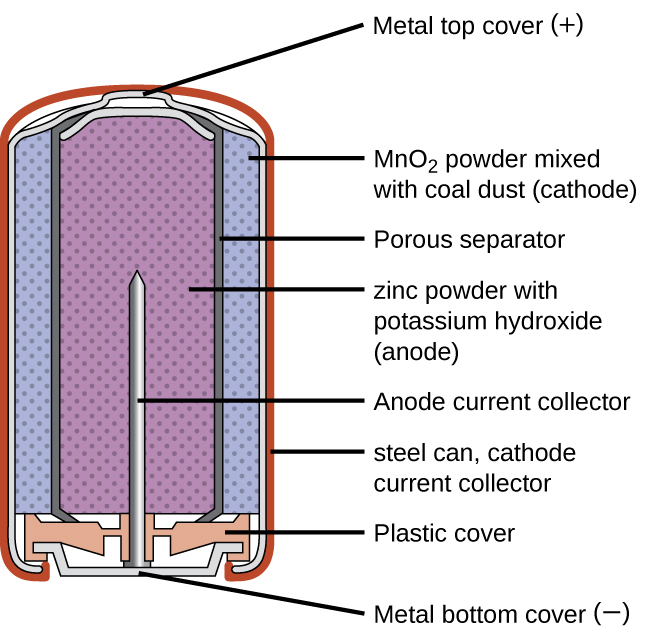
Figure 17.11. Alkaline batteries were designed as direct replacements for zinc-carbon (dry cell) batteries.
Link to Learning
Visit this site to learn more about alkaline batteries.
Secondary Batteries
Secondary batteries are rechargeable. These are the types of batteries found in devices such as smartphones, electronic tablets, and automobiles.
Nickel-cadmium, or NiCd, batteries (Figure 17.12) consist of a nickel-plated cathode, cadmium-plated anode, and a potassium hydroxide electrode. The positive and negative plates, which are prevented from shorting by the separator, are rolled together and put into the case. This is a “jelly-roll” design and allows the NiCd cell to deliver much more current than a similar-sized alkaline battery. The reactions are
\begin{matrix}{\begin{matrix}\text{anode:} \ \text{Cd} ( s ) + {\text{2OH}}^{\text{−}} ( a q ) \ ⟶ \ {\text{Cd(OH)}}_{2} ( s ) + {\text{2e}}^{\text{−}} \\ \text{cathode:} \ {\text{NiO}}_{2} ( s ) + {\text{2H}}_{2} \text{O} ( l ) + {\text{2e}}^{\text{−}} \ ⟶ \ {\text{Ni(OH)}}_{2} ( s ) + {\text{2OH}}^{\text{−}} ( a q )\end{matrix}}_{¯} \\ \text{overall: Cd} ( s ) + {\text{NiO}}_{2} ( s ) + {\text{2H}}_{2} \text{O} ( l ) \ ⟶ \ {\text{Cd(OH)}}_{2} ( s ) + {\text{Ni(OH)}}_{2} ( s )\end{matrix}17.113
The voltage is about 1.2 V to 1.25 V as the battery discharges. When properly treated, a NiCd battery can be recharged about 1000 times. Cadmium is a toxic heavy metal so NiCd batteries should never be opened or put into the regular trash.
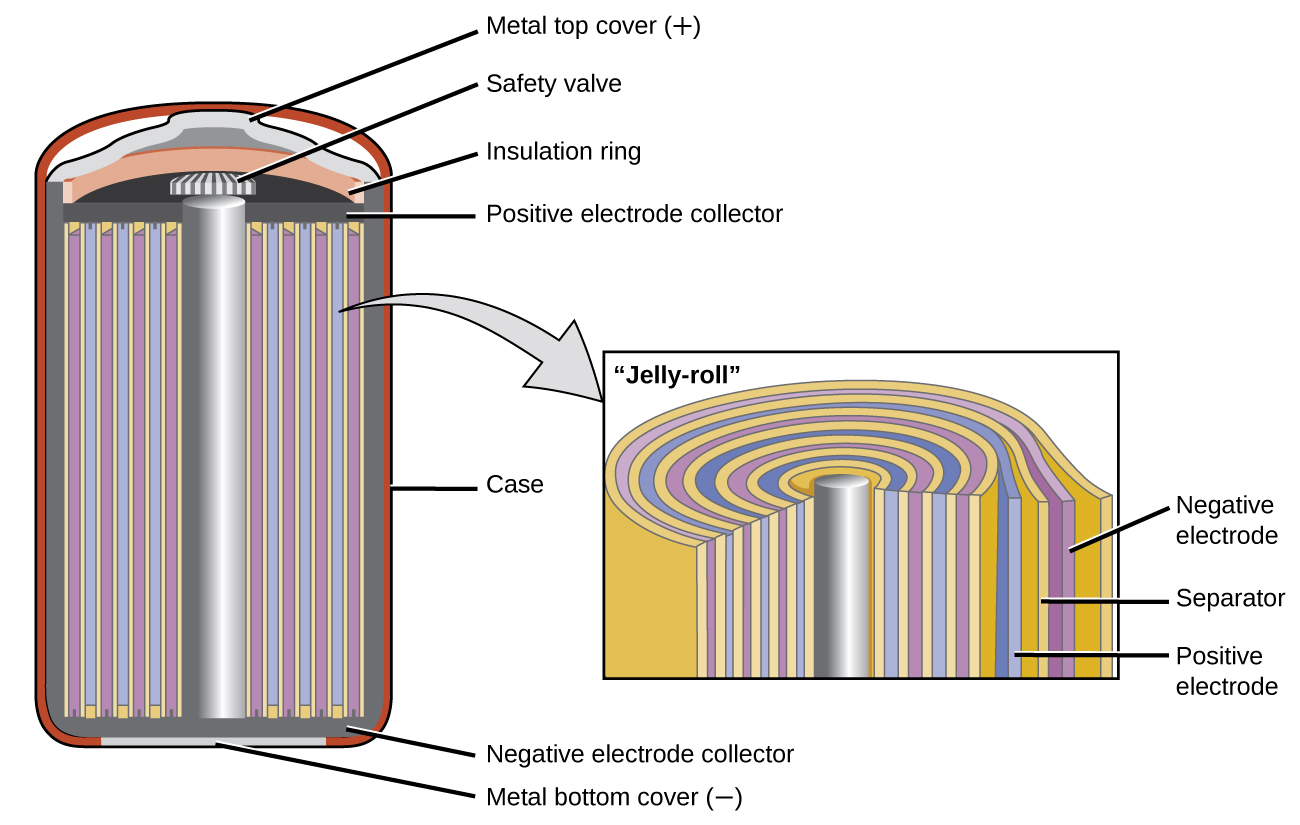
Figure 17.12. NiCd batteries use a “jelly-roll” design that significantly increases the amount of current the battery can deliver as compared to a similar-sized alkaline battery.
Link to Learning
Visit this site for more information about nickel cadmium rechargeable batteries.
Lithium ion batteries (Figure 17.13) are among the most popular rechargeable batteries and are used in many portable electronic devices. The reactions are
\begin{matrix}{\begin{matrix}\text{anode:} \ {\text{LiCoO}}_{2} \ ⇌ \ {\text{Li}}_{1 \text{−} x} {\text{CoO}}_{2} + x \ {\text{Li}}^{\text{+}} + x \ {\text{e}}^{\text{−}} \\ \text{cathode:} \ x \ {\text{Li}}^{\text{+}} + x \ {\text{e}}^{\text{−}} + x \ {\text{C}}_{6} \ ⇌ \ x \ {\text{LiC}}_{6}\end{matrix}}_{¯} \\ \text{overall:} \ {\text{LiCoO}}_{2} + x \ {\text{C}}_{6} \ ⇌ \ {\text{Li}}_{1 \text{−} x} {\text{CoO}}_{2} + x \ {\text{LiC}}_{6}\end{matrix}17.114
With the coefficients representing moles, x is no more than about 0.5 moles. The battery voltage is about 3.7 V. Lithium batteries are popular because they can provide a large amount current, are lighter than comparable batteries of other types, produce a nearly constant voltage as they discharge, and only slowly lose their charge when stored.
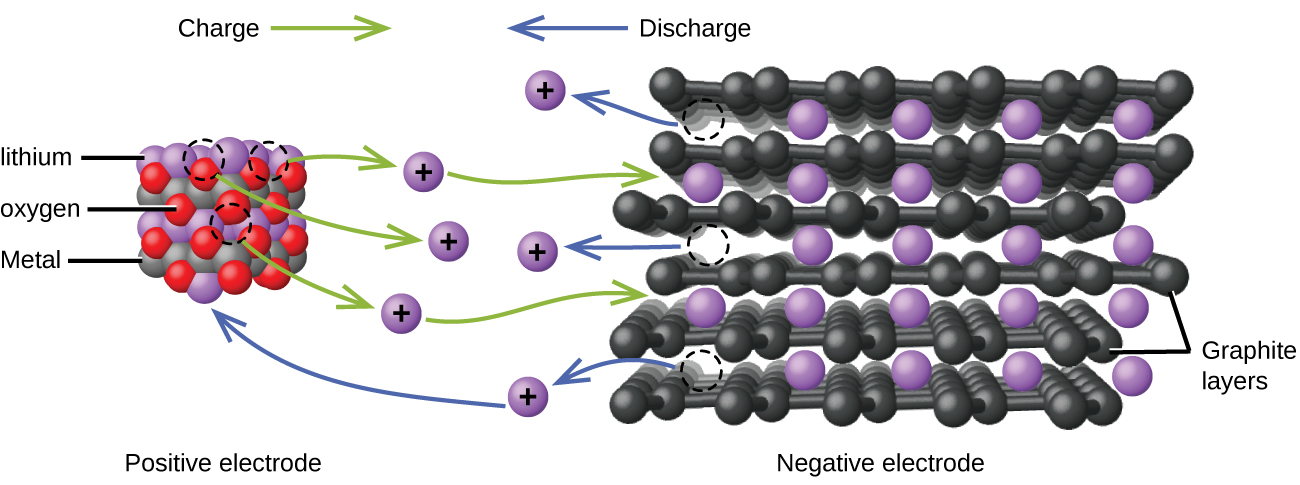
Figure 17.13. In a lithium ion battery, charge flows between the electrodes as the lithium ions move between the anode and cathode.
Link to Learning
Visit this site for more information about lithium ion batteries.
The lead acid battery (Figure 17.14) is the type of secondary battery used in your automobile. It is inexpensive and capable of producing the high current required by automobile starter motors. The reactions for a lead acid battery are
\begin{matrix}{\begin{matrix}\text{anode:} \ \text{Pb} ( s ) + {\text{HSO}}_{4} {}^{\text{−}} ( a q ) \ ⟶ \ {\text{PbSO}}_{4} ( s ) + {\text{H}}^{\text{+}} ( a q ) + {\text{2e}}^{\text{−}} \\ {\text{cathode: PbO}}_{2} ( s ) + {\text{HSO}}_{4} {}^{\text{−}} ( a q ) + {\text{3H}}^{\text{+}} ( a q ) + {\text{2e}}^{\text{−}} \ ⟶ \ {\text{PbSO}}_{4} ( s ) + 2 {\text{H}}_{2} \text{O} ( l )\end{matrix}}_{¯} \\ \text{overall:} \ \text{Pb} ( s ) + {\text{PbO}}_{2} ( s ) + 2 {\text{H}}_{2} {\text{SO}}_{4} ( a q ) \ ⟶ \ {\text{2PbSO}}_{4} ( s ) + 2 {\text{H}}_{2} \text{O} ( l )\end{matrix}17.115
Each cell produces 2 V, so six cells are connected in series to produce a 12-V car battery. Lead acid batteries are heavy and contain a caustic liquid electrolyte, but are often still the battery of choice because of their high current density. Since these batteries contain a significant amount of lead, they must always be disposed of properly.
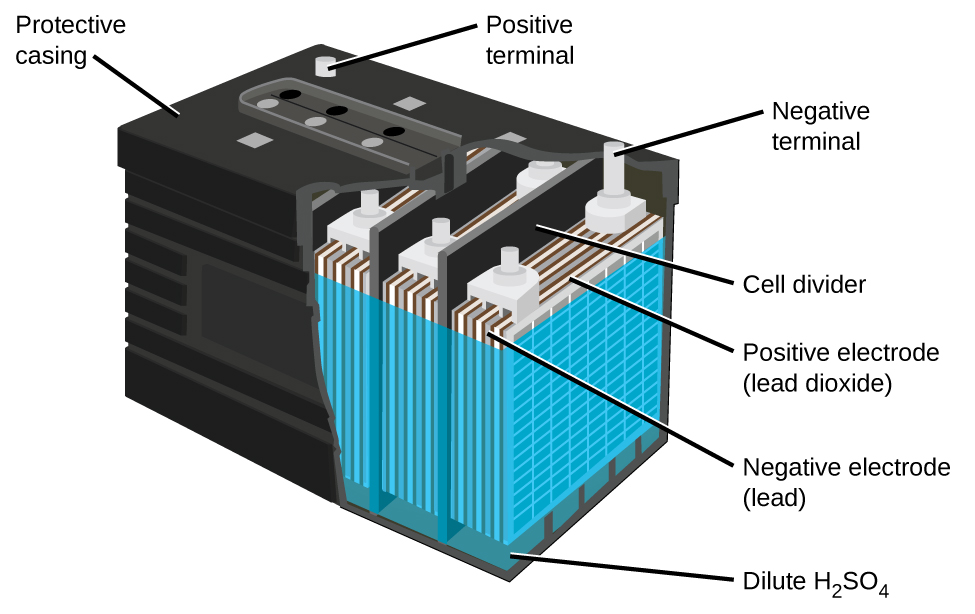
Figure 17.14. The lead acid battery in your automobile consists of six cells connected in series to give 12 V. Their low cost and high current output makes these excellent candidates for providing power for automobile starter motors.
Link to Learning
Visit this site for more information about lead acid batteries.
Fuel Cells
A fuel cell is a device that converts chemical energy into electrical energy. Fuel cells are similar to batteries but require a continuous source of fuel, often hydrogen. They will continue to produce electricity as long as fuel is available. Hydrogen fuel cells have been used to supply power for satellites, space capsules, automobiles, boats, and submarines (Figure 17.15).
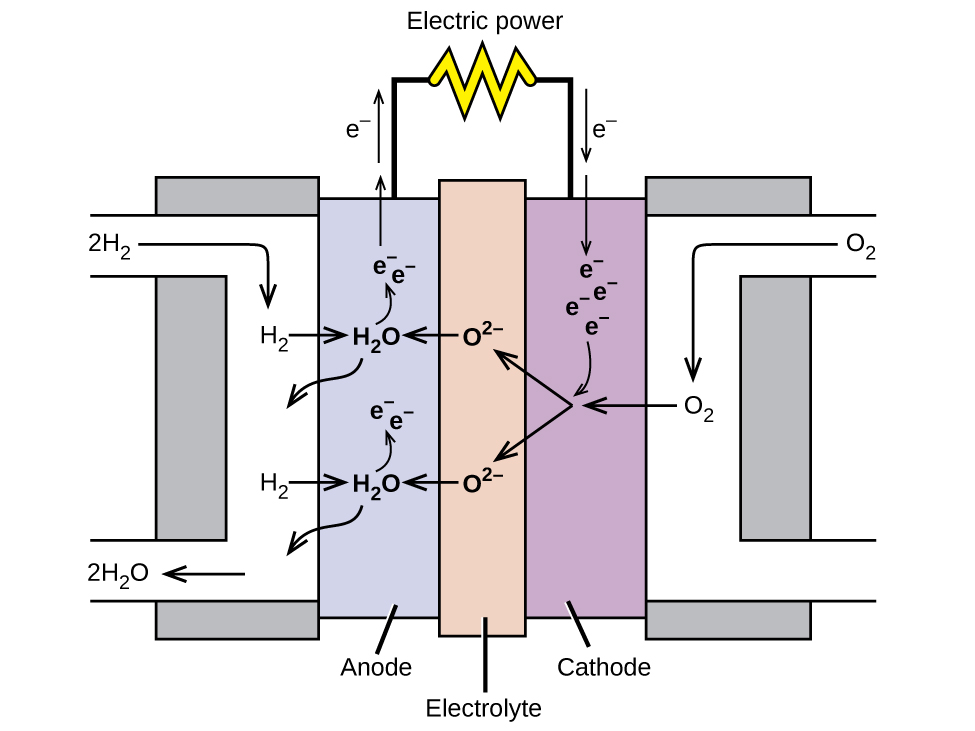
Figure 17.15. In this hydrogen fuel-cell schematic, oxygen from the air reacts with hydrogen, producing water and electricity.
In a hydrogen fuel cell, the reactions are
\begin{matrix} \\ {\begin{matrix}\text{anode:} \ 2 {\text{H}}_{2} + {\text{2O}}^{2−} \ ⟶ \ 2 {\text{H}}_{2} \text{O} + {\text{4e}}^{\text{−}} \\ \text{cathode:} \ {\text{O}}_{2} + {\text{4e}}^{\text{−}} \ ⟶ \ {\text{2O}}^{2−}\end{matrix}}_{¯} \\ \text{overall:} \ 2 {\text{H}}_{2} + {\text{O}}_{2} \ ⟶ \ 2 {\text{H}}_{2} \text{O}\end{matrix}17.116
The voltage is about 0.9 V. The efficiency of fuel cells is typically about 40% to 60%, which is higher than the typical internal combustion engine (25% to 35%) and, in the case of the hydrogen fuel cell, produces only water as exhaust. Currently, fuel cells are rather expensive and contain features that cause them to fail after a relatively short time.
Link to Learning
Check out this link to learn more about fuel cells.
Where this page came from
This page was imported from OpenStax, Chemistry. Section 17.5 of Chemistry by Paul Flowers, William R. Robinson, PhD, Richard Langley, Klaus Theopold, published by OpenStax (Rice University) under CC BY 4.0; the book is free at openstax.org. Changed here: set as a page on its own.
Nobody has written it yet — it is the source material at a new address, which is why search engines are asked to skip it and why no one earns from it. It is up for grabs: take it on, and it is yours to rewrite and to earn from.
I disse publikationerChemistry (OpenStax)
Licens: CC BY 4.0 · Bearbejdet efter openstax.org
Kommentarer