Ser du noget at forbedre? Foreslå en ændring.
Denne side er offentlig.
Introduction
The 2014 Ebola outbreak in West Africa was one of the most severe public-health crises of the twenty-first century. The outbreak began in the village of Meliandou in Guinea and quickly spread to neighboring countries. Lasting from 2014-2016, the virus caused widespread devastation and death, claiming more than 11,000 lives during the outbreak.
Background
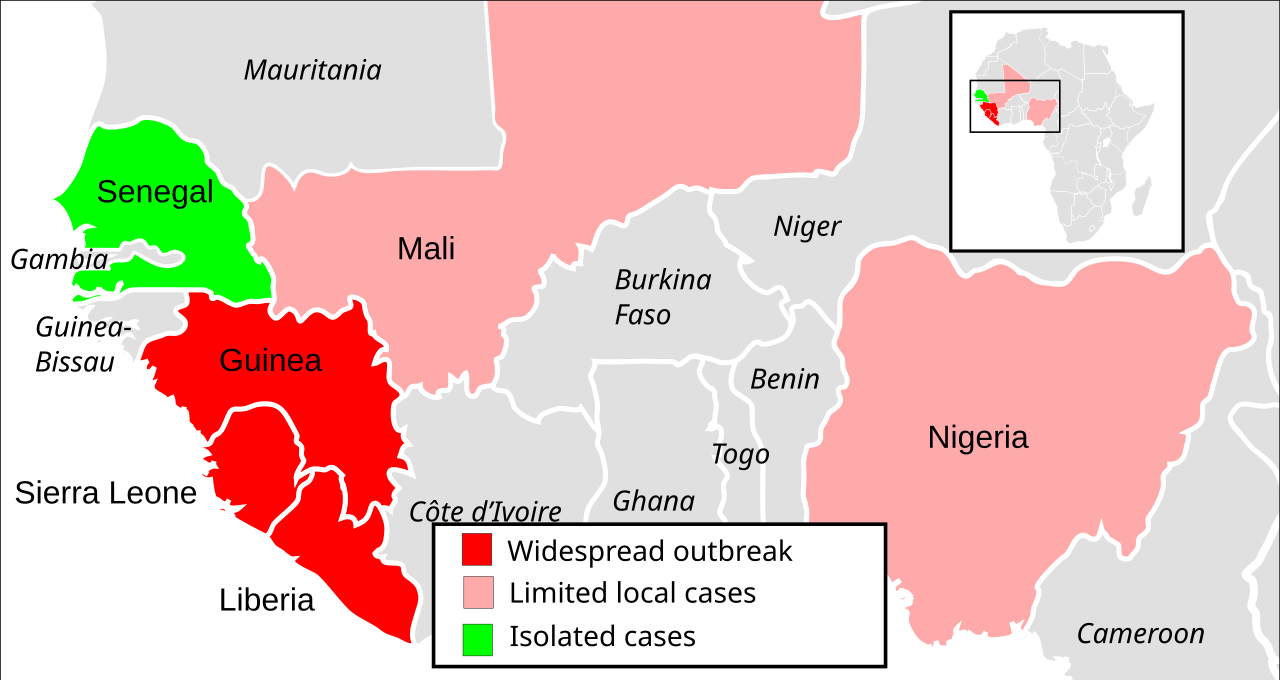
Figure 1. Map of the 2014 Ebola outbreak in West Africa. (Image: ZeLonewolf, CC0)
First identified in 1976 in the village of Yambuku, located in the modern-day Democratic Republic of the Congo, the Ebola virus is a virus belonging to the Orthoebolavirus genus, which consists of 6 species.[1] Ebola is a severe often fatal illness, characterized by symptoms such as fever, hemorrhaging, and organ failure.[1] The virus transmits through direct contact with bodily fluids of infected individuals or contaminated materials.[2]
The 2014-2016 Ebola outbreak was the largest epidemic of Ebola virus. Unlike previous Ebola outbreaks, which were small and geographically isolated, the 2014 outbreak spread across multiple countries in Western Africa and isolated cases were reported in countries outside of Western Africa as well.[2] The 2014 outbreak began in December 2013, in Meliandou Village, Guinea.[3] The virus spread quickly reaching Liberia by March 2014, and Sierra Leone by May 2014 where major outbreaks would occur.
Several factors contributed to the severity of the outbreak, including population mobility across borders, limited healthcare infrastructure, delayed international response, and cultural practices such as burial traditions that increased exposure.[2] Urban transmission distinguished this outbreak from previous cases which had largely occurred in rural and remote areas.[4]
In August 2014, the World Health Organization (WHO) declared the outbreak a Public Health Emergency of International Concern.[4] Despite the increased international aid the outbreak would continue for another two years. The outbreak was officially declared over in June 2016, after infecting more than 28,600 individuals and killing 11,325.[4]
Response
Affected Populations
Communities in Guinea, Liberia, and Sierra Leone encountered Ebola as both a public health crisis and a social disruption. Shortages of healthcare workers and facilities meant that many patients were cared for at home by relatives rather than in formal medical settings.[2] These caregiving arrangements increased transmission risk while reflecting the structural limitations of the region's healthcare infrastructure.
Public health interventions frequently came into tension with established cultural practices. Families placed strong moral and emotional weight on caring for the sick and performing funeral and burial rites for the deceased.[5] These practices constituted major transmission pathways. Isolation protocols, restrictions on touching the sick, and mandatory safe burial procedures were medically necessary, yet many families experienced them as violations of their responsibilities toward the dying and the dead.
The conflict between institutional directives and community expectations produced a breakdown in social trust that directly shaped how the outbreak unfolded. In many regions, patients transported to treatment centers often did not return due to death or poor communication between facilities and families. This reinforced suspicion among communities already skeptical of government institutions. As a result, the resistance to public health measures reflects a socially informed response to perceived institutional threat, rather than ignorance.[6]The specific ways this resistance manifested across Guinea, Liberia, and Sierra Leone are examined in the local government sections.
Response efforts became more effective as organizations shifted from top-down enforcement toward participatory approaches in late 2014. Initiatives such as Community-Led Ebola Action (CLEA) engaged residents in identifying local transmission risks, adapting high-risk practices, and taking active roles in contact tracing and prevention. This shift demonstrated that controlling the outbreak depended not only on medical infrastructure, but on the trust, local knowledge, and cooperation of the people most affected by it.[7]
Healthcare Workers
Healthcare workers were among the most vulnerable groups in the 2014 outbreak, facing exposure due to limited resources and rapidly changing conditions. Facilities across West Africa were unprepared for such an outbreak lacking adequate personal protective equipment, sanitation infrastructure, and consistent training. Healthcare workers were estimated to be 21-32 times more likely to contract Ebola than the general public, with over 800 infected and more than 500 deaths reported.[8] The Center for Disease Control (CDC) identified exposure and insufficient protection as a major driver of infection in healthcare settings.[9] Local healthcare workers often operated in under-supplied facilities with less consistent training, while international responders had better equipment, training, and evacuation options.[10]
Workers were crucial in implementing key containment strategies such as isolation protocols, contact tracing, and safe burial practices. Effectively executing these strategies required public trust and cooperation which became a problem during such an outbreak. In many cases mistrust and cultural tension hindered compliance, as treatment centers were feared and traditional practices conflicted with medical guidelines.[5] Additionally, healthcare workers faced severe psychological strain, burnout, and social stigma due to being seen as a possible risk of infection.[6]
Local Governments
Guinea’s Ministry of Health declared an Ebola outbreak on March 22, 2014, after tracking 86 suspected cases and 59 deaths.[11] Early public messaging by the government's National Coordination Cell failed to reach remote communities. Consequently, rural populations in the Forest Region feared foreign aid workers and local officials were intentionally spreading the virus to secure international funding or harvest organs.[12] This deep mistrust culminated on September 16, 2014, when a government sensitization team arrived in the village of Womey. Angry villagers, armed with machetes and clubs, attacked the delegation, murdering eight people, including local health administrators and three journalists.[12] In direct response to the massacre, the Guinean government deployed a heavily armed military battalion to occupy the region. Soldiers arrested 27 suspects and enforced strict health mandates through prolonged military surveillance.[12]
In Sierra Leone, the Ministry of Health and Sanitation struggled to contain the virus. To locate hidden patients, the government enforced a strict national lockdown, the "Ose to Ose" campaign, from September 19 to 21, 2014. During this period, 30,000 volunteers searched 1.5 million homes, discovering over 200 hidden bodies and identifying roughly 100 new cases.[13] On October 17, 2014, the government centralized operations under the military-led National Ebola Response Centre, directed by Defense Minister Major Palo Conteh.[14] However, heavy-handed military enforcement sparked severe backlash. On October 21, 2014, health workers in the town of Koidu attempted to take a blood sample from an elderly woman. A local youth group rioted, claiming the government was kidnapping citizens.[15] The youths burned down buildings and clashed with police. Security forces fired live ammunition into the crowd, killing two protesters, which prompted the government to impose strict district-wide curfews.[15]
Liberia’s Incident Management System issued strict mandates that conflicted with local cultural norms, most notably the August 3, 2014, order mandating the cremation of all dead bodies in Monrovia.[16] Because traditional burials involve washing and touching the deceased, families rejected the mandate and secretly hid infected bodies in their homes or abandoned them in streets to avoid government collection. Public anger erupted in the densely populated West Point slum. On August 16, 2014, an angry mob raided a local Ebola holding center, shouting that the virus was a government hoax. They looted infected materials and freed 17 patients.[16] The Armed Forces of Liberia and the Liberia National Police retaliated by physically barricading the neighborhood on August 20, trapping 75,000 residents inside without adequate food, water, or sanitation. Residents protested at the barricades, leading soldiers to fire live ammunition into the crowd, killing a 15-year-old boy named Shakir Kamara and injuring others.[16] Intense public and international backlash forced the government to abandon the quarantine on August 30, 2014.[16]
World Health Organization (WHO)
The World Health Organization (WHO) served as the main body responsible for coordinating the international public health response. WHO conducted early field investigations and sent experts to West Africa. It's response was widely criticized for its failure to match the speed and scale of the crisis. Although WHO had known of the outbreak for months, it did not declare Ebola a Public Health Emergency of International Concern until August 2014, after the virus had already spread extensively across Guinea, Liberia, and Sierra Leone. Following this declaration, WHO helped coordinate international response efforts, supported contact tracing, and deployed specialists in epidemiology, laboratory work, risk communication, and social mobilization. [4]
Médecins Sans Frontières (MSF)
Among the international organizations that responded to the 2014 outbreak, Médecins Sans Frontières (MSF), also known as Doctors Without Borders, played the most significant frontline role. MSF was among the first international organizations to recognize the scale of the outbreak and deployed teams to Guinea, Liberia, and Sierra Leone before most governments and agencies had mobilized. Operating multiple Ebola Treatment Centers across the three countries, MSF ultimately treated approximately one third of all confirmed cases.[10]
MSF's early presence also made them one of the first organizations to publicly warn that the outbreak was out of control, repeatedly calling on the international community to scale up its response months before the WHO declared a Public Health Emergency of International Concern in August 2014.[4] This tension between MSF's frontline assessment and the pace of the formal international response highlighted a broader gap between organizations operating on the ground and those coordinating from a distance.
Further Work
This chapter could be extended by examining the role of media in shaping the global public perception of the outbreak. Additional research on the long-term aftermath of the outbreak, including whether institutional trust recovered in Guinea, Liberia, and Sierra Leone, remains an important area for potential analysis.
References
- ↑ a b "Ebola disease". www.who.int. Retrieved 2026-04-29.
- ↑ a b c d Bell, Beth P. (2016). "Overview, Control Strategies, and Lessons Learned in the CDC Response to the 2014–2016 Ebola Epidemic". MMWR Supplements. 65. doi:10.15585/mmwr.su6503a2. ISSN 2380-8950.
- ↑ "Ebola outbreak in West Africa, 2014 – 2016: Epidemic timeline, differential diagnoses, determining factors, and lessons for future response".
- ↑ a b c d e "Ebola outbreak 2014-2016 - West Africa". www.who.int. Retrieved 2026-04-29.
- ↑ a b Abramowitz, Sharon (2017-10-23). "Epidemics (Especially Ebola)". Annual Review of Anthropology. 46 (Volume 46, 2017): 421–445. doi:10.1146/annurev-anthro-102116-041616. ISSN 0084-6570. {{cite journal}}: |issue= has extra text (help)
- ↑ a b Shultz, James M.; Cooper, Janice L.; Baingana, Florence; Oquendo, Maria A.; Espinel, Zelde; Althouse, Benjamin M.; Marcelin, Louis Herns; Towers, Sherry; Espinola, Maria; McCoy, Clyde B.; Mazurik, Laurie; Wainberg, Milton L.; Neria, Yuval; Rechkemmer, Andreas (2016-11). "The Role of Fear-Related Behaviors in the 2013-2016 West Africa Ebola Virus Disease Outbreak". Current Psychiatry Reports. 18 (11): 104. doi:10.1007/s11920-016-0741-y. ISSN 1535-1645. PMC 5241909. PMID 27739026. {{cite journal}}: Check date values in: |date= (help)
- ↑ Bedson, Jamie; Jalloh, Mohamed F.; Pedi, Danielle; Bah, Saiku; Owen, Katharine; Oniba, Allan; Sangarie, Musa; Fofanah, James S.; Jalloh, Mohammed B.; Sengeh, Paul; Skrip, Laura; Althouse, Benjamin M.; Hébert-Dufresne, Laurent (2020-08). "Community engagement in outbreak response: lessons from the 2014-2016 Ebola outbreak in Sierra Leone". BMJ global health. 5 (8): e002145. doi:10.1136/bmjgh-2019-002145. ISSN 2059-7908. PMC 7445350. PMID 32830128. {{cite journal}}: Check date values in: |date= (help)CS1 maint: article number as page number (link)
- ↑ "Health worker Ebola infections in Guinea, Liberia and Sierra Leone". www.who.int. Retrieved 2026-04-30.
- ↑ "Update: Ebola Virus Disease Outbreak — West Africa, October 2014". www.cdc.gov. Retrieved 2026-04-30.
- ↑ a b "Ebola: Pushed to the limit and beyond | MSF". www.msf.org. Retrieved 2026-04-30.
- ↑ Doctors Without Borders (2014-03-24). "Guinea: Priority Is to Isolate Suspected Cases in Ebola Outbreak". Doctors Without Borders. Retrieved 2026-05-01.{{cite web}}: CS1 maint: url-status (link)
- ↑ a b c Al Jazeera (2014-09-25). "Arrests in Guinea over Ebola-related murders". Al Jazeera. Retrieved 2026-05-01.{{cite web}}: CS1 maint: url-status (link)
- ↑ Centers for Disease Control and Prevention (2015-01-16). "Use of a Nationwide Call Center for Ebola Response and Monitoring During a 3-Day House-to-House Campaign — Sierra Leone, September 2014". Morbidity and Mortality Weekly Report. Retrieved 2026-05-01.{{cite web}}: CS1 maint: url-status (link)
- ↑ Centers for Disease Control and Prevention. "In-Countries Responses". EBOLA - CDC Museum Digital Exhibits. Retrieved 2026-05-01.{{cite web}}: CS1 maint: url-status (link)
- ↑ a b Ruble, Kayla (2014-10-22). "Ebola Riots in Sierra Leone Highlight Marginalized Youth Population". Vice. Retrieved 2026-05-01.{{cite web}}: CS1 maint: url-status (link)
- ↑ a b c d MacDougall, C.; Gladstone, R. (2014-08-20). "Clash Erupts in Liberian Capital Over Ebola Quarantine". New York Times. Retrieved 2026-05-01.{{cite web}}: CS1 maint: url-status (link)
Where this page came from
This page was imported from Wikibooks. From “Lentis” on Wikibooks, by its contributors, under CC BY-SA 4.0. Changed here: set as a page; navigation and edit links left out; each image under its own licence, credited in its caption.
Nobody has written it yet — it is the source material at a new address, which is why search engines are asked to skip it and why no one earns from it. It is up for grabs: take it on, and it is yours to rewrite and to earn from.
I disse publikationerLentis
Licens: CC BY-SA 4.0 · Bearbejdet efter en.wikibooks.org
Kommentarer