Ser du noget at forbedre? Foreslå en ændring.
Denne side er offentlig.
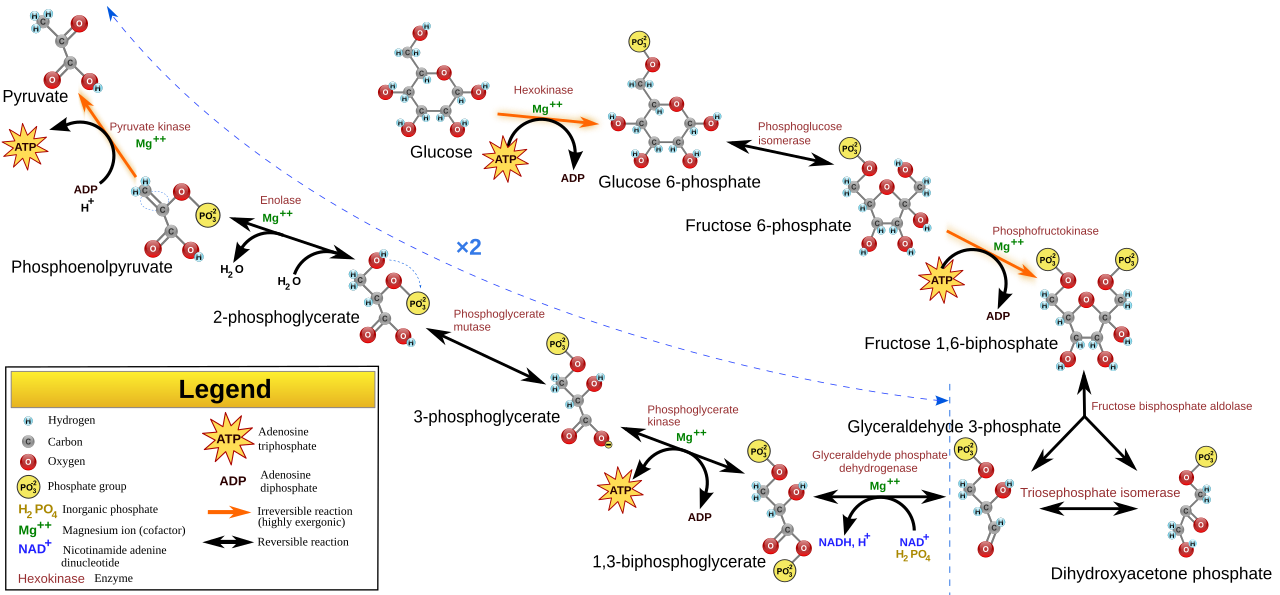
Glycolysis (Image: W YassineMrabet Talk ✉ This W3C-unspecified vector image was created with Inksc, CC BY-SA 3.0)
Glycolysis and Gluconeogenesis
Glycolysis/Gluconeogenesis is the set of reactions that converts glucose into pyruvate. Glycolysis is a compilation of ten reactions (with 1 being an isomerization of 2 products into one another) of glycolysis take place in the cytoplasm.
- One glucose molecule will go under group-transfer reaction with 1 ATP (Adenosine Triphosphate) - which is catalyzed by hexokinase - to become Glucose 6-phosphate (Glu 6-P) and produce 1 ADP (adenosine diphosphate) molecule.
- Glu 6-P, under the activity of the enzyme phosphoglucose isomerase, becomes another isomer, Fructose 6-Phosphate (Fru 6-P).
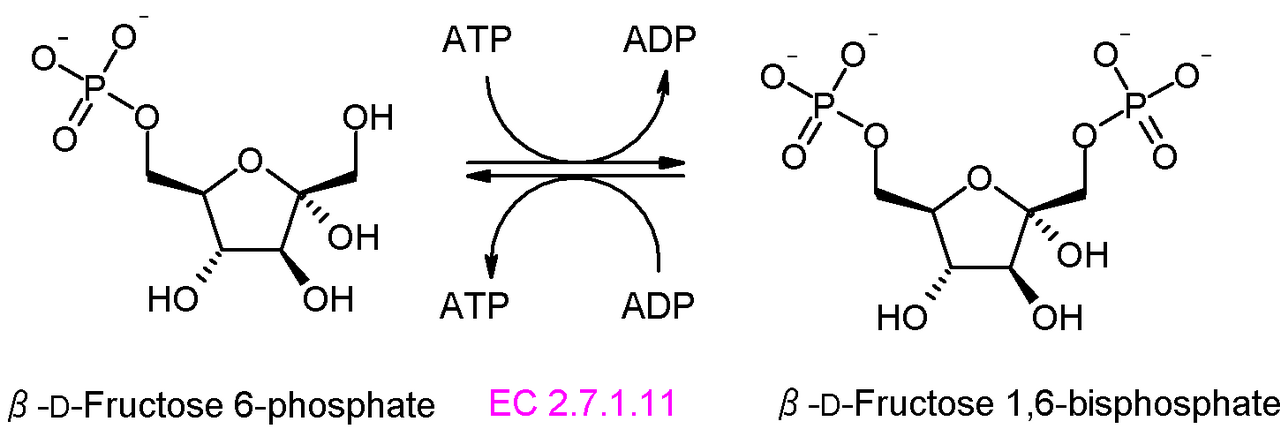
- Then, the group-transfer reaction between Fru 6-P and ATP, catalyzed by the enzyme Phosphofructokinase-1 (known as PFK-1), produces 1 fructose 1,6-biphosphate (Fru 1,6-P) molecule and another ADP molecule.
- Fruc 1,6-P (after ring opening), after binding to the enzyme aldolase, produces two new molecules known as:
Glyceraldehyde 3-phosphate (GAP)
- Dihydroxyacetone phosphate (DHAP)
- Note that GAP can isomerize to DHAP and vice versa in the reaction catalyzed by the enzyme Triose Phosphate Isomerase.
- GAP, which is constantly supplemented by the isomerization of DHAP, continues the process of glycolysis by reacting with 2 inorganic phosphorus molecules and 2 nicotinamide adenine dinucleotide (NAD+, oxidized form) molecules, under oxidation-reduction reactions catalyzed by the enzyme Glyceraldehyde Phosphate Dehydrogenase, to produce 2 1,3-bisphosphate glycerate molecules, 2 protons, and 2 NADH molecules (reduced form of NAD+). Note that from this stage on, reactions are carried out by 2 molecules of the previous products to produce 2 new molecules. Therefore, it is assumed in the next stages, "1,3-biphosphate glycerate reacts with some compound A" means 2 1,3-bisphosphate glycerate molecules react with 2 molecules of compound A to produce 2 new molecules.
- Next, 1,3-bisphosphate glycerate undergoes group-transfer reaction, catalyzed by phosphoglycerate kinase, with ADP to produce 3-phosphoglycerate and ATP.
- Then, 3-phosphoglycerate, catalyzed by phosphoglycerate mutase, becomes 2-phosphoglycerate.
- Catalyzed by the enzyme enolase, 2-phosphoglycerate produces phosphoenolpyruvate (PEP) and water.
- In the last step, PEP reacts with ADP in a group-transfer reaction catalyzed by phosphopyruvate kinase, to produce pyruvate and ATP.
In total, glycolysis consumes 1 glucose molecule, 2 ATP molecules, and 2 NAD+ to produce 2 pyruvate molecules, 4 ATP molecules, and 2 NADH molecules.
Therefore, in overall, 1 Glu + 2 NAD+ → 2 Pyruvate + 2 NADH + 2 ATP
After glycolysis, the products, depending on the appearance of O2, will undergo either aerobic reaction (with O2) to continue the metabolic pathway into the citric acid cycle (also known as Kreb's cycle), or anaerobic reaction (without O2) to start a new process known as fermentation to produce lactic acid (mostly in human's muscular cells) or ethanol and carbon dioxide (CO2) in microbes such as yeasts.
Disaccharide Metabolism
Lactose, sucrose, and maltose are disaccharides that can be hydrolyzed into monosaccharaides and then enter the glycolysis. Latcase, sse, and maltase are enzymes(in epithelial cells) that can hydrolyze the disaccharides respectively.
Maltose is hydrolyzed into two β-D-glucopyranose molecules. These monosaccharaides can readily enter glycolytic pathway.
Add caption here (Image: akane700, Public domain)
Hydrolyzing sucrose produces α-D-glucopyranose and β-D-fructofuranose. However, β-D-fructofuranose must be converted to a form in order to enter glycolytic. This conversion is facilitated by the enzyme hexokinase to form β-D-fructofuranose-6-phosphate or by the fructokinase to form β-D-fructofuranose-1-phosphate. Both of these phosphorylation reactions consume ATP.

Add caption here (Image: Ed ( Edgar181 ), Public domain)
Constituent monosaccharaides residues of lactose are β-D-glucopyranose and β-D-galactopyranose. β-D-glucopyranose is ready to enter into glycolytic process but β-D-galactopyranose needs to convert to a form to enter glycolytic pathway. Since galactose is a epimer of glucose at the C-4 position, it can form glucose-6-phosphate (an intermediate reactant) during glycolysis. [1]
Glycolysis as Survival Pathway for Brain Cells
The brain uses a very large amount of energy, and neurons and astrocytes are mainly responsible for the consumption of oxygen and glucose. The brain is only ~2% of the human body weight, though it consumes over 20% of the body’s oxygen and glucose.
When nitric oxide inhibits respiration in neurons of rats, ATP concentration quickly decreases along with a sharp decrease in mitochondrial transmembrane potential, followed by spontaneous apoptosis or cell death. Astrocytes respond to respiration inhibition by instead increasing metabolism through glycolysis and using the generated ATP to maintain the mitochondrial transmembrane potential. This is done through an increase in the enzyme activity of PFK1 or 6-phosphofructo-1-kinase, independently of cGMP, at a level twice that of normal neuron conditions. Levels of fructose-2,6-bisphosphate rise in astrocytes as well, which also activates PFK1 allosterically. However, levels of this enzyme are NOT raised in the neuron cells. The maintenance of the potential prevents cell apoptosis.
The mechanism that increases the levels of these enzymes in astrocrytes during conditions of respiration inhibition is quick phosphorylation of the enzyme AMPK, or 5’-AMP-activated protein kinase and the gathering of fructose-2,6-bisphosphate. This shows that when respiration is inhibited a ‘crisis’ has occurred causing a cascade of events: 5’-AMP concentration increase, causing phophorylation of AMPK, which activates fructose-2,6-bisphosphatase.
Neurons however are unable to block cell death through an increase in glycolytic activity due to this lack of 6-phosphofructo-2-kinase and fructose-2,6-bisphotase. Instead the metabolism of glucose is achieved via the pentose phosphate pathway, which regenerates reduced glutathione. [2]
References
- Campbell, Neil A. (2005). Biology. Pearson. ISBN 0-8053-7146-0. {{cite book}}: Check |isbn= value: checksum (help); Text "coauthors+ H.C. Van Ness, M.M. Abbott" ignored (help)
- Bolaños, J. SY. “Glycolysis: a bioenergetic or a survival pathway?” Trends in Biochemical Sciences, Volume 35, Issue 3, 145-149, 18 December 2009
- ↑ Berg, Jeremy M. (2010). Biochemistry (7th Ed. ed.). W. H. Freeman and Company. ISBN0-1-42-922936-5. {{cite book}}: |edition= has extra text (help)
- ↑ Berg, Jeremy M. (2010). Biochemistry (7th Ed. ed.). W. H. Freeman and Company. ISBN0-1-42-922936-5. {{cite book}}: |edition= has extra text (help)
Where this page came from
This page was imported from Wikibooks. From “Structural Biochemistry” on Wikibooks, by its contributors, under CC BY-SA 4.0. Changed here: set as a page; navigation and edit links left out; each image under its own licence, credited in its caption.
Nobody has written it yet — it is the source material at a new address, which is why search engines are asked to skip it and why no one earns from it. It is up for grabs: take it on, and it is yours to rewrite and to earn from.
I disse publikationerStructural Biochemistry
Licens: CC BY-SA 4.0 · Bearbejdet efter en.wikibooks.org
Kommentarer