This page is public.
Cycling is a healthy, convenient, and sustainable transportation alternative, but since the introduction of motorized vehicles, it has declined significantly across the globe. However, cycling is still wildly popular in the Netherlands compared to the rest of the world, but not by accident.
In the early 1900s, the Dutch cycle paths were narrow, of poor surface, dangerous or even absent at junctions, and not interconnected. Truly dedicated cycle paths were not necessary as cycling was the primary means of transportation. After World War II, as the Netherlands became wealthier, cars became more common[1].
A street in the Netherlands in the 1950's with relatively few cars (Image: Unknown author Unknown author, CC BY-SA 3.0)
This led to car domination of streets originally intended for bicycles and horse-drawn carriages. To make room for cars, buildings were demolished and some of the old cycling infrastructure was removed. This was clearly demonstrated in the town of Hoogeveen, where streets once used mainly by cyclists became car dominated by the late 1960's. The streets were reconstructed to improve driving safety with little regard for cyclists.2] An informative blog documents the [transformation of a street in Hoogeveen from 1945 to 1965 through photographs.[3] The street once ideal for bicycling was completely reconstructed for drivers. A canal was filled in for a safer driving path and center lanes became parking lots.
Although cycling remained common, it had become dangerous. With car-dominated roads, the number of cyclist-car collision accidents skyrocketed. As a result, cycling declined by 6% every year. 3,300 lives were lost in 1971 alone and over 400 of these deaths were children under the age of 14.4] The slaughter of children led to protests by a group called "Stop de Kindermoord" (Stop the Child Murder in Dutch) who demanded safer streets for children bicycling. Their voices were heard, especially in 1973 when the first oil and economic crisis led to a gas shortage and high energy prices. Then Prime Minister, [Joop den Uyl, declared that the Dutch would change their ways and be less dependent on energy. Policies to encourage cycling emerged as the first city centers were made car-free. Continued protests and mass cycling tours created an awareness that eventually changed the way of thinking about transportation policies. In the mid 1970s, municipalities started experimenting with safer cycle routes separated from motorized traffic. Since then, a considerable effort had been made to implement a new bicycle-friendly infrastructure in the Netherlands..2] The same street in Hoogeveen previously mentioned was reconstructed once more to be reserved strictly for cyclists. The first cycle routes were created from scratch and financed by the [Dutch government.[5] This not only led to an increase in cycling by 30-60%, but also led to leaders and planners to consider cyclists in infrastructure design.[4] With the new infrastructure, the Netherlands now has the lowest non-fatal injury rate and lowest fatality rate regarding cycling accidents in the world even with such a large percentage of the population cycling. 27% of trips in the Netherlands are made on bicycle compared to only one percent of trips in the United States and the UK.[5] This success is a result of many factors, and an example from which the world can learn.
The Dutch philosophy on creating bicycle friendly infrastructure is based on safety and convenience. There are five requirements necessary; cycling paths must be safe, direct, comfortable, attractive, and cohesive. The routes are required to be short and logical from the origin to the destination, have smooth surfaces and generous cycling space, and be void of smell or noise inconveniences.[6]
Cars have been banned from many roads to make room for cycling. In many areas, such as the main street in Hoogeveen, cars were no longer allowed and the space is reserved specifically for cyclists and pedestrians.[3]
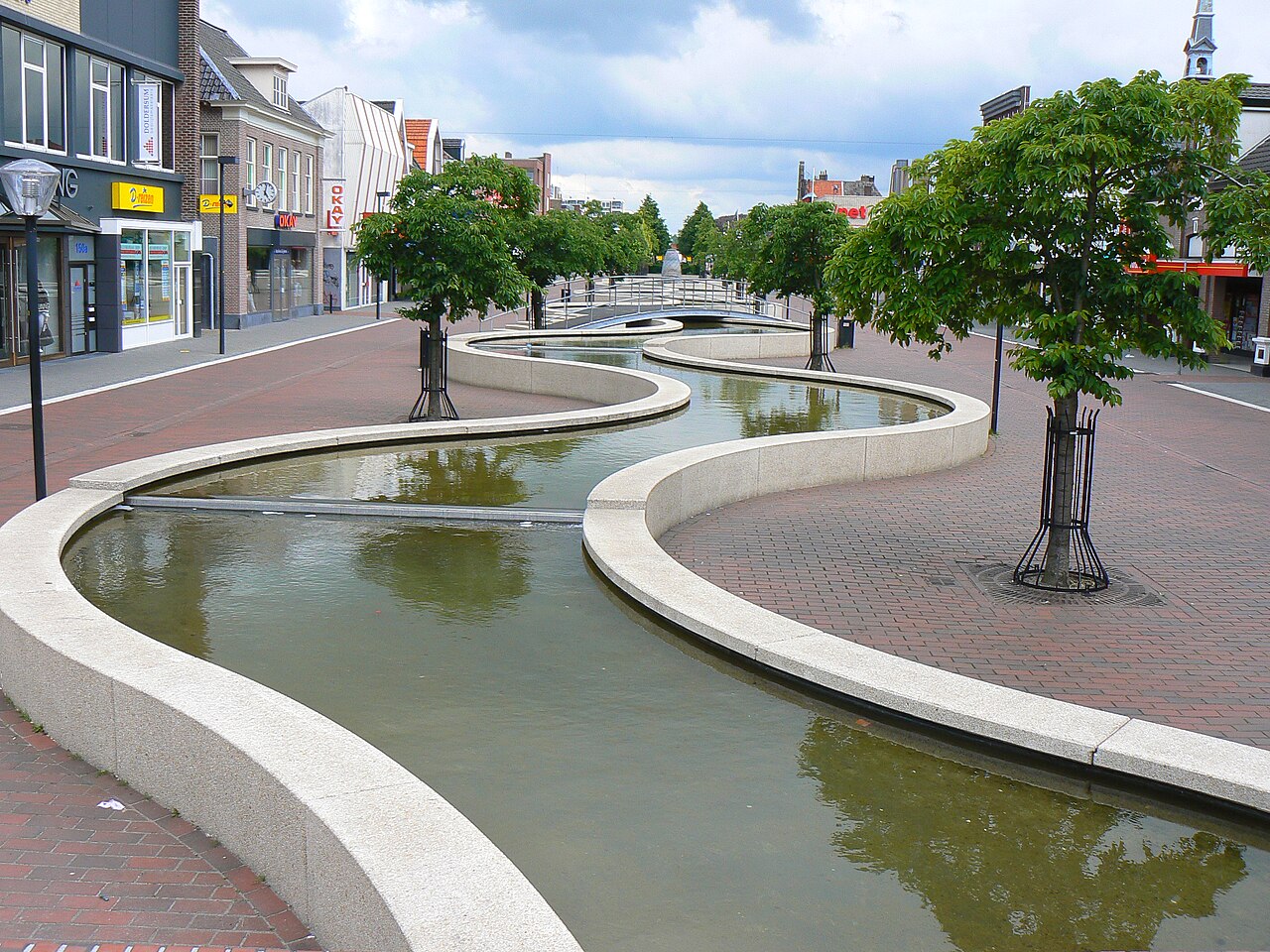
A street in Hoogeveen in 2010 reserved for cyclists (Image: Gerardus, Public domain)
Today, almost everyone in the Netherlands is both a driver and a bicyclist, and equal attention is given to infrastructure for both modes of transportation. Many roads have dedicated cycle paths completely separated from motor vehicles which allows for safe and comfortable cycling and driving.[7]
Entirely Segregated Traffic Networks
In order to encourage use, cycle paths must be safe. In many cities in the Netherlands, including the largest ones, there is complete segregation between bicycling paths and motorized traffic.
Complete segregation between bicycling paths and motorized vehicle roads (Image: Emvee, CC BY-SA 3.0)
This entirely segregated traffic system has improved traffic safety tremendously for both drivers and cyclists. Many older cities are also reserving centralized, historic streets exclusively for cycling. Generally, if speed limits are near or above 50 km/h, cycling paths and motorized traffic need to be completely separated. [6] As speed limits and traffic volumes increase, the separation between cycling paths and motorized traffic should also increase. For example, cycling paths adjacent to highways are typically separated by a small field rather than a strip of grass or concrete used as in lower traffic areas.
Combined Profile Traffic Networks
For residential areas or areas where the speed limit is 30 km/h or less, traffic network separation is less important. Although there are no physical boundaries between cyclists and motorized traffic on combined profile roads, there are often markings or symbols that indicate bicycle lanes. These lanes are painted red, indicating that they are legally dedicated cycle lanes. These combined profile roads are perfectly safe as long as strict speed limits are enforced. Sometimes speed limit enforcing measures such as traffic humps create a hindrance for cyclists. To address this issue, the smooth 0.12 m tall, half-sine-shaped hump was specifically designed to interfere with the suspension of cars, but create no inconveniences for cyclists. Railway level crossings have been replaced by dedicated bicycle underpasses for safety. [6]
Other Bicycle Friendly Measures
Many suburban areas in the Netherlands are separated from cities by wide canals or rivers. Previously, bridges connecting to the cities were designed for motorized vehicles with high traffic and speed limits. Cyclists were forced to take long detours for their commute until new bicycle bridges were constructed.
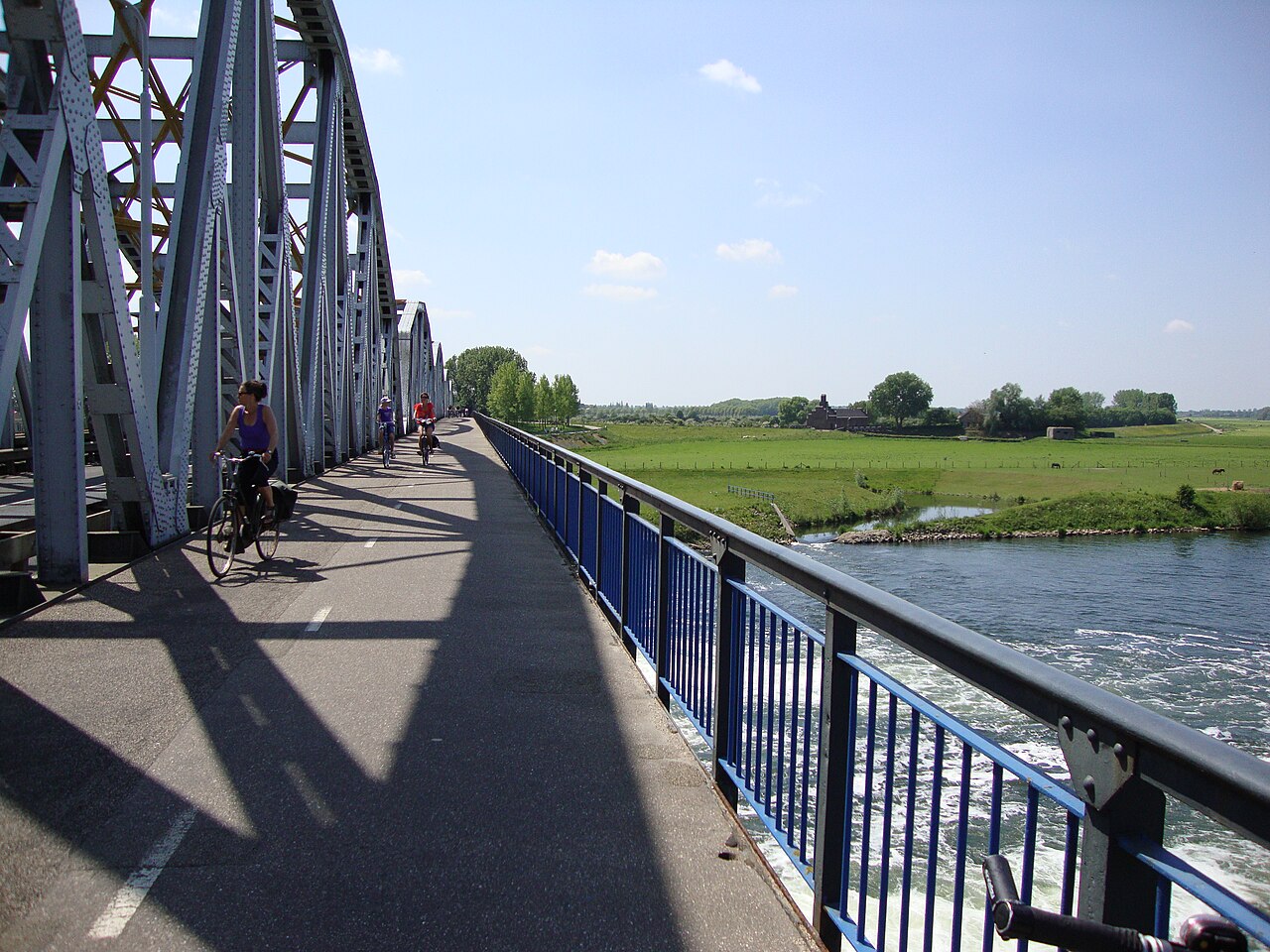
Cyclists crossing a river using a bicycle bridge (Image: Havang(nl), CC0)
At traffic lights, there are different signals for cyclists and drivers. Sensors for detecting cyclists give two green sequences per bicycle. There are also timers which tell cyclists how long they have to wait for the next green light.
Traffic circles have also seen improvement to cater to cyclists. Previously, cyclists yielded to cars in fear of a collision in which they would suffer far greater injuries than the motorist. The alternative traffic circle design includes a completely separated cycling track around the motorized traffic circle with at least 10 m distance between crossing places for cyclists and cars.[6]
Bicycle Parking Facilities
Bicycle parking lot in Leiden, The Netherlands (Image: No machine-readable author provided. Ensopegador~commonswiki assumed (based on c, Public domain)
Convenient, secure bicycle garage used in residential areas (Image: Cx327, CC BY 3.0)
Designated bicycle parking facilities are another essential piece of cycling infrastructure.[7] These facilities are designed to provide safe, clean, and easy bicycle parking as close to the cyclists' destination as possible. Bicycle parking facilities are ubiquitous in the Netherlands ranging from bicycle parking lots outside school and office buildings to large scale multi-level parking garages strictly for bicycles outside popular shopping centers and train stations. Small bicycle garages provide secure, convenient bicycle parking at home, the most common departure and destination point for cyclists.[6]
The benefits of bicycling encourage the Dutch to make more trips on bicycle than any other mode of transportation. Cycling is economical, costing far less than both the private car and public transportation, both in direct user costs and public infrastructure costs. It only requires a small fraction of the space needed for driving and parking cars. Furthermore, bicycling causes virtually no noise or air pollution and consumes far less non-renewable resources than any other mode of transportation. The only energy cycling requires is provided by the cyclist, and the very use of that energy offers valuable cardiovascular exercise.5] Compared to countries with similar wealth, the Netherlands has a relatively low rate of [obesity and heart disease. Those who ride a bicycle for 30 minutes a day are physically five years younger than those who lack this daily exercise.[8]
Fuel Prices
The Netherlands has relatively low car ownership compared to countries of similar wealth.9] In part, this can be attributed to the very high cost of fuel in the Netherlands. [Gasoline prices in the Netherlands are among the ten highest in the world and diesel prices are among the 25 highest in the world.[10] This is due, in large part, to high taxation of both fuels and certainly makes cycling an appealing alternative when compared on a cost basis.
Geography and Density
The Netherlands is among the flattest countries in the world, which certainly makes bicycling less physically strenuous. The majority of the population lives in the flattest part of the country. The three largest cities, Amsterdam, Rotterdam, and The Hague have total elevation differences of less than 10 meters, including parts which are below sea level.[11] The Netherlands is also among one of the densest countries in the world[12] which naturally means that trips are shorter. Generally, cycling is only preferred for journeys totaling to or less than 5 km.
Weather
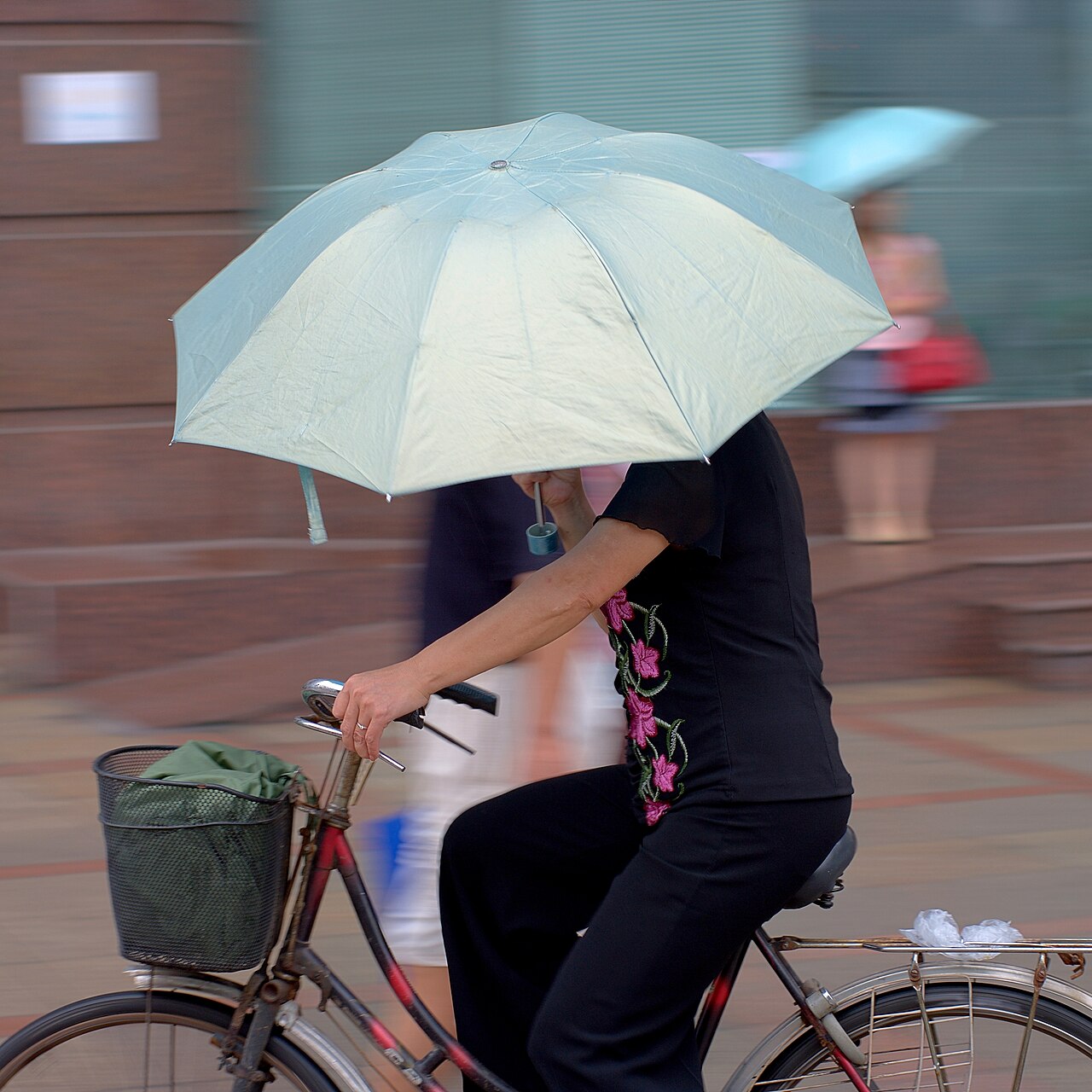
Woman cycling in the rain holding an umbrella (Image: Stougard, CC BY-SA 3.0)
Bicycling in inclement weather is not very common in most countries. However, in the Netherlands, even when it rains, everyone continues to bicycle, perhaps with the addition of an umbrella in their free hand. Generally, weather in the Netherlands is quite mild, with temperatures rarely above 23 degrees Celsius in the summer and rarely below 0 degrees Celsius in the winter. Rain in the Netherlands is not typically intense, which makes bicycling less unpleasant as compared to in other countries. Extreme weather conditions such as snow are rare to non-existant.[13]
Safety
The Netherlands has the lowest cycling fatality rate in the world. Cycling is over three times as safe in the Netherlands as in the UK and more than five times as safe as in the USA, which explains why the Dutch do not perceive cycling to be a dangerous way to travel. Safer cycling in the Netherlands, however, is not due to the widespread use of helmets. In the Netherlands, less than one percent of adult cyclists wear helmets and among children, only three to five percent wear helmets. Helmets are seen as unattractive and therefore discourage cycling. Helmets also provide a false sense of safety, which may encourage risky riding behavior.[14]
Bicycling in the Netherlands clearly shows how technology cannot succeed on its merits alone. The inherent benefits of bicycling, although clear to the Dutch, were not enough to make bicycling as wildly popular as it is today. To foster success, the Dutch made cycling irresistibly convenient and safe, developing an extensive and dedicated cycling infrastructure. This proved to would-be-cyclists that their presence on the roadways of the Netherlands was not just possible, but expected. A similar phenomenon can be seen with another environmentally friendly means of transportation. Plug in electric cars are touted by many to be the wave of the future, but opponents claim that their limited range will doom them.15] Supporters and opponents, however, agree that without a network of [charging stations, their adoption as a mainstream means of transportation will be limited.[16] Much like how the Dutch strove to create a national system of cycling infrastructure, many countries are now striving to create a national system of plug in charging stations. Policy makers acknowledge that the setting must be adapted to a technology just as much as a technology must be adapted to its setting for success.[17]
References
- ↑ Ebert, A. (2004). Cycling towards the Nation:The Use of the Bicycle in Germany and the Netherlands, 1880-1940. European Review Of History, 11(3), 347-364.
- ↑ a b Schwanen, T., Dijst, M., & Dieleman, F. M. (2004). Policies for Urban Form and their Impact on Travel: The Netherlands Experience. Urban Studies (Routledge), 41(3), 579-603.
- ↑ a b Hembrow, D. and Wagenbuur, M. Transformation in the Centre of Hoogeveen. Retrieved from http://hembrow.blogspot.com/2010/09/transformation-in-centre-of-hoogeveen.html
- ↑ a b Documentary: How the Dutch got their cycling paths. Retrieved from http://www.youtube.com/watch?feature=player_embedded&v=XuBdf9jYj7o
- ↑ a b c Pucher, J. and Buehler, R. Making Cycling Irresistible: Lessons from The Netherlands, Denmark and Germany. Retrieved from http://www.vtpi.org/irresistible.pdf
- ↑ a b c d e Ministerie van Verkeer en Waterstaat. Cycling in the Netherlands 2009. Retrieved from http://www.fietsberaad.nl/library/repository/bestanden/CyclingintheNetherlands2009.pdf
- ↑ a b Pucher, J., Dill, J. and Handy, S. Infrastructure, Programs, and Policies to Increase Bicycling. Retrieved from http://www.bikeleague.org/news/pdfs/pucher_preventative_medicine.pdf
- ↑ Dutch Cycling Embassy. (2011). The Netherlands: A history of cycling innovation.
- ↑ World Bank. (2008). Motor Vehicles per 1000 People.
- ↑ Ebert, Metschies, Schmid, Wagner. (2009). "International Fuel Prices 2009". Eschborn, Germany.
- ↑ Actueel Hooghtebestand Nederland. http://www.ahn.nl/viewer
- ↑ Department of Economic and Social Affairs Population Division (2009) (.PDF). World Population Prospects, Table A.1. 2008 revision. United Nations.
- ↑ Weather Underground. (2011). "Seasonal Weather Averages". Amsterdam. http://www.wunderground.com/NORMS/DisplayNORMS.asp?AirportCode=EHAM&StateCode=&SafeCityName=Amsterdam&Units=none&IATA=WUI&normals=on&MR=1
- ↑ Pucher, J., & Buehler, R. (2007). At the frontiers of cycling: Policy innovations in the Netherlands, Denmark, and Germany. World Transport Policy and Practice, 4-6.
- ↑ The Telegraph. (2011). "Nissan Hits Back at Top Gear". http://www.telegraph.co.uk/motoring/top-gear/8676473/Nissan-hits-back-at-Top-Gear.html
- ↑ Palmer, A. (2011). Interview. "Nissan Executive Vice President Andy Palmer speaks to the Global Media Center". Nissan Global.
- ↑ Haggerty, J.R. and Ramsey, M. (2011). "Charging Stations Multiply but Electric Cars are Few". Wall Street Journal.
Further Reading
- Pucher, J. & Buehler, R. (2007). Cycling for everyone: Lessons from Europe, 1-27.
- Pucher, J. & Dijkstra, L. (2003). Promoting safe walking and cycling to improve public health: Lessons from the Netherlands and Germany. American Journal of Public Health, 93, 9, 1509-1516.
- Engbers, L. & Hendriksen, I. (2010). Characteristics of a population of commuter cyclists in the Netherlands: perceived barriers and facilitators in the personal, social, and physical environment. International Journal of Behavioral Nutrition & Physical Activity, 7, 88-93.
- E.E.M.M. van Kempen, RIVM, & National Institute for Public Health and the Environment. (2010). Exchanging car trips by cycling in the Netherlands, 1-71.
Where this page came from
This page was imported from Wikibooks. From “Lentis” on Wikibooks, by its contributors, under CC BY-SA 4.0. Changed here: set as a page; navigation and edit links left out; each image under its own licence, credited in its caption.
Nobody has written it yet — it is the source material at a new address, which is why search engines are asked to skip it and why no one earns from it. It is up for grabs: take it on, and it is yours to rewrite and to earn from.
In these publicationsLentis
Licence: CC BY-SA 4.0 · Adapted from en.wikibooks.org
Comments