This page is public.
| 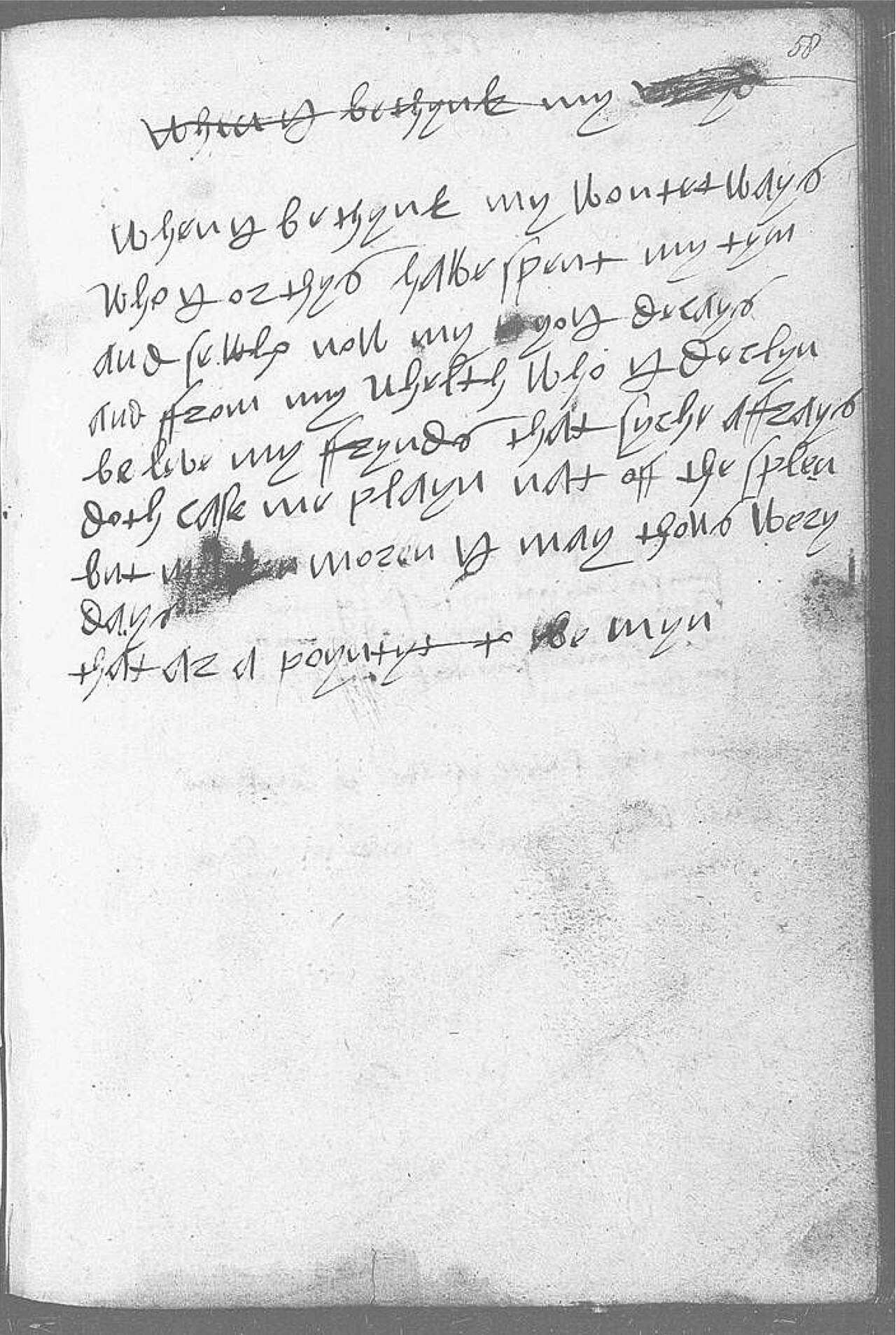
The Devonshire Manuscript facsimile 58r (Image: DMSEG, CC BY-SA 3.0) |
| --- |
| 
The Devonshire Manuscript facsimile 57v 57-1r 57-1v 57-2 r57-2v 57-3r 57-3v 57-4r 57-4v (Image: DMSEG, CC BY-SA 3.0) |
| |
f. [57v]
f. [57.1r]
f. [57.1v]
f. [57.2r]
f. [57.2v]
f. [57.3r]
f. [57.3v]
f. [57.4r]
f. [57.4v]
f. [58r]
when I bethynk my ways
1 when I bethynk my wontet ways
2 who I or thys hawe spent my tym
3 and se who now my yyoI joy decays
4 and ffrom my whelth who I ontwyn
5 be leve my fFrynds that suche affrays
6 doth case me playn nat off the splen
7 but mo [] ren moren I may thous wery days
8 that ar a poyntyt appointed to be myn
Commentary
Written in the hand of Margaret Douglas, this poem remains unattributed. Mary Shelton enters another version of this poem on "wan I be thyng my wontyd was" (59r). Notably, both authors use different word choices: Douglas's version, for instance, uses “or thys,” “joy,” and “declyn,” while Shelton's version uses “anon,” “gay,” and “or myn” (see lines 2,3, and 4). Taken together, Mary Shelton’s and Margaret Douglas’s verses (on 58r to "wan I be thyng my wontyd was" (59r), and again on "my hart ys set not remove" (65r) to "Madame_margeret" (68v)) appear as if they support one another in similar themes: lamenting former happier times “Wan I be thyng my wontyd was” (58r and 59r); professing steadfast love in the face of adversity “my hart ys set not remove” (58v and 65r) and “Lo in thy hat thow hast be gone” (59r); and concealing actual feelings “I am not she be prowess off syt” (65r) and “Myght I as well within my song be lay” (65v). In the case of this particular set of two poems (58r and 59r), Margaret and Mary may have been echoing one another’s poignant sorrow over the loss of happier times and the “wery days/ that [were] apoyntyt to be” theirs.
Textual Notes
Texts Collated
Collation
1 when] wan LDev088 bethynk my wontet ways] be thyngthynk my wontyd wasways LDev088
2 who] how LDev088 or thys] anon LDev088
3 who] how LDev088 yyoIIoy decays] gay dekas LDev088
4 whelth] welth LDev088 who] how LDev088 declyn] or myn LDev088
5 be leve] be leffebelieve LDev088 fFrynds] ffryndes LDev088 suche affrays] swchsuch assais LDev088
6 case] kaas LDev088 playn] plan LDev088 nat] not LDev088 splen] spelenspleen LDev088
7 but moren] potbut LDev088 moren] morn LDev088 thous] thys LDev088 days] das LDev088
8 ar a poyntytappointed] har apoyntyd LDev088
Where this page came from
This page was imported from Wikibooks. From “The Devonshire Manuscript” on Wikibooks, by its contributors, under CC BY-SA 4.0. Changed here: set as a page; navigation and edit links left out; each image under its own licence, credited in its caption.
Nobody has written it yet — it is the source material at a new address, which is why search engines are asked to skip it and why no one earns from it. It is up for grabs: take it on, and it is yours to rewrite and to earn from.
In these publicationsThe Devonshire Manuscript
Licence: CC BY-SA 4.0 · Adapted from en.wikibooks.org
Comments