
One morning in October 2022, from about eight until noon, the nets at Palomarin Field Station caught exactly one bird: a brown creeper. The next day, in a single hour, they caught a dozen birds of five species. Jailyn Hoskins, a science communication assistant with the National Park Service's San Francisco Bay Area Network, had come to watch — a birder who had only recently moved from southeast Louisiana and was still meeting California's birds.
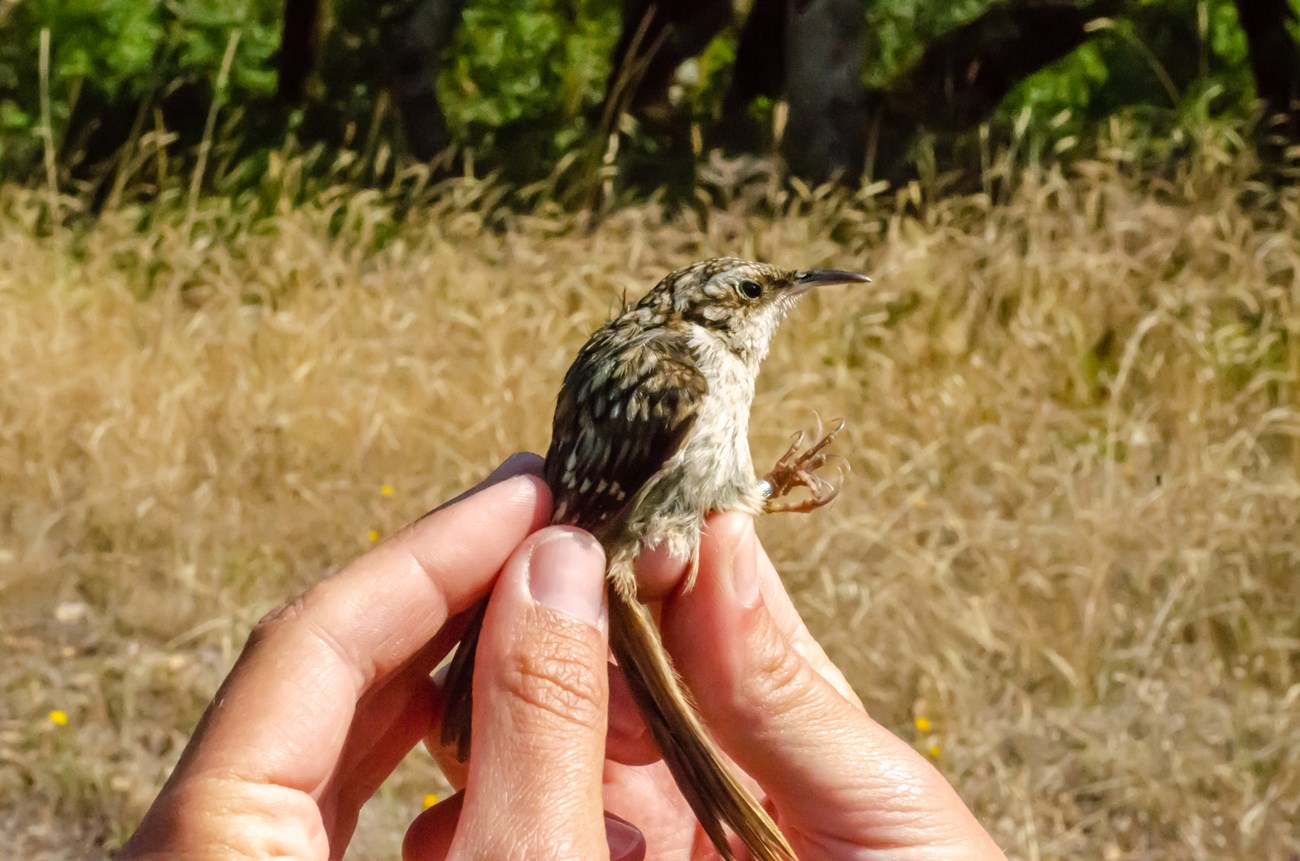
The one bird of the first morning, a brown creeper. Credit: Jailyn Hoskins, NPS / Environment for the Americas.
The station
Point Blue Conservation Science's Palomarin Field Station, at the south end of Point Reyes National Seashore, runs the longest landbird mist-netting and banding effort west of the Mississippi, and the third longest on the continent. Its work in the riparian (streamside) areas of Golden Gate and Point Reyes, in partnership with the Park Service, is the core of the San Francisco Bay Area Network's landbird monitoring program.
How it works
- Net runs. Banders — interns and apprentices in an intensive early-career training program — check every net every 30 minutes for birds caught in the fine mesh.
- Extraction. Working out which way a bird flew in, they free it with techniques suited to how it is caught.
- Examination. At a mobile station, they check its feathers and body to judge its age and condition, and weigh it — in a film canister.
- Banding and release. Each bird gets a small, unique metal leg band, and goes free.
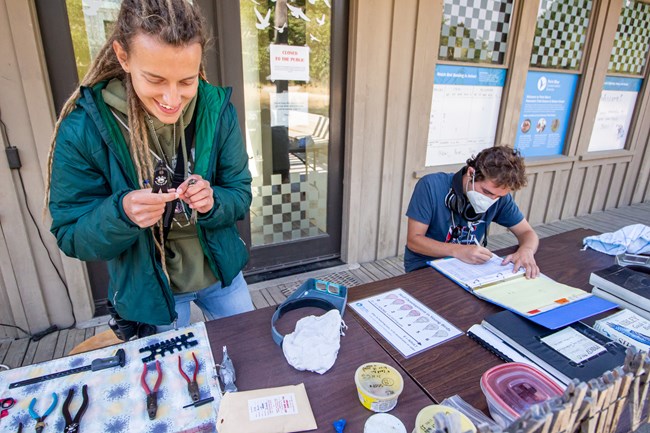
At the banding station, a bird is examined and fitted with a leg band while data are recorded. Credit: Jailyn Hoskins, NPS / Environment for the Americas.
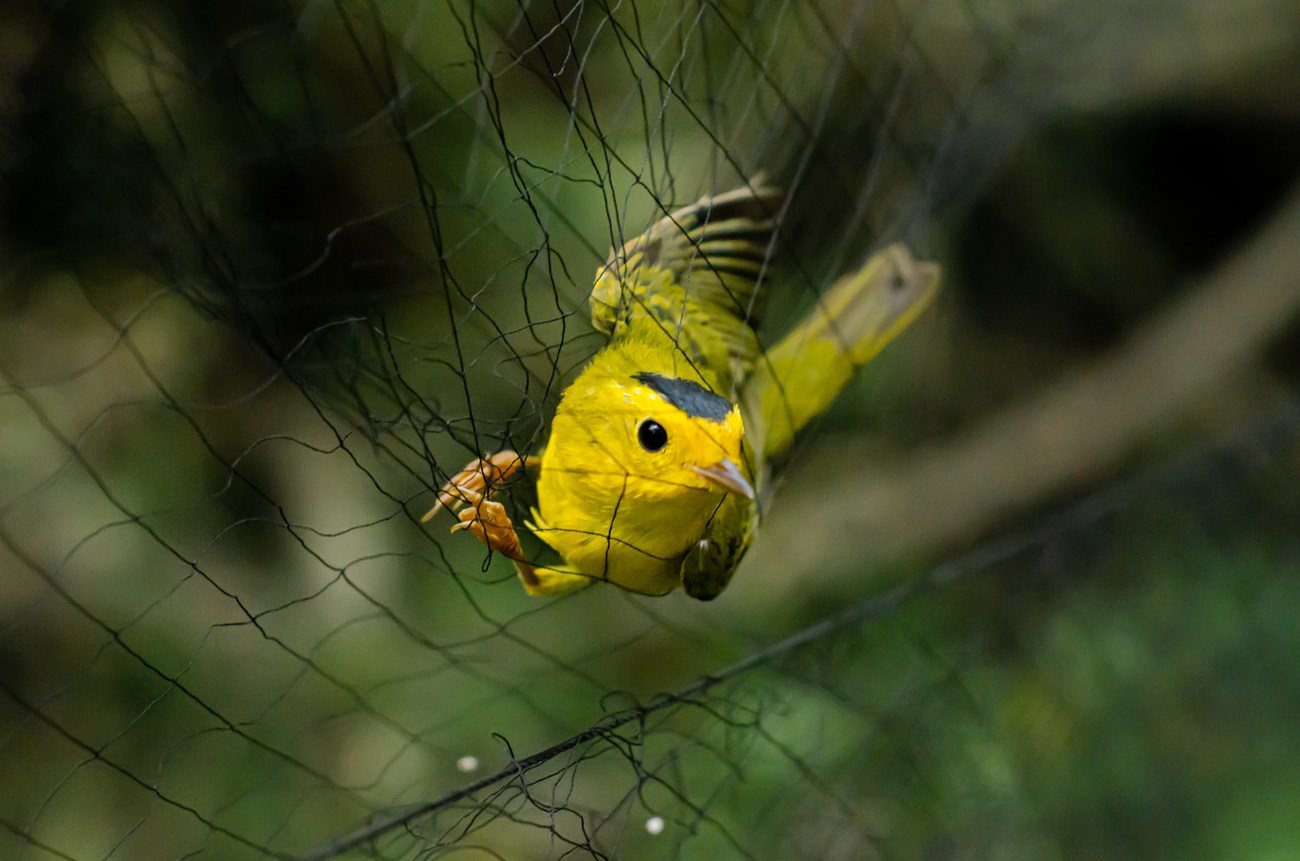
A Wilson's warbler waits in a soft mist net for a trained bander to free it. It was banded, measured and released. Credit: Jailyn Hoskins, NPS / Environment for the Americas.
The Wilson's warbler, especially yellow against the green streamside growth, was Hoskins's favorite of the busy second day.
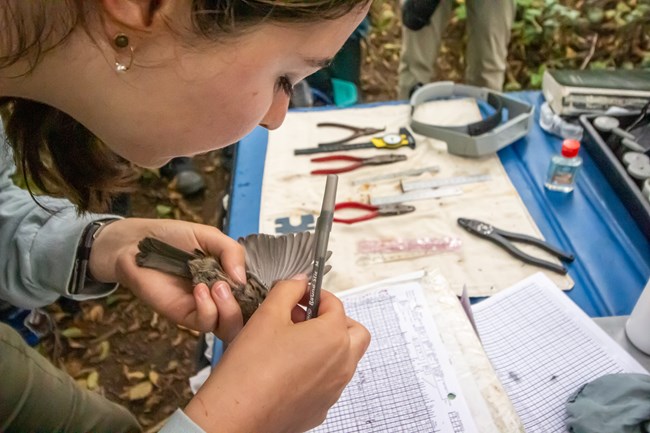
Which of a song sparrow's feathers are new and which are old helps banders estimate its age. Credit: Jailyn Hoskins, NPS / Environment for the Americas.
More than netting
Point Blue also counts breeding birds at fixed points each year, searches for nests, maps territories, tags birds to learn where they migrate, and tracks weather and vegetation — together showing how birds relate to their ecosystems over time.
Other data sets take the research further. The North American Breeding Bird Survey, a large volunteer effort founded by the U.S. Geological Survey in 1966 — the same year as the Palomarin station — covers much larger regions. Comparing its trends with Point Blue's Bay Area park data showed that most species, the Wilson's warbler among them, are doing better inside protected areas.
With climate change and the loss or degradation of habitat, no one can be sure what lies ahead for bird populations. But researchers and the Park Service know that tracking how populations are doing is key to keeping birds around for generations to come.
Sources
Based on "A Window into What a Bird in the Hand Can Teach Us" by Jailyn Hoskins, San Francisco Bay Area Network Science Communication Team, National Park Service, a work of the United States government in the public domain.
In these collectionsGolden Gate National Recreation AreaPoint Reyes National Seashore
Licence: CC0 1.0 (public domain) · Adapted from www.nps.gov
1
0
0
0

Comments


