
Want to improve the page's content? Try to propose a change.
Winning women’s right to vote took the work of three generations of women, the support of men, and nearly a century. It was never a single, united campaign. Suffragists often agreed on the goal but not on how to reach it, and groups split apart, reunited and split again. Their story raises a question every movement for change faces: what happens when allies disagree about methods?
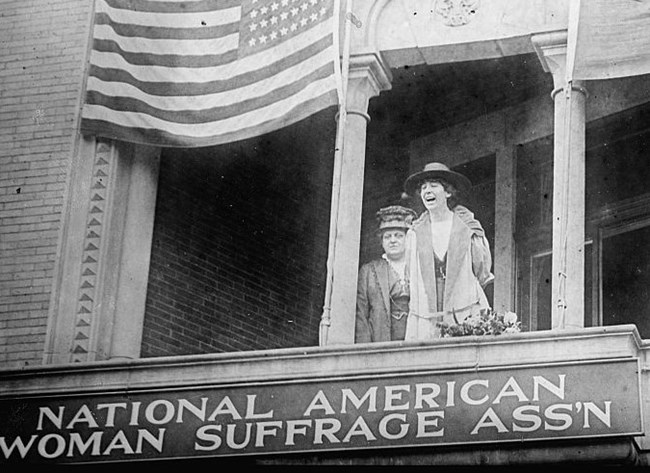
Jeannette Rankin on the balcony of the National American Woman Suffrage Association’s Washington, D.C., headquarters, with Carrie Chapman Catt behind her. National Photo Company Collection, Library of Congress.
A movement that began with abolition
The women’s suffrage movement grew out of the work of abolitionists fighting to end slavery. After the Civil War, reformers founded the American Equal Rights Association (AERA) to win full citizenship, including the vote, for everyone regardless of sex or race.
AERA broke apart over the Fifteenth Amendment, which was designed to protect Black men’s right to vote but left women out.
Two rival organizations
Two women’s suffrage groups came out of the split, and their leaders were at odds for years:
| Organization | Founders | Approach |
|---|---|---|
| American Woman Suffrage Association (AWSA) | Lucy Stone | held to equal rights for all, and worked for step-by-step progress even when some goals had to wait |
| National Woman Suffrage Association (NWSA) | Susan B. Anthony and Elizabeth Cady Stanton | refused to back the vote for Black men if it meant leaving women behind |
Lucy Stone kept her own surname when she married Henry Blackwell in 1855; women who later did the same were often called “Lucy Stoners.”
Back together — for a while
In 1890, as a new generation worked to heal the rift, the two groups merged into the National American Woman Suffrage Association (NAWSA). One of its most effective leaders was Carrie Chapman Catt.
Progress remained slow. After decades of work by two generations, women could vote on equal terms with men in only a few states; elsewhere they might vote only in local or school board elections, and defeats outnumbered victories.
The young challengers
In the early 20th century, younger suffragists began to accuse NAWSA’s leaders of being too cautious. Among them was Alice Paul, who eventually broke away to form the National Woman’s Party (NWP).
The two camps fought each other even as both pushed for the Nineteenth Amendment. The NWP was not the biggest or most prominent group: Catt’s NAWSA had more members, more power and more money. Their rivalry even reached photographs — in an early instance of doctored images.
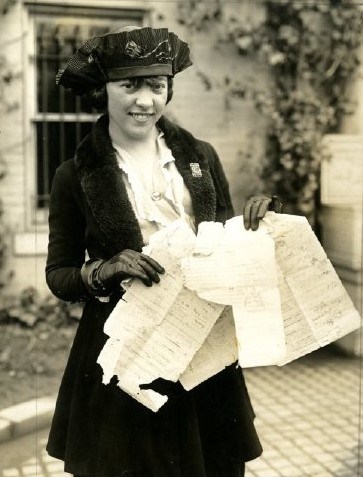
Betty Gram holds the worn pages of the suffragists’ lobby list at the end of the ratification campaign in West Virginia, wearing her suffrage prisoner pin. National Woman’s Party.
Words to know
| Word | Meaning |
|---|---|
| suffrage | the right to vote |
| suffragist | someone who works for the right to vote, especially for women |
| enfranchisement | giving a right or privilege, especially the vote |
| crusade | a strong campaign for social, political or religious change |
| tactician | someone who uses careful plans to reach a goal |
| hypocrisy | when someone’s actions don’t match what they claim to believe |
To think about
How should people resolve conflict when they share a goal but not a strategy? Whose side would you have been on — Catt’s NAWSA or Paul’s National Woman’s Party?
Sources
Based on "Teaching Suffrage: Frenemies," National Park Service, created with the Hard History Project for high school students; the NPS page is a work of the United States government in the public domain, and its text is rewritten in hubnx’s own words.
In these collectionsNational Mall and Memorial ParksBelmont-Paul Women's Equality National MonumentTeaching Suffrage
Licence: CC0 1.0 (public domain) · Adapted from www.nps.gov
1
0
0
0

Comments
Read next


