
Want to improve the page's content? Try to propose a change.
The Bunker Hill Monument in Charlestown, Boston, is 221 feet of Quincy granite that will very likely outlast everyone who looks at it. The weak point is not the stone. It is the thin line of mortar between the blocks — and keeping it sound, more than 200 feet up, has been the job of three caretakers across 180 years.
A monument that opened big
The monument was dedicated on June 17, 1843, 68 years to the day after the Battle of Bunker Hill, the first major battle of the War of Independence. President John Tyler attended with 100,000 spectators, and Daniel Webster gave the address. The 221-foot obelisk was the largest in the country until the Washington Monument overtook it in 1888, and visitors climbed its 294 steps to a chamber at the top with views in four directions. A lodge was soon built beside it to hold artifacts of the battle.
Built to stand
The architect and builder, Solomon Willard, quarried the granite at nearby Quincy, known for its hardness. To make the obelisk look like a single shaft he used very large blocks with thin joints.
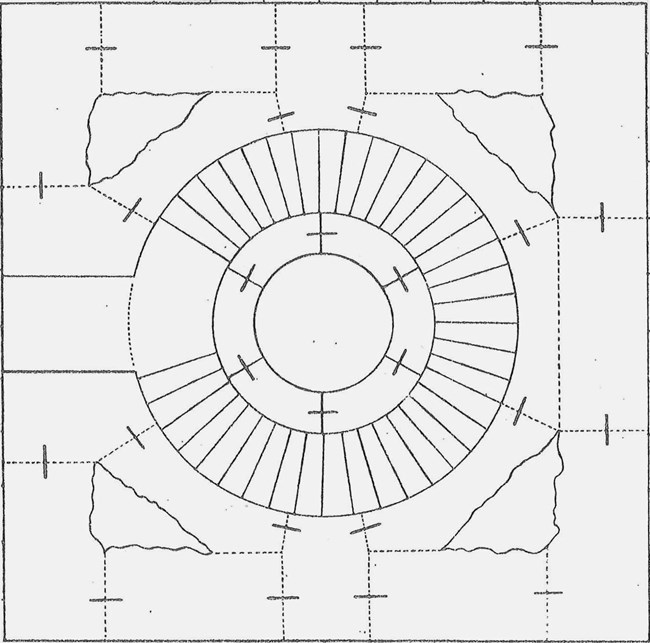
The first level in cross-section: every block linked to the others and to the spiral stair around the core. All 78 levels are laid out the same way. Solomon Willard, Plans and Sections of the Obelisk on Bunker's Hill (1843)
| Blocks | about 3,000, interlocked; five tons on average, ten tons near the base |
| Weight | about 7,000 tons |
| Foundation | granite, 12 feet deep on a 50-square-foot base |
| Mortar joints | more than 11,000 linear feet |
Newspapers have worried over the years that crumbling mortar could loosen the blocks. It cannot: the blocks are held by the design and by their own weight, and when surveyors checked in 1980 the monument was almost exactly as plumb as the day it was built.

Granite and mortar: the mortar is what needs looking after. NPS photo
Why the mortar matters
Mortar — sand, clay, lime and other binders mixed with water, applied as a paste that hardens — seals the joints against the weather. Rain and snow are the danger. Water that gets between the blocks can damage the granite, especially when it freezes and thaws over and over, making the surface flake; water that gets inside pools on the stairs, where visitors can slip. Mortar lasts about 30 years, less on the exposed top.
The fix is repointing: raking out the loose mortar and forcing new mortar into the joints, 6 to 12 inches deep, usually only where it has failed.
Three caretakers, eight repointings
| Year | Caretaker | Work |
|---|---|---|
| 1870 | Bunker Hill Monument Association | the roof leaks; steeplejacks, the only workers used to such heights, repoint the pyramid-shaped top, the pyramidion |
| 1882 | Association | papers report the mortar "washed out" and moss growing; a young MIT engineer, Harry H. Cutler (later the holder of more than 70 patents), designs staging to hang workers outside; the Washington Monument's chief engineer, Lt. Col. Thomas L. Casey, recommends a new product, Portland cement |
| 1919–20 | Commonwealth of Massachusetts, Metropolitan District Commission | the Association, unable to afford a four-acre site of lodge, fences, walks, steps, statues and landscaping, hands it over; the whole exterior is repointed |
| 1958 | MDC | after a local politician deplores its "utter disrepair," the monument is repointed and cleaned and the fences fixed; walks and landscaping follow in 1960 |
| 1976 | MDC → National Park Service | before the transfer, the state adds granite tablets at the four gates — Massachusetts, Connecticut, New Hampshire and United States — for the Bicentennial |
| 1980 | NPS | the costliest restoration yet: everything repointed down to the foundation, a new drainage system, new walks and benches |
| 2006, 2010 | NPS | north and east sides, then south and west; a new accessible entrance and ramp at the lodge; the gate steps rebuilt; the Bunker Hill Museum opens across the street in 2007 |
| 2023 | NPS | rain gets in through the top again; the monument is wrapped in scaffolding and the pyramidion and top ten levels repointed |
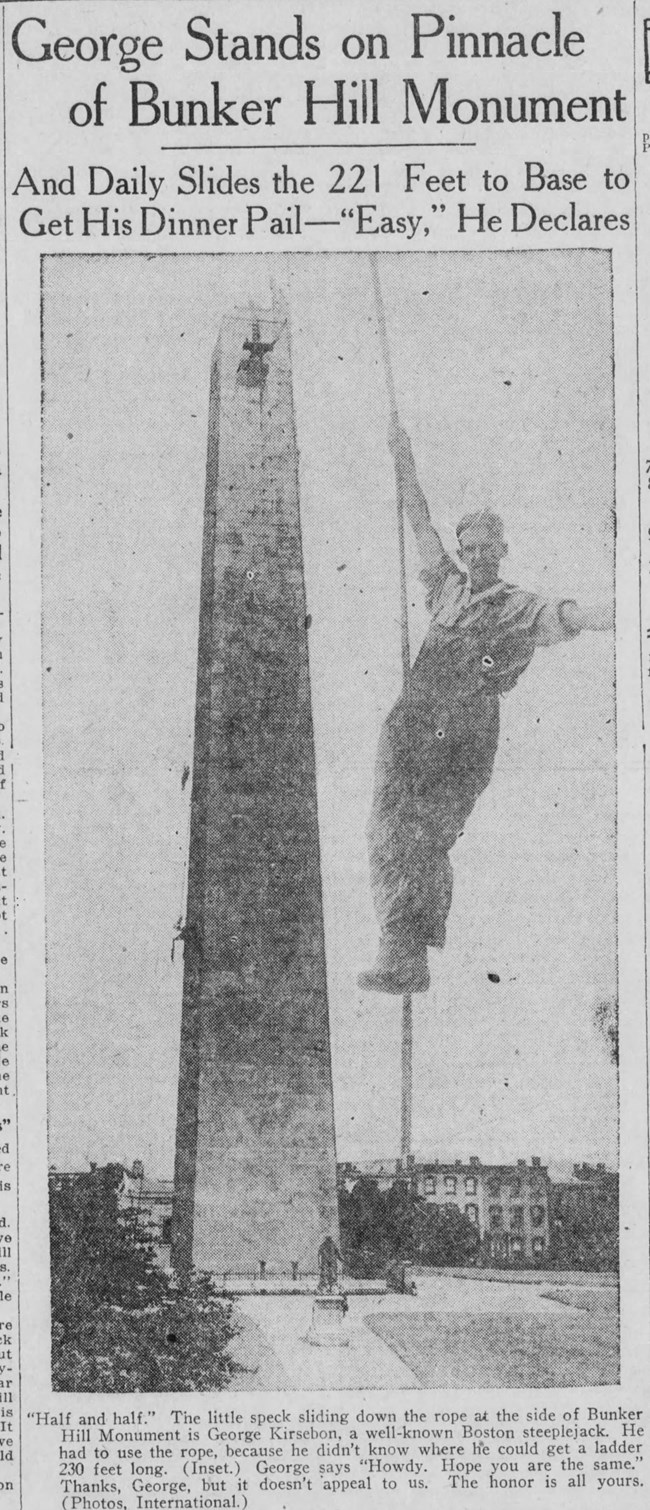
A steeplejack at work in 1920 — well outside today's rules for working at height. Boston Post, July 25, 1920
Safety at 200 feet
In the early years, workers were responsible for their own safety. The 1870 steeplejacks probably built a wooden platform out from the top windows and climbed a ladder to the roof, roped on more than 200 feet up. Falls have always been the leading killer on construction sites; Massachusetts began setting rules for work at height in 1877, and the federal Occupational Safety and Health Administration later did the same. Scores of masons have repointed the monument. None has ever been killed or seriously hurt.

Repairing the lightning rod by crane, 1993. NPS photo / Blaise Davi
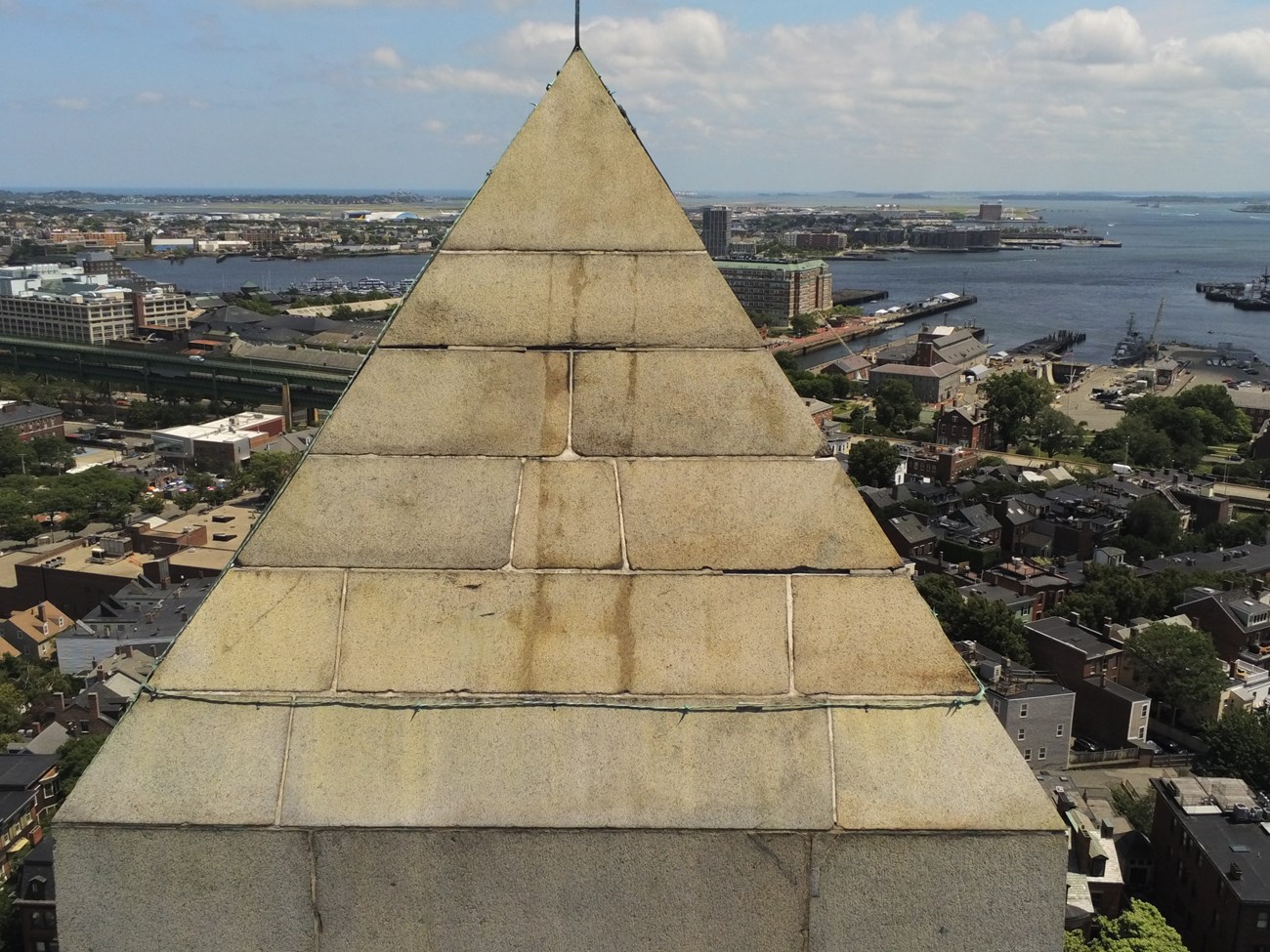
The pyramidion in 2023, before repair. NPS photo

Scaffolded, autumn 2023. NPS photo

New mortar on the pyramidion, 2023. NPS photo
Why it gets the care
The Park Service made the monument a National Historic Landmark in 1961, both for the battle and as the first large obelisk built in the United States. The 2023 work prepared it for three anniversaries: June 17, 2025, 200 years since its cornerstone was laid; the 250th anniversary of the battle the same year; and the nation's 250th in 2026. Hundreds of thousands of people visit each year, and the site stays open year-round.
Sources
Written from "Repairing the Bunker Hill Monument: Preserving Our Nation's Heritage," Boston National Historical Park, National Park Service; a work of the United States government in the public domain.
In these collectionsBoston National Historical Park
Licence: CC0 1.0 (public domain) · Adapted from www.nps.gov
1
0
0
0

Comments
Read next


