
Want to improve the page's content? Try to propose a change.
The Mansion at Marsh-Billings-Rockefeller National Historical Park in Vermont holds close to 700 ceramic pieces — on mantelpieces, on walls, on nearly every flat surface. Frederick and Julia Billings started the collection in 1881, buying mainly from New York retailers and importers such as Louis Lanthier; Black, Starr & Frost; Vantine's; and J.B. Woolley. Mary and Laurance Rockefeller later kept it and added to it. Across both families, one theme recurs: nature.
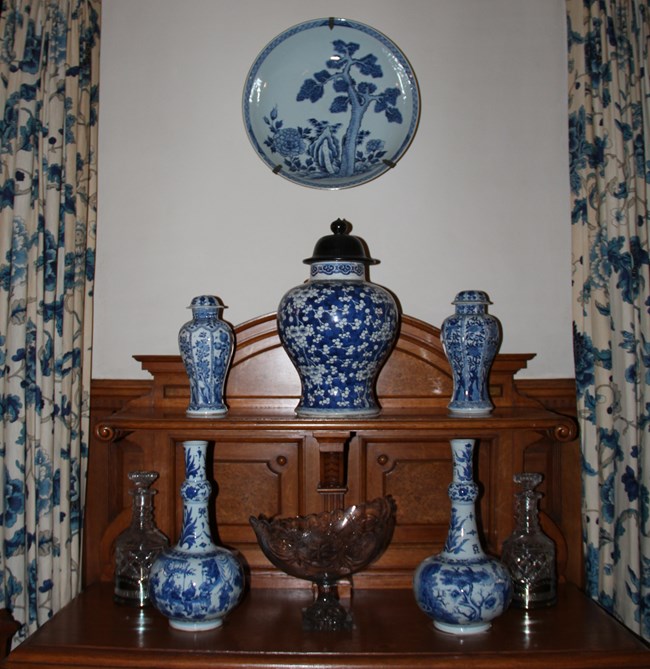
Blue-and-white porcelain in the Mansion's dining room. Image from the National Park Service's article on the collection.
Collecting in the aesthetic movement
"Ceramics were the most avidly collected objects during the aesthetic movement," said Henry Hudson Holly, one of the Mansion's major renovators; "a rare piece of China upon the wall is often more effective than many ornaments or pictures." The movement favored Asian, Indian and Middle Eastern patterns, but the Billingses seem to have chosen mostly Chinese designs tied to the natural world. The Rockefellers kept collecting similar Chinese pieces, while adding other periods and styles, including mid-century modern.
What's in the Mansion
| Type | Where and what |
|---|---|
| Blue-and-white porcelain | Dining room. Chinese blue underglaze pieces from the 1600s–1800s, collected by the Billingses; Frederick called his blue-and-white chargers "so very fine" in his diary. Symbols of the four seasons repeat: tree peony (spring), butterflies and lotuses (summer), chrysanthemum (autumn), prunus (winter) — Julia noted buying a hawthorn (prunus) vase for the room. For everyday dining, the Billingses used British sets such as a Brown-Westhead service |
| Mason's Ironstone | Dining room side table. A 200-piece English set made in 1802–1820, inherited by Laurance Rockefeller from his father, John D. Rockefeller Jr., in the 1960s. Despite the name, it's earthenware — "ironstone" was chosen to suggest strength — with transfer-printed patterns imitating Chinese and Japanese porcelain. The Rockefellers displayed what the Billingses would have eaten from |
| Famille Rose | Hallway and throughout. Chinese "pink family" wares of the 18th–19th centuries, from the Qing dynasty, with flowers, birds, insects and garden scenes, plus later English versions. Collected by the Billingses but arranged by Theodore Muller, a Rockefeller-era decorator who reduced the collection and turned many vases into lamps |
| Sang de boeuf | Prayer room. Miniature Chinese vases made in 1736–1795, their "ox blood" red produced by firing copper oxide without oxygen; set by Muller to complement the wood. Such single-color glazes became popular again in the mid-century modern era |
| Stoneware | Parlor. A 1978 tray by Nancy Wickham Boyd, who moved from New York to Vermont and founded the Vermont Workshop, and a 1980 bowl by Mary Montagu Billings French Moore, signed "Muffy" — mid-century-style pieces bought by the Rockefellers |
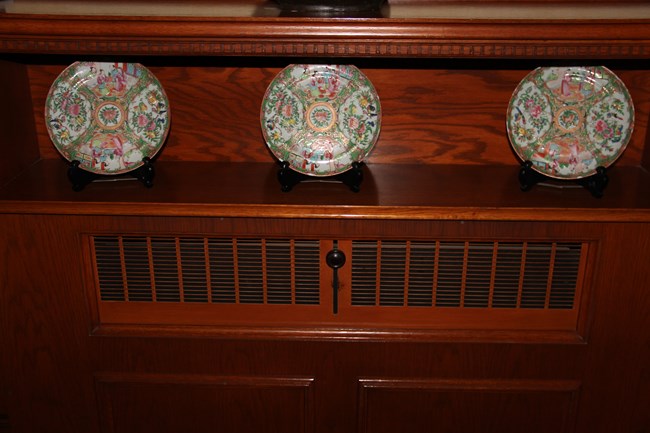
Famille Rose plates in the hallway. Image from the National Park Service's article on the collection.
A closer look: the Famille Verte chargers
Three massive 17th-century Famille Verte chargers line the staircase. Each has a central medallion showing ten women playing games such as go, surrounded by eight petal-shaped panels of people in nature, with flowers and butterflies — often symbols of summer and young love — between them. Rings of geometric designs and "hundred antiquities" motifs include the eight "precious objects," Buddhist symbols. Laurance Rockefeller, who had a particular interest in Buddhism, chose them from the estate of Martha Baird Rockefeller in the 1970s; whether they tell a specific story is unclear, but the combination of symbols makes them unique.
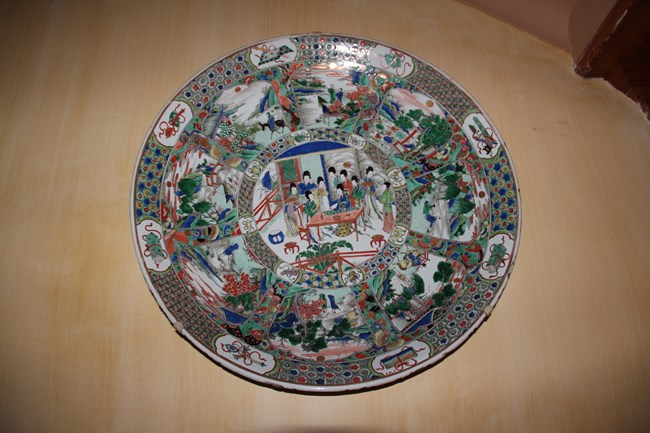
One of the Famille Verte chargers on the staircase. Image from the National Park Service's article on the collection.
A conservation case
In "Dear Aunt's Room," the bedroom of Elizabeth Billings — the house's longest resident, a lover of travel and famous for her herbarium — stands a pair of peach-colored bell-shaped vases painted with a Swiss chalet and chapel, and ivy matching the wallpaper. Seemingly French, perhaps but not certainly Sèvres, they were arranged by Muller in the older fashion of matched "garniture" sets. For unknown reasons, their square bases unscrew from the vases, and in 2013 the metal screws needed conservation treatment.
As Julia Billings wrote to Frederick in 1882: "We are sitting in the Library—Our Satsuma vases look rich & rare."
Sources
Based on "Ceramics at Marsh-Billings-Rockefeller NHP," by Alexa "Lex" Rose, ACE CRDIP curatorial member, Marsh-Billings-Rockefeller National Historical Park, National Park Service; a work of the United States government in the public domain. It draws on the park's Historic Furnishings Report (2013) and works on Chinese porcelain.
In these collectionsMarsh - Billings - Rockefeller National Historical Park
Licence: CC0 1.0 (public domain) · Adapted from www.nps.gov
1
0
0
0

Comments
Read next


