Ser du något att förbättra? Föreslå en ändring.
Den här sidan är offentlig.
Let's Think

NASA Earth Observatory image by Jesse Allen, using Landsat data from the U.S. Geological Survey. Caption by Kathryn Hansen.
Canal Conservation
| S cience, t echnology, e ngineering, and m ath (aka STEM) helps reinforce stewardship principles. Research conducted by STEM professionals help government leaders, law makers, and land managers understand why it is important to conserve and protect our natural world. |
|---|
| There are many STEM marvels throughout the C&O Canal: the geology at Great Falls shaped by a rushing Potomac River, early lift lock technology that stood the test of time, and biodiversity that includes some of the rarest plants in the world. Not to mention the 1,191 historic structures, 11 aqueducts, and 7 dams engineered in the early 19th century, many that you still can view today! |
Imagine: STEM Jobs at NPS

Youth crew interns clean canal basin to allow boat tours to take place. NPS Photo
Museum Conservators in NPS
| An African-American Civil War soldier, a letter from a young Abraham Lincoln, archeological textile fragments, one of Lady Bird Johnson's dresses — these are all objects in NPS collections that received conservation treatment to ensure they remain safe as they are worked on, put on exhibit, or placed in storage. |
|---|
| Museum conservation uses many principles of STEM. Explore what conservators do and how they use old and new techniques to help preserve resources at National Parks. Imagine you are an NPS conservator and go through the basic approaches to conservation: examination, stabilization, research, and restoration. → Begin here |

Youth crew intern learning how to use a seine net to clean canal. NPS Photo
Scientists-in-Parks
| The Scientists-in-Parks program supports the management of natural resources with projects in all the areas of science, communications, and education. Meet some of the people who never lost their curiosity of the natural world as they help protect the plants, animals, sounds, and oceans in the NPS. |
|---|
| Explore the page, virtually "meet a scientist," and see what they do at the NPS. See what inspires them, learn more about their tools of the trade, and more. What areas of science interest you? What areas could you see yourself working in? → Begin here |

Youth crew interns doing important vegetation removal in canal. NPS Photo
The Tools We Use #ScienceDeskDigs
| What do scientists keep on their desks? The #sciencedeskdigs series gives you a special look. Meet the scientists of the NPS talk about the interesting items found on their desks. Check out the 3D printed microphone, ancient bison skull, backpack electrofisher, and more! |
|---|
| Click the link below and explore the different tools scientists use and would likely see on their desks! Which tools did you find interesting? What were some of the jobs that use those tools? Which desk surprised you most? → Begin here |
Outdoor Fun
Build your explorer backpack then go on a scavenger hunt!
- Step #1: Build Your Explorer Backpack
Learn how to create your own explorer backpack! Repurpose old items at home, print maps online, or check out field guides from your local library. Bring your sense of adventure, Leave No Trace knowledge, and explorer backpack for an afternoon of fun at the C&O Canal!
- Step #2: Scavenger Hunt
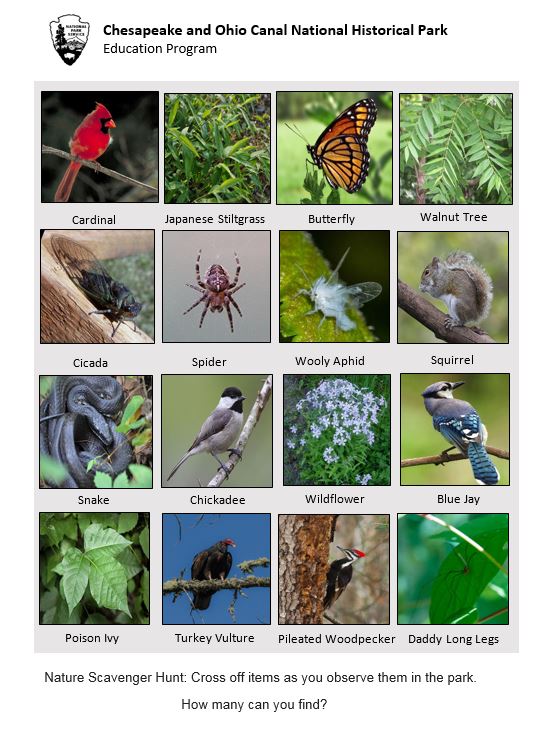
Explore the natural wonders of the C&O Canal with a Scavenger Hunt! Watch for wildlife, look closely at the plants around you, and check them off as you go. See how many plants and animals you can find! Of course, make sure to always #RecreateResponsibly and Leave No Trace while exploring the Park!
Listen to the Sounds of the Canal
Step #1 ⇒ Explore the Sounds Along the Canal page, then move to the next step.
The next time you visit the towpath, close your eyes, and pay attention to what you hear. Along the 184.5 miles of the C&O Canal, you will hear a diversity of sounds! Learn about what a soundscape is, why sound preservation is important to National Parks, and listen to cool sounds recorded along the C&O Canal on the Sounds Along the Canal resource page.
Step #2 ⇒ Get ready for an outdoor soundscape activity!
- Materials needed – Blanket or mat to sit on, paper, and something to write with
- Visit the C&O Canal, your local park, or even your backyard.
- Find a comfortable spot that you can sit and listen for this exercise.
- Once you are seated in a comfortable spot, close your eyes and listen closely.
- Everytime you hear a new sound, write down what you think the sound is.
- If you're with a friend, compare your findings! Did you hear the same things? Which were man-made sounds? Which were natural?
- Switch to a new spot and repeat the exercise. Are the sounds the same? What type of environments did you visit?
Rock Talk on the Towpath
Get started here ⇒ Rock Talk: Geology Conversations on the C&O Canal
The Potomac River and the land it runs through are talking to you. They share stories of ancient oceans, wrenching forces, and powerful floods shaping the landscape in ways large and small, ancient and modern. Come see their stories and observe interesting features like underwater potholes and hollowed out mountains and cliffsides. Learn about these amazing places online, then visit them yourself at C&O Canal.

Spiderwort flower. NPS Photo / Kristen Maxfield
National Capital Area Natural History Collections
The National Capital Area (NCA) of the National Park Service includes a rich cultural and natural history. Many sites include a diverse array of forests, mountains, and estuaries which support high levels of biodiversity in a narrow geographic range. Parks are located in the Valley and Ridge region and extend east to the Fall Line, which demarcates the Atlantic Coastal Plain. Discover the rich and beautiful natural history the NCA from the comfort of your home!
Learn More
Carbon Footprint Activity
Get started here ⇒ Carbon Footprint Activity
Every day, we make choices that impact our natural environment. Some of these activities contribute to carbon dioxide emissions in the atmosphere. Do you know what your carbon footprint is? Check out this fun activity and learn how you can help lower your Carbon Footprint!
Trees, trees, trees... Come meet Lock and Key!
Get started here ⇒ Trees, trees, trees... Come meet Lock and Key!
Take a journey with Lock & Key, two mules who work along the C&O Canal, as they teach us about trees! Learn about what happens to trees during the seasons, do a scavenger hunt, embrace your creative side, and so much more. There are plenty of fun activities to explore, so what are you waiting for? Meet Lock & Key!
C&O Canal Biology Guide
Would you like to know more about birds, reptiles, amphibians, dragonflies, butterflies, deer, bats, freshwater mussels? Discover flora and fauna (aka plants and animals) that call the C&O Canal home!
Stop, look, and listen. Wildlife is all around you! Explore the wildlife at the C&O Canal. Checkout the Species Checklist feature to search animals by category or even search species of other national parks. Read NPS articles that talk about hot environmental issues today, like invasive species, health of amphibians, and what we can do to help.
The C&O Canal is home to some of the rarest plants in the world and fields of beautiful flowers. Checkout the Canal Association's Guide to Spring Wildflowers on the Towpath. Investigate the beautiful wildflowers, other native plant species, as well as "alien" invasives. Using the Species Checklist feature, you can download a checklist of all the vascular plants in the park. How many can you find?

Drag your cursor or use the controls at the bottom of the image to navigate this 360-degree photo. What clues help you identify this park?
Where this belongs
- Chesapeake & Ohio Canal National Historical Park
Where this page came from
This page was imported from National Park Service. Produced by the U.S. National Park Service and, as a work of the United States government, in the public domain.
Nobody has written it yet — it is the source material at a new address, which is why search engines are asked to skip it and why no one earns from it. It is up for grabs: take it on, and it is yours to rewrite and to earn from.
I dessa publikationerChesapeake & Ohio Canal National Historical Park
Licens: CC0 1.0 (allmän egendom) · Bearbetat efter www.nps.gov
Kommentarer