
Vill du förbättra nodens innehåll? Försök att göra en redigeringsbegäran.
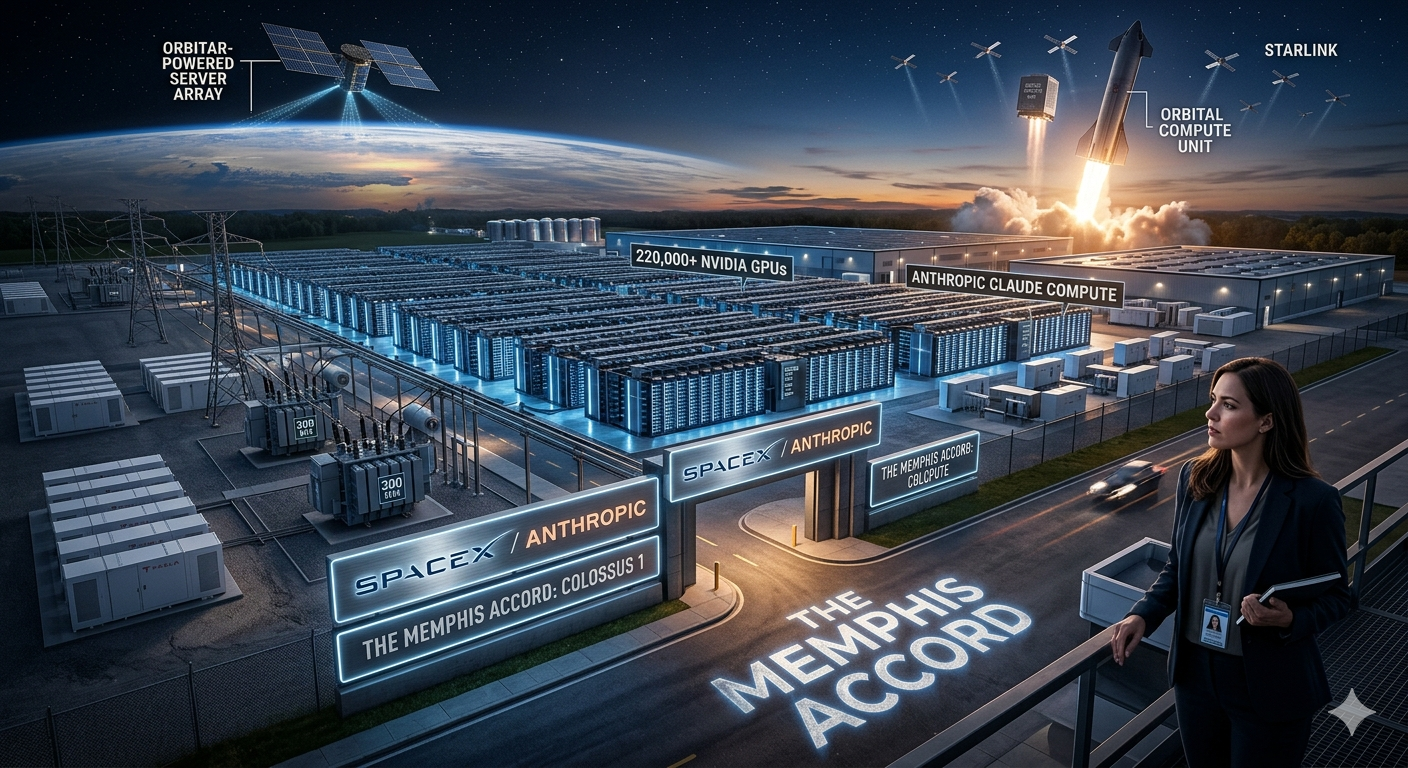
In a transformative shift for the artificial intelligence landscape, SpaceX—having recently absorbed Elon Musk’s xAI—has entered into a definitive agreement with Anthropic to lease the entirety of its "Colossus 1" supercluster. This landmark deal provides Anthropic with immediate access to over 220,000 Nvidia GPUs and 300 megawatts of power capacity at the Memphis, Tennessee, facility. Analysts estimate the annual lease value at approximately $5 billion, a critical revenue stream for SpaceX as it approaches a projected $1.75 trillion IPO in June 2026. The partnership represents a significant pivot for Elon Musk, who transitioned xAI from a direct competitor to Anthropic into a strategic infrastructure provider. Musk cited a "humanity-aligned" vetting process of Anthropic’s leadership as the catalyst for the deal, though he retained a controversial "reclaim clause" should the AI engage in harmful actions. For Anthropic, the deal solves a crippling compute shortage, enabling a doubling of rate limits for its flagship Claude Code and Opus models. Beyond terrestrial infrastructure, the agreement includes a strategic "Letter of Intent" to develop the world’s first orbital AI compute network. By leveraging SpaceX’s Starlink architecture, the duo aims to deploy multiple gigawatts of space-based processing power, utilizing direct solar energy to bypass Earth’s environmental and regulatory constraints. This collaboration effectively crowns SpaceX as the primary "landlord" of the AI era, bridging the gap between aerospace engineering and frontier model development.
THE ARCHITECTURE OF A TRILLION-DOLLAR ALLIANCE
The Colossus Handover: From Rivalry to Rent
The announcement on May 6, 2026, that Anthropic would occupy 100% of the Colossus 1 data center marked the end of an era for xAI as an independent frontier lab. Colossus 1, which gained notoriety for being constructed in a record 122 days using mobile gas turbines and Tesla Megapacks, had reportedly been underutilized, with internal reports suggesting only an 11% utilization rate for xAI’s own Grok models.
By leasing the facility to Anthropic, SpaceX (which dissolved xAI into its own corporate structure in February 2026) has effectively monetized one of the world's most expensive hardware assets. The 220,000 Nvidia H100 and H200 GPUs now serve the inference and training needs of Claude 4 and its derivatives. The financial terms, while not publicly detailed in a single filing, are estimated by Altimeter and other institutional observers to be worth $5 billion annually, bolstered by Anthropic’s massive $900 billion valuation and its recent $30 billion funding round.
The Geopolitics of Compute: Why Anthropic?
Anthropic’s "compute-first" strategy has seen it sign massive agreements with Google ($200 billion over five years) and Amazon ($100 billion over a decade). However, the immediate availability of the Memphis cluster offered a "plug-and-play" solution to capacity bottlenecks that had plagued Claude users in early 2026.
Elon Musk’s justification for the deal focused on "AI Safety," a rare point of alignment between Musk and Anthropic’s founders, Dario and Daniela Amodei. Musk stated that after extensive meetings, he was convinced Anthropic’s "Constitutional AI" framework was sufficiently robust to warrant access to his hardware. However, the agreement contains a "kill switch" provision: SpaceX reserves the right to terminate compute access if Anthropic’s models are deemed to be "misanthropic" or harmful to human interests—a clause that introduces a unique form of supply-chain risk for the AI startup.
The Orbital Frontier: Gigawatts in the Void
The most speculative yet significant component of the deal is the commitment to "Orbital AI." As terrestrial data centers face increasing scrutiny over water usage and power grid strain, SpaceX and Anthropic are looking upward.
The proposed orbital servers would utilize SpaceX’s next-generation Starlink bus to house high-density compute modules. These "Space Servers" offer three distinct advantages:
- Unlimited Solar Energy: Avoiding the day/night cycle and atmospheric interference of Earth-based solar.
- Passive Cooling: Utilizing the vacuum of space for thermal management, though heat dissipation remains a significant engineering hurdle.
- Jurisdictional Autonomy: Operating outside the immediate regulatory reach of national power commissions.
Strategic Implications for the SpaceX IPO
This deal repositioned SpaceX from a launch and satellite provider to a vertically integrated AI infrastructure titan just weeks before its June IPO. By folding xAI’s assets into SpaceX, Musk has provided the company with a diversified revenue stream that complements Starlink’s $10 billion annual run rate.
For the broader tech industry, the SpaceX-Anthropic deal signals a consolidation of power. The "Big Three" of AI compute—Microsoft/OpenAI, Google/DeepMind, and now SpaceX/Anthropic—have created a barrier to entry so capital-intensive that only trillion-dollar entities can compete.
Technical Specifications of the Memphis Cluster
The Colossus 1 facility remains a marvel of "cowboy engineering."
- Total GPUs: 220,000 (Nvidia H100/H200).
- Power Density: 300MW dedicated capacity.
- Networking: Custom RoCE (RDMA over Converged Ethernet) fabric designed for low-latency weight distribution.
- Storage: Multi-petabyte All-Flash arrays optimized for rapid checkpointing of large language models.
The New Infrastructure Paradigm
The partnership between SpaceX and Anthropic is more than a lease; it is a recognition that the future of intelligence is tethered to the scale of energy and silicon. As Anthropic migrates its workloads to Memphis and looks toward the stars, the deal sets a precedent for how "Hard Tech" companies will dictate the pace of AI evolution. The era of the "Compute Landlord" has arrived, and its first capital is Memphis; its next will be Low Earth Orbit.
1
0
0
0

Kommentarer