
Vill du förbättra sidans innehåll? Föreslå en ändring.
The United States told the world that its missing plane was a NASA weather research aircraft that might have drifted into Soviet airspace with an unconscious pilot. Nikita Khrushchev let the story grow. Then he announced that the Soviets had the pilot, alive, and the wreck — with a camera and film of Soviet military installations. The U-2 incident was a great embarrassment to President Dwight D. Eisenhower, and it ended the summit he had hoped would ease the Cold War.
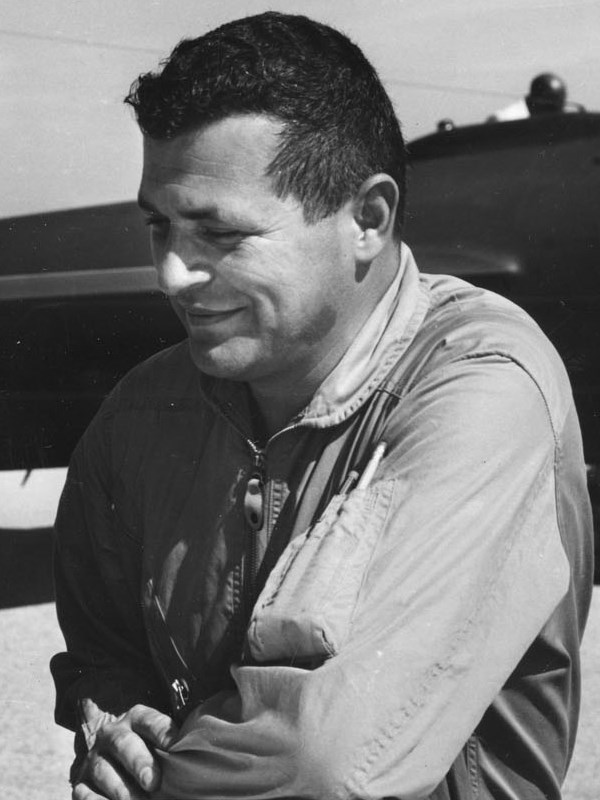
Francis Gary Powers in 1966, six years after he was shot down over the Soviet Union. Credit: U.S. Air Force.
A glider with a jet engine
In the 1950s the United States watched the Soviet Union from the air, but its reconnaissance aircraft, the RB-47 and RB-57D, had become vulnerable to Soviet surface-to-air missiles. The idea was that a plane flying high enough could evade Soviet detection and any missile.
In complete secrecy, the aircraft designer Kelly Johnson and Lockheed's Skunk Works built the answer: the U-2, essentially a glider with a jet engine in its fuselage. The Air Force rejected the design, but it appealed to CIA director Allen Dulles and to Eisenhower, who recommended the CIA build and operate it. Construction began in 1954, and the first test flight came in July 1955, only 8 months after the contract started. Missions followed soon after, and to hide their purpose the CIA let the public believe the aircraft was for high-altitude weather research.
Over the Soviet Union
At first U-2s flew only along the Soviet border. Eisenhower feared American pilots being shot down over Soviet territory, but after several successful flights by British pilots he allowed a few American missions — to be flown by May 1, 1960, leaving time before a summit with Khrushchev in Paris later that month. He hoped to build on the goodwill of Khrushchev's tour of America a year earlier, which had included a visit to Eisenhower's farm in Gettysburg, and he had an invitation to tour the Soviet Union in return.
The Americans believed the U-2 flew too high to be detected. In fact the Soviets had tracked it since it began operating. What they lacked was a weapon that could reach it, and they were developing a missile to do so.
May Day, 1960
| The last flight before the cutoff | |
|---|---|
| Route | from Pakistan to an airfield in Norway: almost 3,000 miles across the Soviet Union, with several points to photograph key installations |
| Pilot | Francis Gary Powers — an Air Force captain until his discharge in 1956, then a CIA civilian pilot with 27 missions behind him, including the first overflight of the Soviet Union from his base at Adana, Turkey |
| Date | May 1, the May Day holiday, when Soviet air traffic dropped sharply — so he was easy to track the whole way |
Four and a half hours into the flight, a Soviet SA-2 missile detonated close to the plane at 70,000 feet. The U-2 began to spiral down. Powers tried to eject, but his oxygen hose held him in until it broke a few seconds later; his parachute opened automatically and he landed unhurt. He carried a concealed needle of the poison saxitoxin, meant to kill him before capture, and did not use it. Soviet citizens surrounded him, found his U.S.-issued firearm and other items bearing the American flag, and handed him over. He and the wreck were shipped to Moscow, and within hours Khrushchev knew.
The trap
When Powers failed to arrive in Norway, the CIA's contingency plan went into action. NASA announced that one of its high-altitude weather research U-2s had gone missing over Turkey and might have drifted into Soviet airspace with an unconscious pilot, and showed off a U-2 in NASA colors. The Soviets said only that a spy plane had been shot down. The Americans kept adding detail — oxygen trouble, an autopilot that might have carried the plane into Soviet territory.
On May 7, Khrushchev sprang the trap: the pilot was alive, and the Soviets had the aircraft, its camera and its film. Eisenhower got the news by telephone in the office of his Gettysburg home and knew the Soviets would hold him responsible. He reportedly told an aide, "I would like to resign."
At the Paris summit on May 16, 1960, Khrushchev demanded an apology. Eisenhower said the overflights had been suspended and refused to apologize. The summit ended, and with it any chance of his visit to the Soviet Union.
What became of Powers
Powers was held at KGB headquarters in Moscow and interrogated for several weeks. He gave away no classified information, mostly confirming what the wreck had already told the Soviets. At a trial staged largely for show, he apologized at the urging of his Soviet-appointed defense counsel; he escaped the death penalty and was sentenced to 10 years, three of them in prison, and was held in Vladimir Central Prison with other political prisoners. He was later exchanged, together with the American student Frederic Pryor, for the Soviet spy Rudolf Abel on the Glienicke Bridge between East and West.
Back home he was debriefed and praised for revealing nothing, and Congress echoed that praise at a hearing where he testified. He returned to the Air Force for a time, then flew U-2s again for several years as a Lockheed test pilot, and later flew helicopters for a Los Angeles news outlet. He was killed in 1977 when his helicopter crashed while he was covering a wildfire.
After the U-2 incident
American high-altitude reconnaissance flights never entered Soviet airspace again. Instead came faster aircraft that could outrun interception — another Skunk Works design, the SR-71 Blackbird, took on that role in 1966. The U-2 was not retired: it still flies with the Air Force and, officially, as a NASA research aircraft, and in 2023 U-2s tracked a high-altitude Chinese balloon across the continental United States, more than 60 years after the type first flew. The wreck of Powers's plane is in an aircraft museum in Moscow.
Sources
Based on "Eisenhower and the U-2 Spy Plane Incident" from the National Park Service (Eisenhower National Historic Site and the Dwight D. Eisenhower Memorial), a work of the United States government in the public domain.
I dessa samlingarEisenhower National Historic SiteDwight D. Eisenhower Memorial
Licens: CC0 1.0 (allmän egendom) · Bearbetat efter www.nps.gov
1
0
0
0

Kommentarer


