
Vil du gøre sidens indhold bedre? Foreslå en ændring.
The Current is the newsletter of the National Park Service's Great Lakes Inventory and Monitoring Network, which monitors natural resources in nine parks. Its Fall 2023 issue covered the items below.
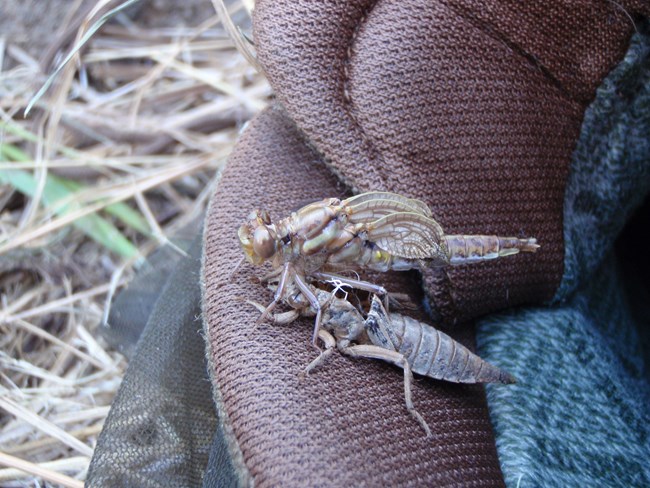
Change and growth. NPS/T. Gostomski.
A division takes a hard look at itself
In 2019, then–Inventory and Monitoring Division (IMD) lead Kirsten Gallo launched the Conservation Initiative, asking staff to imagine the next 20 years of monitoring and set an audacious goal: "2,040 science-based solutions by 2040." COVID-19 stalled that momentum, Gallo retired, and her successor, Meg White, was hired in early 2022.
Under White, the division is starting program reviews — an open, honest examination of workloads, priorities, how science is delivered and what it achieves, including the assumptions the program was founded on decades ago. The reviews ask:
- Are the vital signs being monitored relevant to the questions park managers face?
- Is the information accessible, timely and useful for decisions under changing conditions?
- Are partnerships and expectations with parks clear — and is the work achievable?
Sustainability here means a workload that yields high-quality science while keeping staff safe, healthy and resilient, and making sure the networks have the money and capacity to keep running. The reviews also aim to shape how staff are valued, emphasizing developing talent, creativity and shared leadership.
Comings and goings
| Person | Change |
|---|---|
| Thomas Parr | Network program manager, who joined just before the pandemic; left in late September to co-direct the Great Lakes Northern Forest Cooperative Ecosystem Studies Unit in St. Paul |
| Carmen Thomson | Midwest Region I&M program manager in Omaha for 18 years; left in early September to become superintendent of Canaveral National Seashore |
| Katy Goodwin | Began as a volunteer intern at Isle Royale in 2001, then nine seasons as a biological technician there; network bat monitoring coordinator from 2017; left for the USGS Forest and Rangeland Ecosystem Science Center in Bozeman |
| Mark Hart | Network data manager, retired in August after a 20-year career; ran weather and climate monitoring, piloted an eDNA project alongside amphibian audio monitoring, and helped with data for the Isle Royale wolf reintroduction |
| Cyrus Hester | Promoted to data manager in October |
| Joni Guenther | Joined in October as administrative support assistant, bringing 19 years of federal experience |
| Kate Miller | Acting network program manager from late October, on detail from the Northeast Temperate and Mid-Atlantic Networks |
| Kate Roberts | GIS intern from October, validating vegetation-disturbance data |
Earlier in the year, Tammy Keniry retired in April and intern Hallie Arno left for graduate school in July. Senior aquatic ecologist David VanderMeulen and ecologist Suzy Sanders served 120-day details — he with the Natural Resource Condition Assessment Program, she as natural resource program manager at Katmai National Park and Preserve in Alaska.
A conference returns
On March 21, more than 158 registered participants gathered at Northland College for three days — the first Western Great Lakes Research Conference since 2012. The Great Lakes Science for Parks Symposium featured 44 talks and 14 posters, from the Great Lakes Indian Fish and Wildlife Commission's climate vulnerability assessment for Upper Midwest Ceded Territories to assisted migration of vulnerable trees and a decade of archaeology on Isle Royale. Students could drop in and meet potential employers. Organizers argue that in-person meetings build the deeper connections virtual ones can't, and hope to hold it every year or two, with more poster time, social events, some virtual sessions and more participation by cultural resource managers and tribal partners.
Field season notes
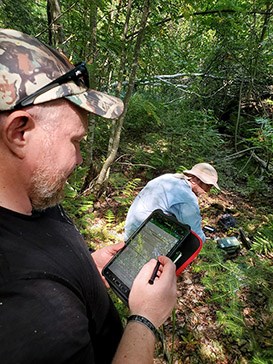
Thomas Parr checks an amphibian recorder while Cyrus Hester logs the unit on a tablet. NPS/T. Gostomski.
| Program | 2023 highlights |
|---|---|
| Amphibians | Acoustic recorders in seven parks; a new digital field form; reports on 2019 data completed |
| Dragonfly larvae | Collected in all nine parks and sent to a USGS lab for mercury testing; most will also be tested for PFAS, the long-lasting "forever chemicals," in a nationwide assessment |
| Bald eagles | Nest productivity at Mississippi National River and Recreation Area similar to recent years; low at Apostle Islands, especially island nests, perhaps from the cold, wet spring. Wisconsin DNR partners sampled nestlings for PFAS |
| Landbirds | Mosquitoes so thick at Voyageurs they drowned out birdsong. At Isle Royale, a brown thrasher and more than 29 red crossbills in the 2021 Horne Fire burn; indigo buntings and Blackburnian and Canada warblers did well, possibly thanks to a spruce budworm outbreak |
| Vegetation | All 47 permanent plots at Indiana Dunes resampled, starting the third round of visits; fire and wetland restoration are reshaping plots, and near Mt. Baldy a dune is burying forest |
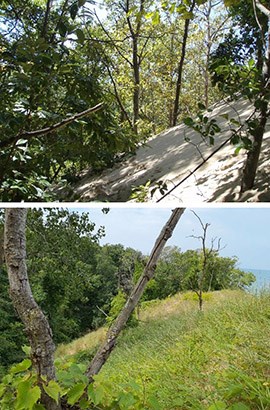
A photo point on the edge of Mt. Baldy: forest in 2012 (top), dune vegetation by 2023 (bottom). NPS photo.
Lakes and rivers
- Pictured Rocks: most lake levels were below average, but Chapel Lake hit a record high in June — backed up by a large beaver dam that crews reached by canoeing down Chapel Creek.
- Isle Royale: with the University of Minnesota Duluth, crews sampled zooplankton, adding two "first contact" lakes where paddlers arrive from Lake Superior, to watch for the invasive spiny water flea. Lake Desor had its worst algae bloom on record, and nearly all lakes now show noticeable algae by August.
- Voyageurs: Locator Lake fell more than 2 meters (6.5 feet) below its benchmark by August; shallow lakes were typically without oxygen below about 4 meters. After historic 2022 flooding and a wet spring, biting flies and ticks were extraordinary.
- Large rivers: late ice-out delayed April sampling; the St. Croix ran very high in early May, then below median from June through September in drought.
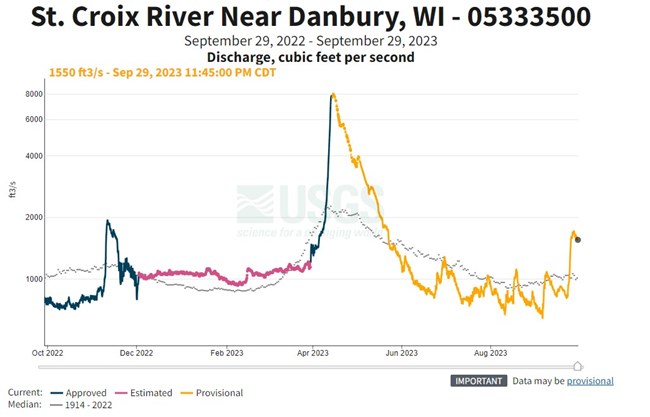
St. Croix River discharge at the Danbury gauge, September 2022–September 2023, against the 1914–2022 median. Graph from the U.S. Geological Survey.
Weather stations
Stations at Sand Island (Apostle Islands) and Munising (Pictured Rocks) were serviced; a solar sensor at Munising and fuel sensors at Sand Island still need fixing. Wind and waves canceled the trip to North Manitou Island. In November, the network's diatom water-quality protocol went through a science review.
Sources
Based on "The Current: Fall 2023," Great Lakes Inventory and Monitoring Network, National Park Service, edited by Ted Gostomski; a work of the United States government in the public domain.
I disse samlingerIndiana Dunes National ParkGrand Portage National MonumentIsle Royale National ParkApostle Islands National LakeshoreMississippi National River & Recreation AreaPictured Rocks National Lakeshore
Licens: CC0 1.0 (offentligt eje) · Bearbejdet efter www.nps.gov
1
0
0
0

Kommentarer
Læs videre


